With demolition due to start, what's next for Casement Park?

 PA Media
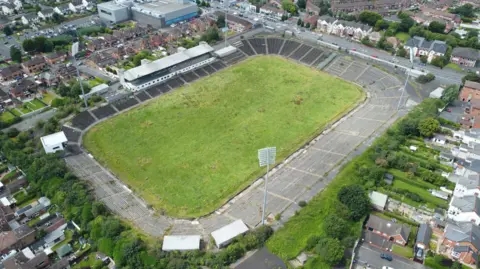
Casement Park stadium in west Belfast is about to be knocked down with no guarantee it will be rebuilt any time soon.
The site should be cleared completely by May but what happens next is uncertain.
For 15 years, plans to redevelop the GAA (Gaelic Athletic Association) stadium in west Belfast have been the subject of sporting, political and legal wrangling.
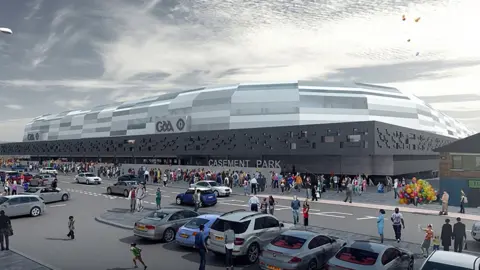
With planning permission for a brand new 34,500-capacity ground due to expire in the summer, minds have been focused.
What is clear is that the GAA are not giving up on the project.
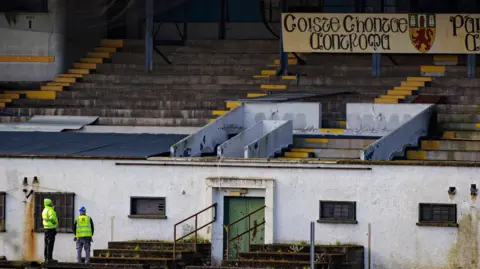
Starting on Monday 26 January, all existing structures at Casement Park, including the main stand, will be demolished.
This work is due to take 12 weeks, and then all eyes will be on the GAA to see their next steps.
In theory, it will be time to move from the demolition to the construction phase, and confirm a deal with a contractor to build it.
In practice, it is not quite so simple.
How much money is needed for Casement Park?
 INPHO - Artist's impression
Modern stadiums do not come cheap. It is not just about green grass and plastic seats.
Accessibility, connectivity and comfort are vital, and it is hard to imagine the GAA receiving much change out of £300m if they want room for 34,500 people.
As things stand, it is not clear how much money they have to spend.
The GAA President, Jarlath Burns, estimated last year a new stadium would cost £260m.
Since then, the GAA has talked about reducing the specification to cut the price.
At the same time, inflation means costs are going up, not down.
Ulster GAA, which is spearheading the redevelopment, gave an update in its annual report, published at the start of January.
It stated: "To date, £170.5m has been secured for the project and we are hopeful that an additional inflationary funding allocation can be secured which should bring the overall funding package for the project to circa £220m."
The wording used is significant – "hopeful", rather than certain.
How quickly can the stadium be built?
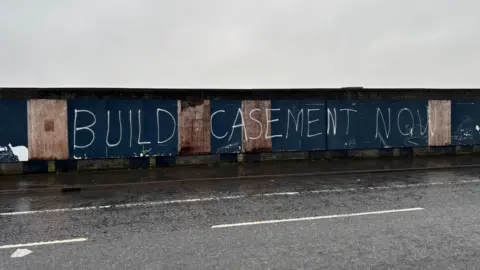
It is not an exact science, but a stadium with a 30,000-plus capacity is likely to take at least three years.
Before that, the tendering process for the construction needs to take place.
In its annual report, Ulster GAA said it had been in contact with planners and "the principle of a phased delivery of the stadium is accepted".
The current phase is the demolition of the existing stadium.
Alliance Party economy spokesperson David Honeyford recently gave his assessment.
He said: "This current step is about protecting planning permission, but the next step must be the long-awaited delivery."
That is easier said than done.
Are Stormont's ministers helping?
The planned redevelopment of Casement Park is a priority for Sinn Féin but not for the DUP (Democratic Unionist Party).
The two largest parties in the Northern Ireland Executive cannot agree on the urgency of the issue and at Stormont that often means nothing gets done.
If all had gone according to plan, the new Casement Park would have been built by now, ready to host gaelic games and also international soccer matches at the 2028 Euros.
That plan collapsed in September 2024 but that did not signal the end of the project.
The GAA remains committed to rebuilding Casement Park and making it a provincial stadium, hosting Ulster finals, high-profile matches and Antrim fixtures.
Where is the money coming from?
Funding for the project is complicated.
Here is the money which has been secured:
- GAA has promised at least £15m
- Irish government has pledged approximately £43m
- Stormont has allocated £62.5m
- UK government says it will contribute £50m
There is the possibility of more from Stormont - the "additional inflationary funding" mentioned by the GAA - but that has not been finalised.
There is pressure on the GAA to raise their contribution, given inflation in the past decade.
However, they may be reluctant to put a figure on it until they know, for sure, how much Stormont is willing to pay.
Could the 34,500 capacity be reduced?
 PA Media
The original design, more than a decade ago, had room for 38,000 fans but planning approval was overturned in 2014.
A slightly smaller stadium was then drawn up and it cleared all of the planning hurdles in 2021.
Having reduced the capacity once, the GAA is reluctant to do so again.
Indeed, a new design would mean a new planning process and further delay.
The bottom line is that the GAA wants a big stadium in Belfast. In spite of the setbacks, it is sticking with the plan.
What happens next at Casement?
Bulldozers are arriving soon to clear the site.
Residents living near the Andersonstown Road stadium have been told that work will take place between 08:00 GMT and 18:00, Monday to Friday, and 08:00 to 13:00 on Saturdays.
Work is expected to take place throughout February, March and April.
It will be the end of an era, as reminders of the stadium which opened in 1953 are demolished.
The task now for the GAA is to ensure 2026 is the year the foundation stone is laid for a new Casement Park.
It is more than 12 years since matches were played at the west Belfast venue.
At the moment, there is only a waiting game.
