'I've been eating duck eggs containing chemicals'

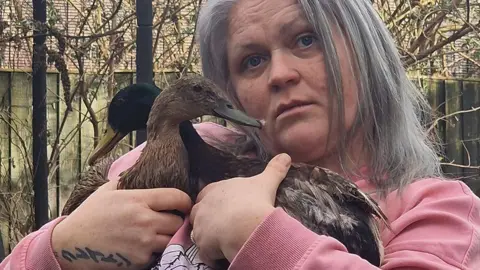 Sam Hammond
A woman who lives next door to a Lancashire chemical plant said she was "worried and shocked" to be told raised levels of a potentially cancer-causing substance were found in her ducks' eggs.
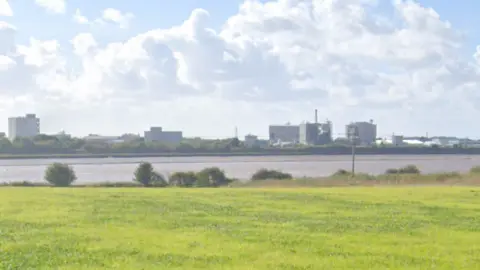
Wyre Council said scientists sampled eggs from a small number of domestic poultry keepers within 0.6 miles (1km) of the former ICI site in Thornton-Cleveleys and found elevated levels of chemicals.
The Food Standards Agency said eating just one of these eggs a week would go over the safe weekly limit.
Sam Hammond said she had been aiming to teach her children where their food comes from, but now she "can't sleep".
In 2024 Wyre Council advised residents not to eat fruit and vegetables grown in the local soil over concerns about the levels of a potentially carcinogenic substance in the ground near to the plant.
The authority said samples of Perfluorooctanoic Acid (PFOA) were found in an area in the south east of the site.
PFOA was used at the former ICI site between the 1950s and 2012 as part of the manufacturing process.
It is a member of a family of chemicals referred to as Per- and Poly-fluoroalkyl Substances (PFAS) often described as "forever chemicals."
'Toxic town'
Following testing of the eggs, PFAS levels were found to be "elevated", and two weeks ago residents were advised to avoid eating domestically-produced eggs or egg-laying poultry near to the site, now operated by AGC Chemicals Europe Ltd.
Ms Hammond said she received a letter from Wyre council informing her that after testing, her ducks' eggs, reared in her garden, are contaminated with PFAS.
She said the family stopped eating the eggs about a year ago when they first knew about possible contamination.
"We live next door to some allotments and it started off with the allotments having their crops sampled and soil samples done," she said.
"We bought a big parcel of land from the council about 10 years ago and the purpose of it was to have our own allotment garden to grow our own stuff, to teach my children where your food comes from and to be self-sufficient.
"I have five children and they're all neuro-diverse.
"With them having difficulties I wanted a safe environment where they could play and now I just feel like I've trapped them in some toxic town.
"In 20 years' time are we going to be testing again to see what else I've been poisoned with?"
 Google
The leader of Wyre Council, Michael Vincent, said he can "absolutely" understand why residents are concerned.
He said a multi-agency group led by the authority and carried out by the Environment Agency was conducting the investigation.
"It's clearly taking longer than anybody would have wanted, but at the moment all we have is the raw data," he said.
"We are waiting on the relevant people to give us the advice about what that means and what happens next and as soon as we get that we will share it with the public."
Community drop-in events will be held in the local area in early March to allow residents to speak to experts from organisations involved in the multi-agency investigation.
AGC Chemicals Europe, which took over part of the ICI plant, said it stopped using PFOA in 2012, and that 40 years of monitoring showed "no significant impact" from emissions.
It said it "has never used or manufactured PFOS".
PFAS are known as "forever chemicals" because of the time it takes for them to break down, which the PFAS Scientific Advisory Panel previously found was linked to serious health conditions.
Listen to the best of BBC Radio Lancashire on Sounds and follow BBC Lancashire on Facebook, X and Instagram. You can also send story ideas via Whatsapp to 0808 100 2230.
