Holocaust survivor shares her story with the next generation

 BBC
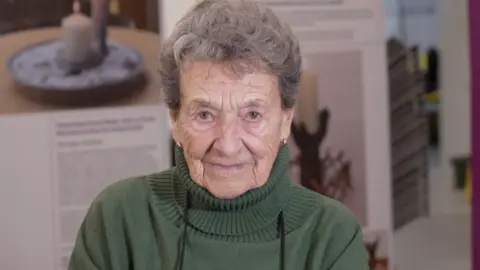
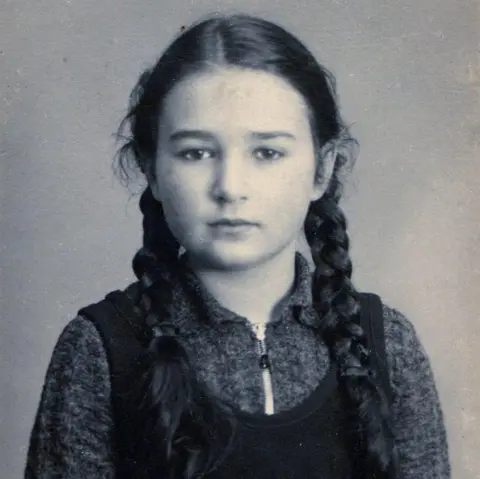
BBC"I'm here to tell you the story of two children. Both children were Jews, and one of them was me," says Holocaust survivor Hedi Argent.
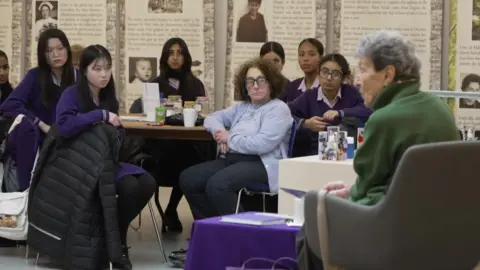
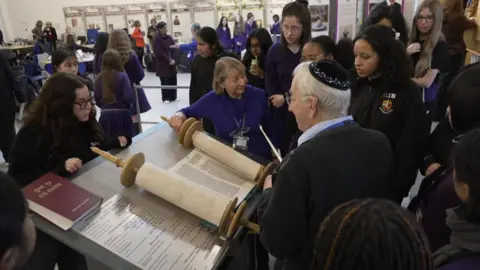
The 96-year-old is addressing Year 9 pupils from St Michael's Grammar School in Barnet, north London.
"I was four years old when I first heard about antisemitism," she tells them. "It was explained to me that people didn't like Jews."
Speaking at Finchley Reform Synagogue, Hedi's story is one of persecution, survival and loss.
More than 80 years after the liberation of the concentration camps, Holocaust survivors are now few in number, and the pupils listening are acutely aware they are hearing a first-hand account of a world that no longer exists.
Warning: This article contains details that some readers may find distressing
 Hedi Argent
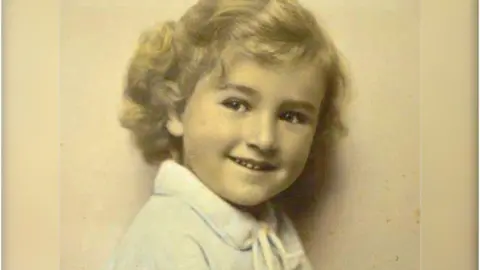
Hedi was born in Vienna in 1929. An only child, she was especially close to her older cousin, nicknamed Bubi.
"He was very kind. He was more like a big brother to me than a cousin," she says.
At school, she recalls being pushed to the back of the classroom because she was Jewish, and never being allowed to go on outings.
"I was never included in anything. I was never given a place in a team or a part in a play," she says. "I was called a filthy Jew, a dirty Jew."
After the Anschluss in 1938, when Nazi Germany annexed Austria, Hedi says life became impossible for Jewish families.
Her father lost his job as a lawyer overnight. His office was taken over and he was told to leave.
Hedi herself was expelled from school.
"The headmistress was standing outside the wrought-iron gates of the school," she says.
"She shouted very loudly so everyone could hear, 'Go away, you're expelled. We don't want Jews in our school anymore'."
At a time when so many Jewish families were being sent to concentration camps, Hedi's story took a different turn.
She and her parents escaped Nazi Austria and reached England just six weeks before the outbreak of World War Two, one of the small number of Jewish families granted visas.
"Once the war was declared, servants were in short supply because they were all called up into the army," she explains.
"So my parents got jobs as butler and cook in a manor house in Hertfordshire, and I went to the village school there."
For Hedi, life in England was a revelation.
"I thought I'd landed in heaven because everybody was nice to me," she says. "I had loads of friends, and children invited me to their homes. I went to birthday parties for the first time in my life."
 Hedi Argent
But her cousin Bubi - the second child Hedi mentioned at the beginning of her talk - and many of her other relatives faced a different fate.
Bubi and his parents were sent to a concentration camp in Poland. His immediate family were murdered there, and Bubi himself died one day after the camp was liberated.
Seventeen of Hedi's relatives were murdered in the Holocaust.
Reflecting on that period, Hedi tells the pupils that the warning signs were visible then, just as she believes they are now.
"It happened because Germany was in a terrible state at the time," she says.
"There was loads of unemployment, there was ill health, there was every bad thing you could think of. They needed a scapegoat. The Jews were an easy scapegoat."
"There were conspiracy theories and misinformation and fake news, and it went on and on and on until people believed it," she adds.
"And you look at the world today, and there is misinformation. There are conspiracy theories. There is fake news everywhere, about everything, and we must not let it happen again.
Her final plea to the students is simple: "We must not listen to all this stuff that pours out from social media."
Listen to the best of BBC Radio London on Sounds and follow BBC London on Facebook, X and Instagram. Send your story ideas to hello.bbclondon@bbc.co.uk
