Court told police facial recognition needs limits

 PA
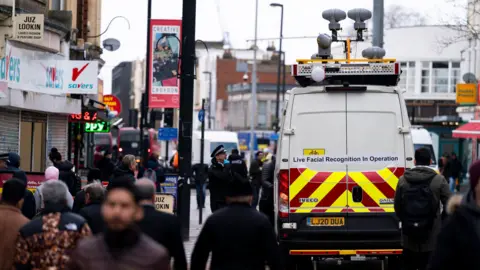
PAPolice use of facial recognition technology must be tightly controlled or Londoners will find it "impossible" to travel without being scanned, the High Court has been told.
The Met Police is facing a legal challenge over its use of live facial recognition (LFR) from two campaigners who say the technology is expanding without adequate safeguards.
They argue that the tool risks arbitrary and discriminatory use.
Their case comes as Home Secretary Shabana Mahmood moves ahead with plans to expand facial recognition to police forces across England and Wales, despite an ongoing consultation.
Under the proposals, the number of facial recognition vans would be increased from 10 to 50, and be made available nationwide.
Shaun Thompson, a youth worker, was wrongly flagged by LFR, and Silkie Carlo, is the director of privacy campaigning organisation Big Brother Watch.
Dan Squires KC, representing the pair, told the court that police use of LFR was increasing "exponentially".
He said the Met deployed the technology 231 times in 2025 and scanned about four million faces. On 17 December alone, LFR cameras at Oxford Circus scanned more than 50,000 people in four and a half hours, he said.
'Thousands of wanted individuals'
Squires described facial recognition as "similar to a DNA profile", converting facial features into coded data which is checked against a watchlist.
He noted that the Met announced earlier this year that the first permanent cameras would be installed on buildings and lampposts in Croydon.
Squires warned that without limits on where LFR could be used "it will be impossible for people to travel across London without their biometric data being taken and processed".
Representing the Met, Anya Proops KC said officers were searching for "literally thousands" of wanted individuals in London.
She said locating them is "akin to looking for stray needles in an enormous, exceptionally dense haystack" and argued that LFR enabled police to identify people who would otherwise go undetected.
Proops said officers made 801 arrests in 2025 "specifically as a result of LFR" and insisted that intrusion on the public's privacy was "only minimal". Data from people not on a watchlist was deleted "a fraction of a second" after creation, she added.
The hearing, before Lord Justice Holgate and Mrs Justice Farbey, is due to conclude on Wednesday.
A judgement will be handed down at a later date.
Listen to the best of BBC Radio London on Sounds and follow BBC London on Facebook, X and Instagram. Send your story ideas to hello.bbclondon@bbc.co.uk
