I mocked the Saudi leader on YouTube - then my phone was hacked and I was beaten up in London

 BBC
BBCWith hundreds of millions of views, YouTuber Ghanem al-Masarir was flying high.
From his flat in Wembley, the loud-mouthed and sometimes offensive comedian was making waves as a critic of the Saudi Arabian royal family. But as well as fans, he'd made some powerful enemies.
The first thing al-Masarir noticed was that his phones were behaving weirdly. They had become very slow, with the batteries running out quickly.
Then he noticed seeing the same faces appear in different parts of London. People who seemed to be Saudi regime supporters began stopping him in the street, harassing and filming him. But how did they know where he was all the time?
Al-Masarir feared his phone was being used to spy on him. Cyber experts would later confirm he'd become the latest victim to be spied on with the infamous Pegasus hacking tool.
"It was something that I couldn't comprehend. They can see your location. They can turn on the camera. They can turn on the microphone, listen to you," al-Masarir tells the BBC. "They got your data, all pictures, everything. You feel you've been violated."
On Monday, after six years of legal battles, the High Court in London ruled Saudi Arabia was responsible, and ordered the kingdom to pay al-Masarir more than £3m ($4.1m) in compensation.
 The Ghanem Show
Al-Masarir's iPhones had been hacked in 2018 after he clicked on links in three text messages seemingly sent from news outlets as special membership offers.
It led to him being stalked, harassed and in August of that year, beaten up in central London.
The court heard two strangers had approached al-Masarir and shouted at him, demanding to know who he was to talk about the Saudi royal family, before punching him in the face and then continuing to attack him.
Passers-by intervened and the two men retreated, calling the YouTuber a "slave of Qatar" and saying they were going to "teach him a lesson".
The High Court judge described the physical attack as premeditated and noted that one of the assailants was wearing an earpiece.
"There is a compelling basis" that the assault and the hack "was directed or authorised by the Kingdom of Saudi Arabia or agents acting on its behalf," Mr Justice Saini said in his written judgement.
"The Kingdom of Saudi Arabia had a clear interest in and motivation to shut down the claimant's public criticism of the Saudi government," the judge ruled.
After the assault, the harassment continued. In 2019, a child approached al-Masarir at a Kensington café and sang a song praising King Salman, the Saudi monarch.
This incident was filmed and posted on social media, began trending with its own hashtag, and was even broadcast on state-owned television in Saudi Arabia.
On the same day, a man walked up to al-Masarir as he was leaving a west London restaurant and told him, "Your days are numbered", before walking off.
Al-Masarir was born in Saudi Arabia but has lived in Britain for more than 20 years, originally coming to study in Portsmouth.
He is now a British citizen and lives in Wembley, but no longer ventures far from home - going into central London is still frightening for him after he was attacked.
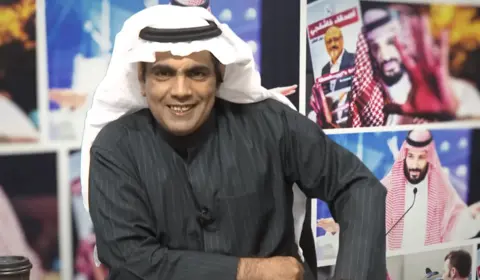
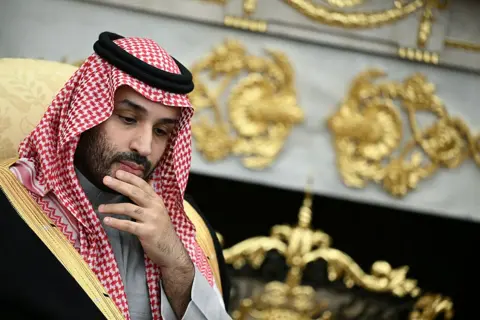
The 45-year-old rose to fame in the Arabic-speaking world for his satirical YouTube videos criticising Saudi rulers, in particular the crown prince and de facto ruler Mohamed bin Salman.
 Getty Images
Al-Masarir's humorous takes - and sometimes personal and offensive attacks on the Saudi government - often went viral, generating more than 345 million views.
In his most watched clip - which has 16 million views - he criticised the authorities for being angry about a viral video of girls dancing in Saudi Arabia. Mysteriously, the sound has been removed on YouTube and al-Masarir has no idea how or when the video was edited.
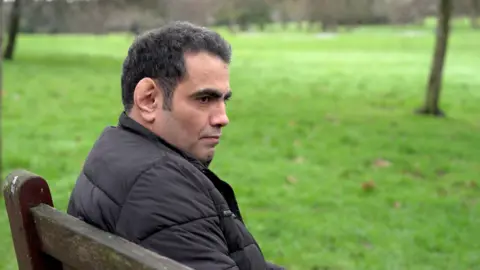
Since al-Masarir was hacked and attacked he has lost his confidence and become depressed and fearful. The once funny and outspoken personality agreed to talk to the BBC - but was reserved and didn't want to fully show his face.
He hasn't posted a video for three years and says in spite of his legal victory, the Saudi government has succeeded in silencing him.
"No amount of money can repay the harm this has done to me," he says. "The hack has really changed me. I am not the same Ghanem I used to be."
It was spyware experts from the University of Toronto's Citizen Lab who confirmed al-Masarir had been hacked with Pegasus spyware. They sent an analyst to London and deemed it highly likely the hack had been orchestrated by Saudi Arabia.
Pegasus is a powerful and controversial hacking tool made by Israeli company NSO Group. NSO Group insists it only sells its spyware to governments to help track terrorists and criminals.
But Citizen Lab has discovered it on phones belonging to politicians, journalists and dissidents - including al-Masarir.
When al-Masarir first tried to bring a claim against Saudi Arabia, the kingdom argued it was protected from legal action under the State Immunity Act 1978.
But in 2022 the court ruled Saudi Arabia did not have immunity. Since, then the country has not been represented in any further proceedings.
"The Kingdom of Saudi Arabia has failed to serve a defence or to respond to this application and has breached multiple further orders. It appears unlikely to participate in the claim," the High Court judge concluded.
The total damages awarded are £3,025,662.83 but it's not clear if Saudi Arabia will pay.
The BBC contacted the Saudi embassy in London but has not had a reply.
Al-Masarir says he is determined to enforce the judgement and is willing to use international courts if necessary. But no amount of money will make up for how the hack has turned his life upside down, he says.
"I feel depressed that they got away with something like this in London - in Great Britain."
