'Fire left market like a wartime bomb site in heart of city'

 Leeds City Council
Nearly 50 years after a city's famous market was almost completely destroyed by fire, traders and former firefighters have shared their memories of the devastating event.
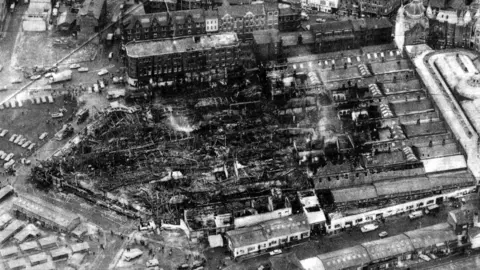
About two thirds of Leeds Kirkgate Market, once the largest indoor market in Europe, was ravaged by the blaze on Saturday 13 December 1975.
No lives were lost, but many stalls and shops in the market, which first opened in 1857 and which was the birthplace of Marks & Spencer, were left utterly beyond repair.
According to Shane Ewen, professor of urban history at Leeds Beckett University, pictures from the scene show it was "like a wartime bomb site right in the heart of a city - you could see the flames from 15 miles away".
"If you read papers at the time, or look at the BBC coverage, it talks about the total decimation of all the livelihoods of the market traders, and how it basically ruined their Christmas," Prof Ewen says.
Working with East Leeds Fire Heritage Group, Prof Ewen has developed an interactive map to commemorate the anniversary of the fire, and a collection of photos and press cuttings has gone on display in the market.
As part of his work, Prof Ewen spoke to two firefighters who still have vivid memories of tackling the blaze, and one who helped with the clean-up operation in its aftermath.
They told him that it was at 18:30 GMT on Saturday evening that firefighters were first called to the market and it would be about nine hours before those crews were able to take a break.
"They would go in and do 20 minutes then come out and another crew would go in, so they would keep swapping," Prof Ewen explains.
"They got sent back by senior officers to their stations to get a meal and get some sleep, and so they managed to do that.
"They were only back for about an hour when the alarm went again and they had to come back out.
"They ended up coming back and working through till about 10:00 on Sunday morning."
 Leeds City Council
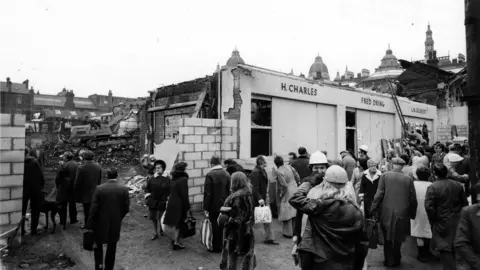
Prof Ewen says it was thanks to the dedication of those firefighters that the market's landmark Grade I listed frontage on Vicar Lane survived.
"The fact they saved that big, beautiful listed heritage building is a brilliant achievement," he says.
"It shows that their training really kind of kicked in and worked effectively."
Despite the destruction, Kirkgate Market's central 1904 Hall survived and three days later it reopened with a temporary shelter in the car park for the displaced traders.
On the Wednesday following the fire, Prince Charles visited the site and said he was "amazed" at how quickly part of the market had been able to reopen.
In summer 1976, a new hall was built on the site, which is where many of the market's food stalls remain today.
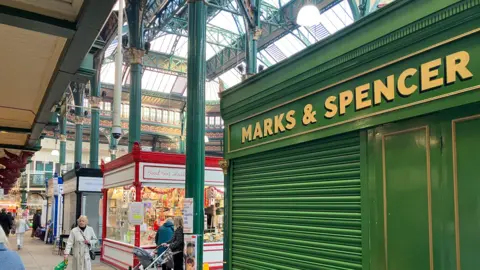
Anthony Wiles has been working at Kirkgate Market since 1974, and while nowadays he is assistant facilities manager there, in December 1975 he was part of its clerical staff.
"I'd been at work on the Saturday but had finished and was in town for a Christmas night out with colleagues," Mr Wiles says.
"I was walking along the Headrow and there it was, the market in flames. It was a massive shock, clearly, and something you never forget.
"It was incredible how people pulled together in the days afterwards – market staff, traders, councillors, shoppers, everyone.
"It was a huge effort and obviously a difficult time in many ways. I'm sure people have lots of different memories of their own – it's hard to believe it was 50 years ago."
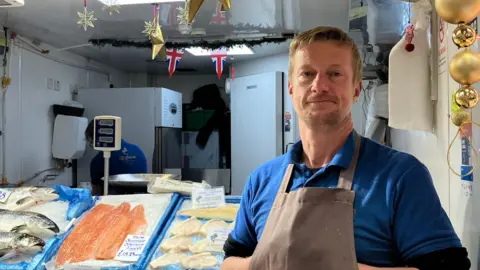
Joseph Laughton, 50, was born in the year of the fire and now works at the R Bethels fishmongers in the market, which was managed by his family at the time of the blaze.
He describes what he was told of the aftermath when traders returned to Kirkgate Market the day after.
"When they came in the next morning, all the units were gone but all the stall bases were still there," he says.
"They had all the change bags welded to the ground, so they had all the coins, because in the intensity of the fire they turned into elephants' feet of metal.
"So whenever you went in a stall, they were just the concrete base and an elephant's foot of change in middle - they were all melting into one."
"I think a lot of market traders didn't have insurance. They didn't always do things by the book," he adds.
"I think a lot of them paid for it with their lives and their livelihoods."
'Everybody shopped there'
Prof Ewen says that while tackling the blaze at Kirkgate Market was obviously "a really tough job" for the firefighters involved, it also had a "sort of spiralling effect for the whole of the city".
"Everybody shopped there. A lot of working class families, ordinary families, would have still shopped there, done their weekly grocery shopping there," he says.
"Two weeks before Christmas, there was that question: where do you get your turkey from? Where do you get your Christmas dinner from?"
However, Prof Ewen says that his research has also shown that many people probably had a lucky escape - and it was purely down to the time the fire broke out.
"The astonishing thing is that had it happened 30 minutes or an hour earlier, it would have been absolutely devastating," he says.
"So they were lucky in that respect, all the traders and the cleaning staff that come in, because I don't believe there were any injuries to firefighters either."
Listen to highlights from West Yorkshire on BBC Sounds, catch up with the latest episode of Look North.
