'Welcome to 2976' - North Africa's Amazigh people ring in the new year

 APP/NurPhoto via Getty Images
Across North Africa, the Amazigh people have been coming together to usher in the year 2976.
They have, unfortunately, not cracked time travel. Rather, they are almost a thousand years ahead of much of the world because they follow a calendar that starts at 950 BC, when King Sheshonq ascended the throne of Egypt.
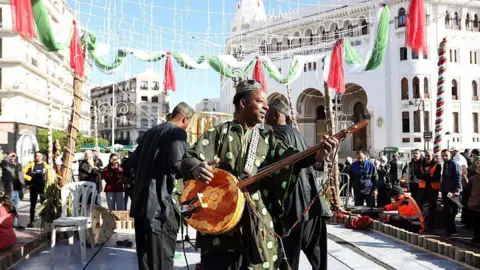
The Amazigh new year, known as Yennayer, begins between 12 and 14 January - depending on the area in which they live in Algeria, Morocco, Tunisia and Libya - so over the last few days families have been laying on huge feasts, lighting bonfires and playing traditional music.
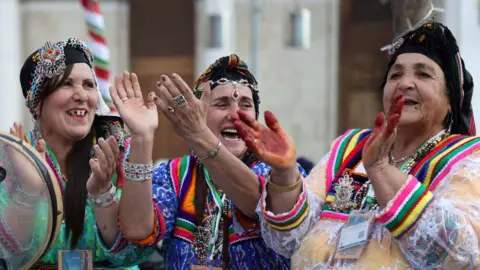
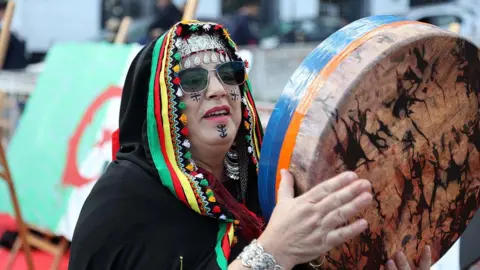
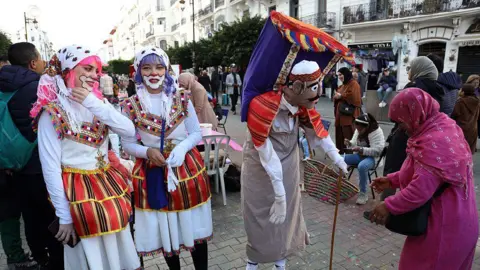
Calls of "aseggas ameggaz", or happy new year, have been ringing through villages and busy city streets, while vibrant, meticulously embroidered traditional clothing has been donned for the occasion.
 APP/NurPhoto via Getty Images
The Amazigh (which means "free people" or "noble people") are a range of ethnic groups that are North Africa's original inhabitants, having occupied the region since the beginning of recorded history.
The exact size of the population is not known because of a dearth of official statistics, but according to estimates there are tens of millions of Amazigh people living across North Africa. Algeria and Morocco have the biggest populations - the latter is thought to be 40% Amazigh.
Yennayer centres on family gatherings, celebrating renewal and the deep connection the Amazigh people have traditionally had with nature.
 APP/NurPhoto via Getty Images
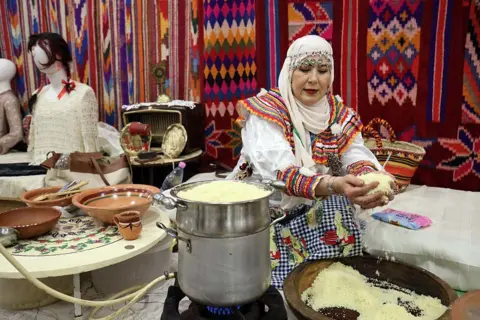
Because the Amazigh are a diverse group, traditional Yennayer food differs from country to country and area to area. In Morocco's High Atlas region, "ourkemen", a rich mixture of legumes, spices and whole grains, is a new year's favourite.
Many families in Algeria enjoy "trèze", a combination of sweets, dried fruit and nuts, after the main meal. The snack mix is sometimes gently thrown over the youngest child in a symbol of prosperity.
But Yennayer is not just a family thing. It can also be celebrated with the wider community - parades, concerts and carnivals take the new year's spirit out on to the streets.
Such proud displays of Amazigh culture are particularly significant as the community has a long history of being marginalised.
 APP/NurPhoto via Getty Images
In the 7th Century, as Arab conquerors swept across North Africa, they brought with them their language and the Islamic religion.
Both of these were adopted officially, at the expense of Amazigh languages and culture.
For instance, during Colonel Muammar Gaddafi's rule of Libya, the Amazigh language Tamazight was banned in schools and parents were not even allowed to give their children Amazigh names.
However, thanks to the dogged campaigning of Amazigh activists, their culture and language has seen greater recognition over the past decade.
In 2011, Morocco recognised Tamazight as an official language. Both Algeria and Morocco also declared Yennayer a public holiday, in 2017 and 2023 respectively.
So Yennayer marks not just a victory for the Amazigh people, but also a reminder of centuries-long fight that has got the community to where it is now - in 2976.
 APP/NurPhoto via Getty Images
 Getty Images/BBC
Go to BBCAfrica.com for more news from the African continent.
Follow us on Twitter @BBCAfrica, on Facebook at BBC Africa or on Instagram at bbcafrica
