What we know about Mandelson's vetting and security clearance

 Reuters
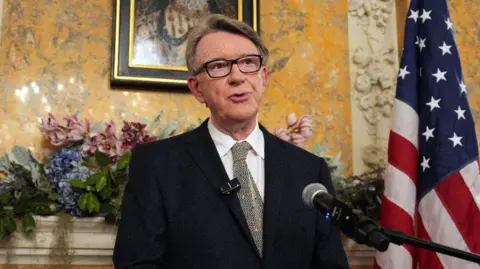
It has emerged that Lord Mandelson was granted security clearance by the Foreign Office, despite concerns being raised during the vetting process.
The peer was appointed as the UK's ambassador to the US in December 2024 but was sacked last September when further information about his ties to convicted sex offender Jeffrey Epstein came to light.
Prime Minister Sir Keir Starmer and Sir Olly Robbins, the Foreign Office's top civil servant who was sacked over the decision to grant Lord Mandelson security clearance, have now both given their version of events.
However, discrepancies have materialised between their accounts after Sir Olly gave evidence to the Commons Foreign Affairs Committee.
What is a Developed Vetting security check?
Lord Mandelson underwent a process called Developed Vetting (DV) after his appointment was announced but before he formally took up the role in February 2025.
The status is required for any official whose work is likely to involve having access to sensitive material.
The process is carried out by United Kingdom Security Vetting (UKSV), a specialist agency within the Cabinet Office, and applies to thousands of relatively junior officials working in government departments and overseas, as well as senior figures like Lord Mandelson.
It is designed to identify whether people applying for government jobs pose a security risk, either because they might seek to abuse their position, or because their personal lives make them a potential blackmail target - for example, if they are in high levels of debt or are having an affair.
In practice, it means candidates have to fill out various questionnaires, including being asked to provide detailed information about their finances, internet use and medical conditions.
Official records are also checked, including a candidate's credit history and any criminal offences. Records held by the Security Service are also reviewed.
Those being vetted then have to undergo an interview with a specially trained vetting officer, which is designed to be intrusive.
Candidates are asked about very personal areas like friendships, family, health and sex life, sometimes over several hours.
What happened with Mandelson's vetting?
The government has said it recently learned Lord Mandelson was granted DV status by Foreign Office officials against the recommendation of UKSV - and that neither the prime minister nor any government minister were previously aware of this.
The Cabinet Office has published a template of UKSV's vetting form which includes three tick boxes - green, amber and red - that allows officials to give their view and recommend whether the appointment should be approved.
A separate email disclosed by the department said that the recommendation in Lord Mandelson's case had been that security clearance "should not be granted".
Sir Olly Robbins says he has never seen the UKSV document.
Instead, he says he was given an oral briefing, during which he was told the vetting agency considered Lord Mandelson to be a "borderline case" and that they were "leaning towards recommending that clearance be denied".
He says UKSV acknowledged that the Foreign Office "may wish to grant clearance, with appropriate risk management".
Sir Olly has refused to reveal what risks were identified in Lord Mandelson's case but has said they did not relate to Epstein.
The senior civil servant says he did not share the vetting recommendation with ministers as this would have undermined the confidentiality of the process.
What other checks did Mandelson go through?
A due diligence check was carried out by a team at the Cabinet Office and sent to the prime minister in December 2024, prior to Lord Mandelson's appointment.
The point was to identify reputational risks or potential conflicts of interests that may need to be considered in Lord Mandelson's case.
This was largely based on public information, such as media reports.
At the time, it was public knowledge that the peer had maintained his relationship with Epstein after his conviction for soliciting sex from a minor in 2008.
Documents released by the government reveal Lord Mandelson's continued friendship with Epstein was flagged as a potential "reputational risk".
Other issues it highlighted which could pose a reputational risk include his previous resignations as a minister during the last Labour government.
The document also noted there could be risks related to clients of his Global Counsel lobbying firm and their dealings with the UK or US government.
What questions did No 10 ask about Mandelson?
After reviewing the due diligence findings, No 10 sources said Sir Keir Starmer asked Lord Mandelson to address three specific questions, which were sent to him via email by the prime minister's then chief of staff, Morgan McSweeney.
These questions were:
- Why has he continued contact with Epstein after he was convicted?
- Why was he reported to have stayed in one of Epstein's homes while the financier was in prison?
- Was he associated with a charity founded by Epstein associate Ghislaine Maxwell that the financier had backed?
At the time, his answers were considered sufficient for him to be appointed to the role, for this to be announced publicly, and for the in-depth vetting process to begin.
The PM has since said Lord Mandelson repeatedly lied about his relationship with Epstein and portrayed the financier as "someone he barely knew".
The BBC understands Mandelson's view is that he answered questions about his relationship with Epstein in the vetting process accurately.

Sign up for our Politics Essential newsletter to keep up with the inner workings of Westminster and beyond.
