Bangladesh Nationalist Party sweeps to victory in first election since Gen Z uprising

 Reuters
The centre-right Bangladesh Nationalist Party (BNP) has secured a landslide majority in parliament, 18 months after mass protests ousted the country's longest-serving prime minister Sheikh Hasina.
The party took more than two-thirds of seats in the historic general election, with Jamaat, the country's main Islamist party, coming second. Hasina's Awami League was banned from taking part.
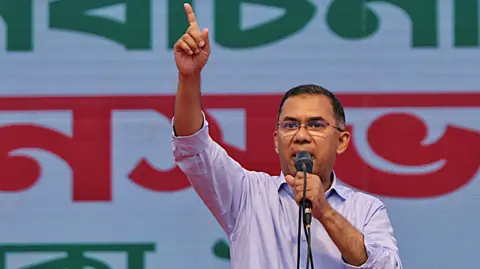
BNP leader Tarique Rahman is set to be the next prime minister and faces huge challenges in getting the economy back on its feet and restoring democracy after 15 years of authoritarian rule under Hasina.
Voters also backed sweeping democratic reforms in a referendum held alongside the election.
"I am grateful for the love you have shown me," Raman told well-wishers in Dhaka as he attended Friday prayers.
His party said there would be no victory procession and he urged supporters to attend prayers instead of street celebrations in memory of his late mother, former PM Khaleda Zia, who died in December.
His formal election as the country's new leader will happen after new MPs are sworn in, which is expected to take place on Saturday.
Rahman's family background - his late father was also a leader of Bangladesh - is a reminder that while the BNP have promised change, Rahman, like Hasina, hails from a political dynasty.
The absence of both Sheikh Hasina and Khaleda Zia, who alternated in power over four decades, was one of a number of firsts in this election.
Another was that, with the Awami League banned, Jamaat for the first time ran as one of the main parties vying for power. The alliance it leads took 77 seats, six of which went to the student-led National Citizen Party (NCP) born out of the 2024 protests.
The Awami League has questioned the legitimacy of the election given that it was unable to participate, while Jamaat has questioned the way the vote was conducted. Both it and the BNP have accused the other of voting irregularities.
For Rahman, it is a huge change of fortunes. He spent 17 years in self-imposed exile in London before returning to the country five days before his mother's death and is seen by many as largely untested.
As well as being on track to become the country's next leader, is also his first time as an MP. He was elected as member for the Dhaka-17 and Bogra-6 constituencies, and is one of 212 successful BNP candidates, according to the Election Commission, which put voter turnout at 59.44%.
During his campaign, Rahman promised that Bangladesh's democracy would be restored.
Reviving the country's economy, bringing rising food prices under control and creating jobs for its huge young population are the big challenges facing the new government.
Repairing strained ties with giant neighbour India is also high on the list of priorities.
Within hours of his win, Rahman had received a call from India's Prime Minister Narendra Modi who congratulated him on a "remarkable victory".
"As two close neighbours with deep-rooted historical and cultural ties, I reaffirmed India's continued commitment to the peace, progress, and prosperity of both our peoples," Modi wrote on X.
 Reuters
Although the BNP are promising to lead change in the country, the party was criticised for corruption and accused of human rights violations when it was last in government in the early 2000s.
Rahman himself was subject to various criminal investigations while Sheikh Hasina was in power but was later cleared of all charges.
Thursday's democratic exercise is a moment of huge potential - and risk - for the country, with one of its two main parties winning such a big victory.
Among the constitutional reforms envisaged are prime ministerial term limits, a directly elected upper parliamentary house, stronger presidential powers and increased judicial independence.
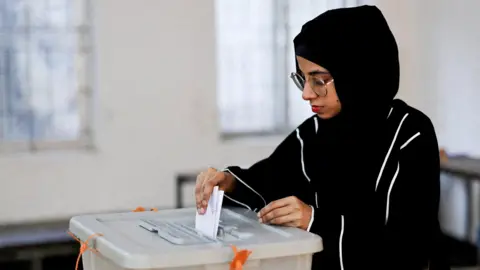
Greater representation of women in parliament is also in the charter but only a tiny number of female candidates were successful in the election, showing there is a long way to go.
Of the main parties, the BNP fielded 10 female candidates, the student-led National Citizen Party (NCP) just two and the Islamist Jamaat-e-Islami none.
Both the BNP and Jamaat have denied sidelining women, instead claiming the number of those standing was a result of Bangladesh's "social structure".
One voter, Shima Akhter, was among many women who took part in the student-led protests leading to Hasina's downfall - paving the way for the election - and dismissed this as "just a patriarchal excuse".
Rahman will be under great scrutiny to deliver for Akhter and other young people like her who are hungry for change as Bangladesh has one of the youngest demographics in the world.
While there may be mixed feelings among some about the election result and concerns over whether the BNP can deliver, Rashna Mahzabin is among those who are happy they got to "raise their voices" after years of authoritarian rule.
"That's a huge win," she told the BBC.
Additional reporting by Azadeh Moshiri and Kathryn Armstrong
