Family court system 'scary' and 'not fit for purpose', say parents

 Getty Images
The family court in Northern Ireland is "scary" and "not fit for purpose", according to two parents who have been through the system.
Family courts make thousands of rulings every year on issues such as adoption, divorce, and child custody.
The Lady Chief Justice, Dame Siobhan Keegan, said she has requested specialist courts with better facilities to allow more time for cases to be dealt with.
However, she added: "The elephant in the room though is the funding of family justice along with other justice areas."
Domestic abuse claims and dealing with private legal issues around custody and parental contact can take up a lot of court time.
In 2024, more than 75% of Child Order cases in Northern Ireland were private law proceedings.
Child order cases involve applying to the court for decisions about a child's upbringing, with options ranging from child arrangements to emergency protection orders.
'It's a very scary place'
Jenny - not her real name - is a mother-of-one who left her partner due to domestic abuse and had to attend family court in relation to custody arrangements.
"I didn't know anything before I went into the courts. But, when I did go in, it's a very scary place," she said.
Jenny said the court ordered her to maintain contact between her child and the father, despite her allegations of domestic abuse.
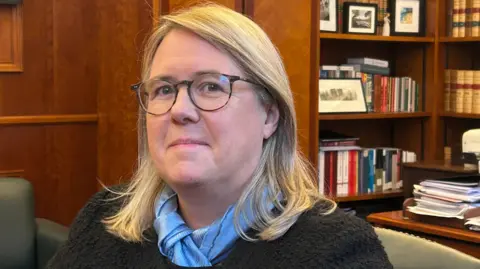
Dame Siobhan believes Jenny's experience is the exception, not the rule.
However, she has recently issued new domestic abuse guidance to family court judges.
"My primary concern is that someone comes away from the court understanding the decision and not feeling that the court itself has added to their trauma and anxiety," she said.
'Letting parents and children down'
Colin - not his real name - applied for a contact order through the court after he and his ex-partner could not agree on custody arrangements.
He said the system is "not fit for purpose".
"It's letting parents down. It's letting children down."
Colin said he has spent a lot of money having to go back to court when the custody arrangements are not honoured.
He said he would like to see the courts enforce orders they put in place.
"People should go in with open eyes and be prepared to spend a lot of money and exert a lot of energy, it comes at a cost, but you can't put a cost on seeing your child," he said.
"There have been times people have said to me, it would be easier if I just walked away, but that's not an option for me. I love my child."
 Getty
GettyDame Siobhan said she understood breached orders can be "frustrating".
"We have seen orders enforced in the past; the problem is where you go at the sharp end of this," she said.
"You do have a different analysis than you would in another area of contempt of court because you have children in the middle."
Jenny said court-enforced contact has had a detrimental impact on her child.
"They're having counselling. Their anxiety levels are through the roof. They're not coping very well at all."
Jenny believes her ex-partner has been "weaponising" her child in order to maintain "coercive control" by constantly bringing her back to court.
"His need for power and control got a lot worse after the separation and the court system doesn't seem to see or care about it."
Jenny believes this will continue until her child is old enough to make their own decisions.
'Resources are a massive issue'
Last year, Dame Siobhan established a working group to look at possible reforms in family courts.
She said there has been "a tremendous amount" of change but she is not content to sit on her laurels.
"I can't make the bigger changes that I would love, I can only achieve change within the parameters of the current system, I do want to see change outside that.
"Resources are a massive issue, but we can still make changes."
There has been criticism of family courts and calls for greater transparency for decades.
These courts are closed to the media and the public for the privacy of the children involved in the cases.
However, a media pilot, which began in November, will allow journalists to report on some cases in Northern Ireland.
