Americans are celebrating their split from Britain - how is the UK marking it?

 AFP via Getty Images
The forecourt of St Paul's Cathedral in London feels like an unlikely place to embark on an exploration of American independence - but a lesser-known statue in that very spot has a tale to tell within one of history's most infamous breakup stories.
The sculpture depicts America as an indigenous female figure - holding a bow and arrow, and wearing a headdress. There's been a statue here that looks like this one since 1712 - well before the United States went its own way as a nation.
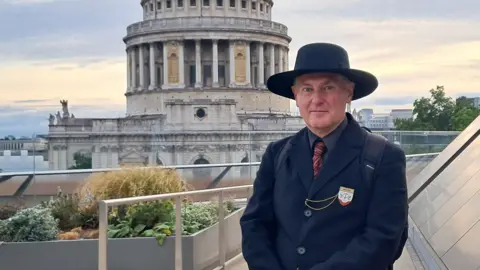
The figure goes some way to showing how those far-flung lands fuelled the imaginations of people at the centre of the British empire, as tour guide Mark Grant explains at the start of a guided walk through the area.
Grant is one of many people across the UK marking the 250th anniversary of American independence by holding special events - whether walks like this, a parade, or even cookery.
Organisers are eager to show that 4 July is not just a date for fireworks and barbecues in the US. It's a cause for wider reflection - and even a little fun, too.
Given that the UK was on the receiving end of the breakup, what do Brits hope to get out of the occasion?
British spin on 1776 intrigues visiting Americans
Grant's tours are designed to reveal the often-overlooked links between the City of London and the young United States. The history buffs include people from both sides of the pond.
Grant says the two groups have been appreciating different things about the sessions, which are being run on a time-limited basis by the City of London Guides Lecturers Association.
For the Brits, "it's interesting facts among other interesting facts", Grant says, noting that there's also plenty of Roman and medieval heritage in the City to take the interest of a local. "Whereas with the Americans, they feel more personally involved."
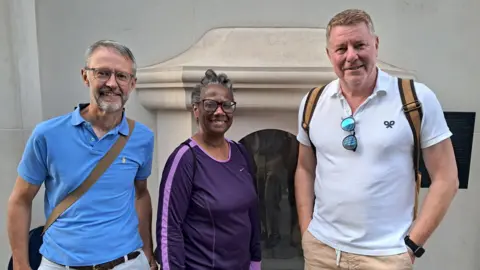
Patricia Windham, visiting from Chicago, wanted to understand how American independence was experienced in Britain at the time of the rupture. "You only get one side of the picture from the US," she explains. "I think it's important to get various perspectives from people, not just the one that you get from home, because that's the party line."
Windham enjoys the many tour stopoffs. Whether it's the church where US Founding Father Benjamin Franklin worked for a time as a printmaker, or the sites of old coffee houses where merchants made transatlantic trade deals, the American-ness of the Square Mile runs deep.
Declaration print prompts reflection - and a little humour
Saturday's semiquincentennial, as it is formally known, marks 250 years to the day since the United States adopted its foundational document - the Declaration of Independence.
The text itself has become a focal point of special events across the UK. The events consider how those words were received by Brits at the time, and how they might be understood today.
The ancestral home of George Washington's family - Washington Old Hall, Tyne and Wear - is just one such location, where local young people are set to read from the document on 4 July itself.
Meanwhile, the American Museum & Gardens in Bath has become the first location in England to display a certain rare printed edition of the declaration.
 Getty Images
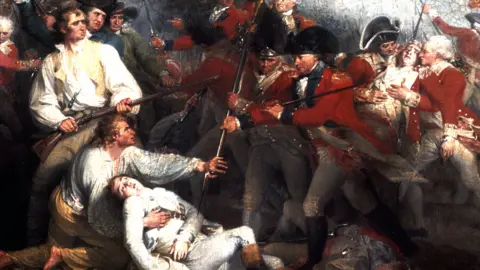
This particular copy is remarkable not just because it was printed on 4 July 1776, but because it was intercepted by British soldiers and sent back home - with their annotations added. It would have taken weeks for the bombshell document to reach Whitehall. Meanwhile, a bloody war over the future of the US was raging.
Just as special as the loan of the paper itself is the way visitors have enjoyed thinking about what they would put in a declaration of their own, says museum director Lucy Littlewood.
"That's producing some really lovely responses, particularly from young people about what's important in the world," she says. "Peace and equity are the main two themes there, but we've also had comments about free ice-cream for children… so lots of humorous ones as well."
Puppet depicts Founding Father who helped pull the strings
The 4 July milestone might not sound like an obvious patriotic moment on these shores, but some groups in the UK are using the event to highlight that many of the ideas and thinkers behind American independence were British or had British connections.
The town of Lewes, in East Sussex, will hold a Festival of Democracy on Saturday, promising a colourful parade inspired by the same values that drove the American Revolution.
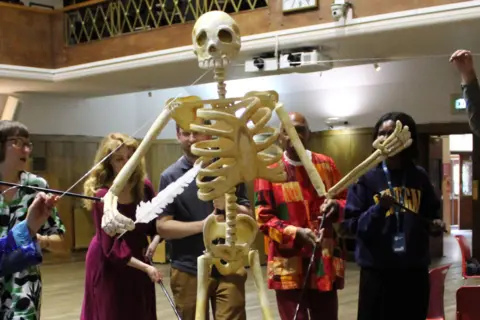
Leading the parade will be a giant puppet depicting Thomas Paine. This English philosopher, a former resident of the town, is seen by scholars as one of the US Founding Fathers on account of a pamphlet he penned in 1776 that argued for the cause.
 Paul Fitzgerald
The creator of the 8ft (2.4m) contraption, Paul Fitzgerald, sees 1776 as a moment worthy of celebration far beyond the borders of the United States: "I'd see it as a part of a global movement towards people being in charge of their own lives in their own countries."
As for the upcoming parade, organised by Thomas Paine, Legacy and the Lewes Climate Hub, Fitzgerald says there is a wider significance: "A democracy is something that wants to be constantly renewed."
The puppet depicts Paine as a skeleton because Fitzgerald - AKA graphic artist Polyp - was moved by the mysterious story of the disappearance of Paine's exhumed bones after his death.
"I travel around the country with him," he says. "I get some very interesting looks on the train."
Northern Ireland samples some culinary crossovers
Other special events have similarly been designed to celebrate the flow of people and ideas both ways across the Atlantic - a shared heritage that can still be tasted today, in a very literal sense.
The weekend programming at the Ulster American Folk Park, near Omagh, will pay tribute to the ways in which Ulster migrants helped to shape the United States - not least when it came to food.
As part of the programme, Paula McIntyre, who trained in the US and later returned there to present a BBC series on American cuisine, will demonstrate a range of Appalachian dishes. Many of them use preservation techniques that would have been known to that migrant population.
 Paula McIntyre
"It would have been people using what they had," she explains. "There was absolutely no waste, and I mean, there was nothing luxurious at this stage. It was all about survival."
Buttermilk, cornbread, apple butter, pork and kale, and other dishes will all be on McIntyre's menu. She proudly points out that plenty of ideas from Ireland went in the opposite direction. "We brought our whiskey… and we brought an element of sophistication to it with the triple distilling and using different grains rather than just, you know, corn."
Liquor is just one thing that helped fuel revolutionary America 250 years ago. People joining the UK events say they've enjoyed learning about the extent of the cultural crossover - not just because the US's big birthday is a milestone that resonates globally, but because it's also taught them things about their own part of the world.
Back in the City of London, participants on Mark Grant's tour say the deep-dive into American history has also had the effect of showing them a side of their city they never knew.
"It took me to a few alleys I'd never been to," says Peter Tidmarsh, a local. "I'm just amazed."
Not for nothing has Grant been a contestant 13 times on the BBC's Mastermind game show, thanks in part to his prolific knowledge of the UK capital. Blue plaques, historic pubs, and even the site of an church that was moved brick-by-brick to Missouri - all these sites feature on his tour.
For Grant, the Square Mile is its own character in the American story, and it offers an illuminating window into how a young US might have looked at a turning point in history. "The cities [in the UK and the US] would have been the same, and so this is kind of the foundation of it all," he reckons.
An Australian by birth, Grant acknowledges that he's neutral on the question of which side was responsible for the infamous 18th Century breakup. Britons on the tour, meanwhile, insist they're not taking sides either - they've just come along to learn something.
"Well, there's some regret," jokes Tim Parry from Essex. "But I think I think we got over it."
"I think 250 years is long enough," adds Tidmarsh.
