How a missing infant uncovered prolific baby traffickers

 Hinchcliffe
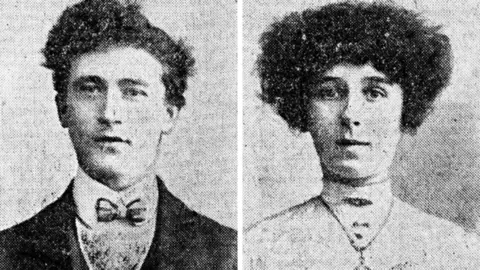
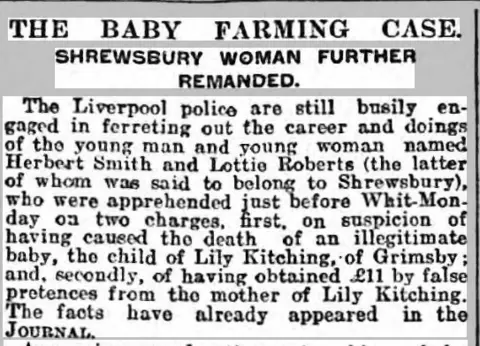
In 1907, a travelling showbiz couple were arrested on suspicion of causing the death of a two-week old baby boy from Grimsby.
Herbert Smith, an Houdini-inspired escapologist and conjurer, met Lottie Roberts in Shrewsbury where she was working in a cafe.
They travelled the country together showcasing his Musical Hall act "Leo Selwyn the Handcuff Prince", with Roberts as his glamorous assistant.
The couple, who had met 18 months earlier, had taken the boy from his teenage mother, Lily Kitching, who paid them £11 to adopt her child on the promise he would go to a loving home.
As grisly as the case appeared to be with just one child involved, what nobody knew at the time was this arrest would lead to the shocking discovery of Britain's most prolific baby traffickers. Their story was recently told on the BBC's Strange But True Crime podcast.
It's a story I first stumbled on almost a decade ago while perusing the newspaper archives – and the more I dug, the more I discovered.
It began in November 1906, when Roberts gave birth to a baby, Jessie, while in Swansea.
 Leeds Mercury
However, career came first, and they put an advert in the local newspaper offering her up for adoption. Eventually they found a home for her in nearby Neath.
But they had been so inundated by responses for people offering to pay to adopt their child the idea of a perfect business opportunity presented itself. They just needed more babies.
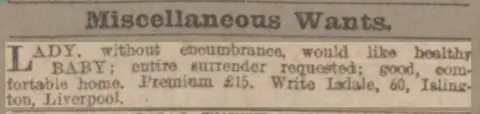
So, they set about putting adverts in papers across the country, posing as a couple desperate to adopt a child. Teenage parents and families of illegitimate children would respond, offering to pay them up to £15, approximately £2,300 in today's money.
They promised the children a wonderful new life, but instead, they would take them to other parts of the country and give them to baby farmers offering a few shillings a week to care for them.
Baby farms were orphanages and nurseries run by women who would often let the children die while still claiming money off unsuspecting parents.
Smith and Roberts used fake names and addresses, so when the money did not appear, the baby farmers would often abandon the babies on the street or send them to the workhouse.
Baby handed to 'Mrs Baker'
Now, back to Lily Kitching, who gave her baby to the couple.
Her son was born out of wedlock, so she and her parents responded to an advert in the newspaper: "Lady – without encumbrance, would like healthy baby; entire surrender requested, good comfortable home. Premium £15. Write Isdale, 60, Islington Liverpool".
A week later, a well-dressed and well-spoken young woman arrived at the house in Grimsby, calling herself Mrs Baker.
Kitching handed over the child and the money and the woman left.
A few days later another letter arrived at the Kitching's house from Baker, asking for more money and if it arrived swiftly, the matter "would be settled."
This raised alarm bells and Kitching's mother went to the Liverpool address given to them, only to discover it was a letter call office. She went straight to police.
Sgt Moore had heard similar stories over the few months prior, but this lead meant they could investigate further.
Inquiries led him to a sweet shop on Scotland Road, where he found Smith and Roberts in an upstairs flat.
Their arrest would lead to the discovery of systematic trade in illegitimate babies that some thought numbered in the hundreds and stretched across the country.
It was believed that they took babies from dozens of areas including Leeds, Chester, Worcester, Bath and Staffordshire.
 Wellington Journal
When Smith and Roberts went on trial at Liverpool Crown Court, aged 21 and 20, the Grimsby baby was still missing.
A number of witnesses were called including their own baby, Jessie, and her adoptive mother, Mrs Ball.
At least a dozen other children were produced as evidence.
The scope of their deception was enormous, and it was discovered they had conducted their operation across every part of England and Northern Ireland.
Facing a potential death penalty, the couple must have breathed a sigh of relief when, during the trial, police found the Grimsby baby.
They were found guilty of fraudulently obtaining more than £150 - about £23,000 in today's money - and were sentenced to 15 months and 8 months in prison respectively for trafficking 15 babies – but the true figure is believed to be much higher.
When they left prison, they got the old act back together, however, I discovered that with a damaged reputation, they struggled for work and Smith, possibly with Roberts, headed abroad.
Newspaper archives show that he first took his act to Canada, before heading to New Zealand and Australia.
The latest record I found dated to 1928. Their baby Jessie took the name of her adoptive parents grew up and got married.
 Michael Kitching
As for the Grimsby baby - he had been left with a baby farmer in Lincoln.
He was returned to live with his grandparents in Grimsby and was given the name Harry.
Eventually he married a woman called Sybil and had children, leading a happy life.
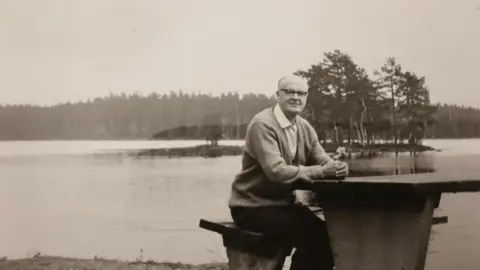
I was able to trace his great grandson, 38 year-old Michael Kitching.
Michael told me that his only memories of them were from the late 80s and early 90s.
"Whenever we went around, there would always be a tin of sweets that would come out. We knew them as the sweetie great-grandparents," he said.
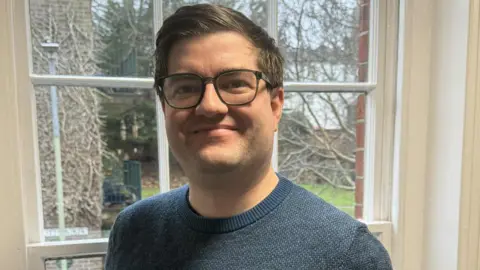
The revelation of the elder Kitching being effectively kidnapped and trafficked was a surprise, as the story had never been passed on.
Michael Kitching suspects his granddad did not know about it because of the social shame.
He described Lily Kitching giving up her infant as "heart-breaking and horrific."
"It can only be social pressure that's around her that's causing that. So, I do feel for her," he said.
"If they hadn't have found Harry, I wouldn't exist.
"Our whole family never would never have existed if this whole thing hadn't been uncovered and Harry hadn't been found".
Follow BBC Shropshire on BBC Sounds, Facebook, X and Instagram.
