First day of Russia-Ukraine peace talks ends in Geneva

 State Emergency Service of Ukraine/Anadolu via Getty Images
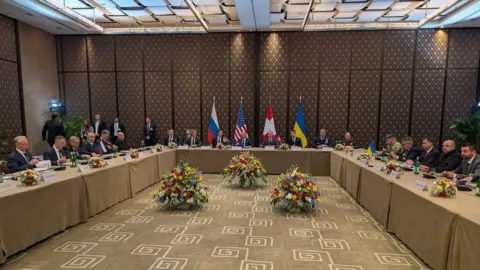
Russian and Ukrainian delegations have ended the first day of US-brokered peace talks in Geneva, a week before the fourth anniversary of Moscow's full-scale invasion of Ukraine.
Top Ukrainian negotiator Rustem Umerov said the negotiations would continue in the Swiss city on Wednesday morning.
Hopes for a breakthrough during the latest - third - round of trilateral talks are low, as the Kremlin has not wavered from its maximalist demands for Ukrainian territory.
Russian strikes on Ukraine continue on a nightly basis, further damaging the country's already battered power grid as subzero temperatures continue.
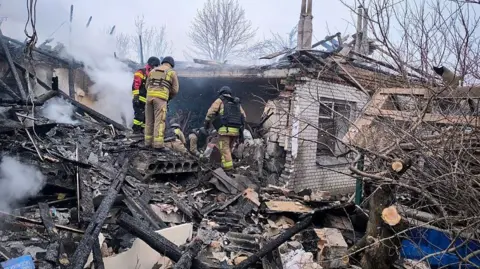
Just hours before the delegations met in Geneva, Russia carried out a large combined aerial attack on Ukraine, hitting 12 regions with 400 drones and almost 30 missiles. At least three people were killed, Ukrainian officials said.
Meanwhile, Russia said its air defences had repelled more than 150 drones, while an oil refinery caught on fire after a Ukrainian drone strike.
 Rustem Umerov/Telegram
In a statement on social media on Tuesday evening, Umerov, Ukraine's top security official, said the talks focused on "practical issues and the mechanics of possible solutions".
He said he would now inform Ukrainian President Volodymyr Zelensky about the results.
In his video address shortly afterwards, Zelensky said Ukraine was ready to refrain from carrying out strikes as earlier proposed by the US to both Kyiv and Moscow.
"We don't need war," he said, stressing that Ukrainians were "defending our state, our independence".
"We are also ready to quickly move towards a worthy agreement to end the war. The question is only for the Russians: what do they want?"
Meanwhile, Russia's state RIA news agency quoted a source saying that Tuesday's negotiations, which lasted six hours, had been tense and took place in different bilateral and trilateral formats.
The talks are being mediated by Steve Witkoff, Donald Trump's special envoy, and Jared Kushner, the US president's son-in-law.
On the Russian side, President Vladimir Putin's aide Vladimir Medinsky is the top negotiator.
Both Ukraine and Russia also had senior military figures in their teams.
Ahead of the talks, Trump said Ukraine had "better come to the table fast."
He has previously signalled his impatience with the lack of swift progress in solving the four-year conflict.
Russia occupies roughly 20% of Ukraine, including large parts of the eastern Donbas region. The Kremlin wants Ukraine to hand over the rest of the region, which Ukraine has ruled out.
For Ukraine, robust security guarantees from the West - including the US - must come before any settlement with Russia can be agreed.
In Kyiv, Ukrainian Foreign Minister Andrii Sybhiha condemned the overnight Russian strikes, saying they showed the "extent to which Russia disregards peace efforts".
At least three energy workers were killed near the frontline city of Slovyansk in Monday's overnight attacks, Ukraine's deputy Energy Minister Artem Nekrasov said.
A further nine people - including children - were injured across the country, President Zelensky said. More than 10 residential buildings were damaged, with railway infrastructure also damaged.
"Russia must be held to account for its aggression," he wrote on X, adding: "For peace to be real and just, action must target the sole source of this aggression".
Kyiv said 12 regions were hit, damaging infrastructure and leaving thousands without power in the southern port city of Odesa.
DTEK, the country's largest private energy firm, said power infrastructure in the city had suffered "incredibly serious" damage, adding it would take a long time to return to a working condition.
Ukraine is facing an acute energy crisis after months of relentless Russian attacks on its infrastructure and as it struggles through a freezing winter.
It launched its own volley of attacks on Russia overnight. Officials said a fire broke out at the Ilsky oil refinery in the southern Krasnodar region after a drone strike. A reservoir storing oil products also caught fire.
The border region of Belgorod continued to come under attack, with Ukraine launching dozens of drones and causing significant damage of power infrastructure.
These latest discussions follow last month's trilateral talks in Abu Dhabi, which were the first three-way between Russia, Ukraine and the US since Moscow launched its full-scale invasion of its neighbour in February 2022.
They ended with no breakthrough - although the first prisoner of war exchanges in months took place shortly after.
Additional reporting by Jaroslav Lukiv
