Voters share views with MPs on immigration

 BBC/Richard Moss
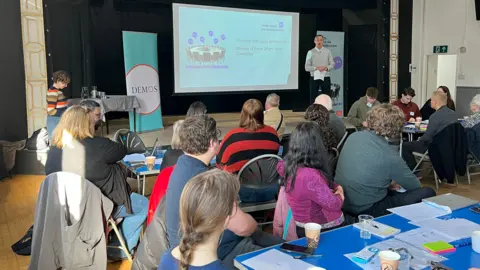
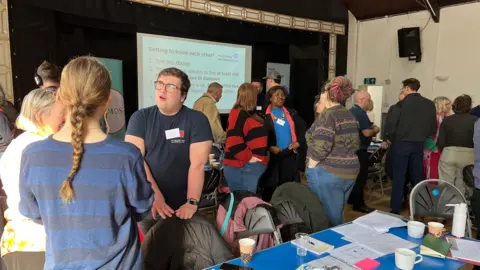
In the unlikely setting of an arts centre in the Northumberland village of Seaton Delaval, more than 20 people spent two days discussing one of the most contentious issues in politics - how the government should tackle immigration.
These were not experts though. Instead, all were run-of-the-mill voters, selected to reflect the demographics of the community and a range of political views.
They were invited by a group of cross-party MPs sitting on the Home Affairs Committee. Its job is to scrutinise the work of the Home Office and its associated bodies.
They want to find out what people think about the government's policy of reducing net migration – the sum of those entering the country, minus those leaving it.
Their focus was not on asylum and small boat crossings though. Instead, it was on how many people should be allowed to come from abroad to the UK for work.
They were considering what migrant workers the country might need, but also the impact on the economy and public services.
Their conclusions will be part of a committee report, and the findings also used to help frame questions members put to the Home Secretary Shabana Mahmood and other ministers.
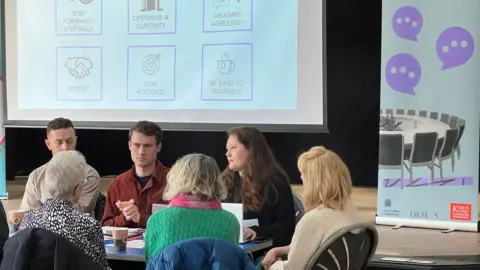
Among those observing was Sunderland Central Labour MP Lewis Atkinson.
He is one of 11 politicians from three different parties who sit on the committee.
"As a set of MPs we need to be asking the questions that the public want us to ask and that reflect their views," Atkinson said.
"That isn't just the loudest, like those who are active on social media or people who email us."
Among those taking part, were Reform UK voters with strong views on the subject, as well as those who just thought it would be a good way to spend a weekend.
For some of those taking part though the topic was intensely personal.
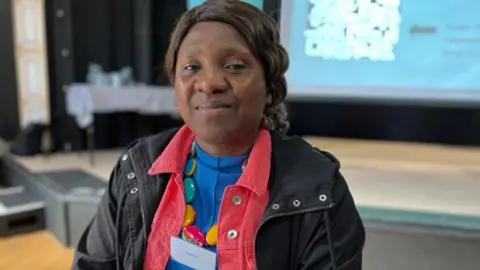
Support worker Nneka Iroegbu, 49, lives in Howdon, North Tyneside, but came to the UK from Nigeria more than 20 years ago.
"There's a lot of negative press about immigrants," she said. "You know, everything that's going wrong in England is apparently immigrants' fault.
"So, I wanted to be here to see what the whole issue was about."
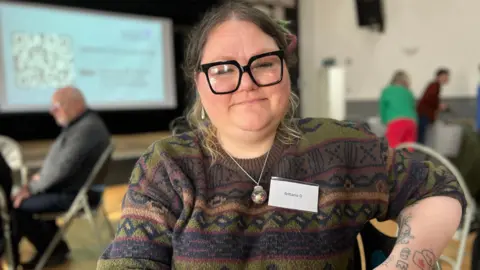
Artist Brittania Douglas, 44, also arrived in the region more than 20 years ago from the US.
She said: "As I am white, I am often told I am the 'right' type of immigrant and I want to challenge the idea that there is a right and wrong kind. A lot of it is bias we feed ourselves."
Immigration is a subject that can cause bitter arguments. For that reason, the MPs asked think tank Demos to oversee the two days.
It regularly runs sessions on contentious parts of politics which aim to avoid rows and rancour.
Director of participatory programmes Miriam Levin says even with the most difficult subjects it is possible to seek consensus rather than contention.
"Often discussions online on immigration are very shouty and get quite nasty," she said.
"What we're trying to create in the room is a sense that it's OK to have differing views, but there's a way of disagreeing agreeably, so you can have a really healthy conversation."
 BBC/Richard Moss
In order to ensure the discussions were as well-informed as possible, two experts were on hand to supply statistics and context, as well as answer questions.
Topics they tackled ranged from which people could qualify for UK work visas, to the causes of a steep rise in non-EU migration in the early 2020s.
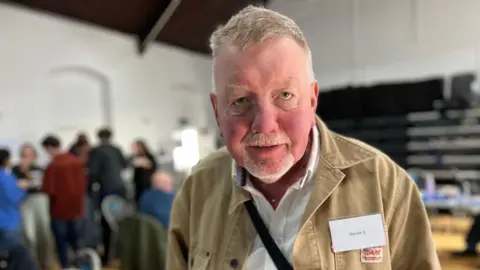
One of the participants was Steven Shepherd, 64, from Killingworth. He said he had found the experience valuable.
"You are hearing other people's perspectives which differ from yours, and so if your mind's open, you can think, 'Yeah, they could be right'."
Freelance creative Nicola Sokell, 57, from Whitley Bay, said she felt people were listening to other points of view.
"When we're talking to each other, there's a sense of people actually hearing each other and finding relatable things," she said.
Prison tutor Roisin Sheppard, 40, from Wallsend, said she felt the experience had been positive.
"I did worry people would have more racist tendencies, but I've been quite shocked that hasn't been the case."
 BBC/Richard Moss
Levin said the think tank often received feedback that discussions made them feel empowered.
She said: "You are talking directly to power, and that is incredible. That's the thing that makes people go, 'Ok, that was worth it'."
To make sure people were as free as possible to express their views, the BBC was not allowed to record detailed discussions.
The aim was to reach some form of collective view on the subject by the end of the two days.
 BBC/Richard Moss
But the people gathered in Seaton Delaval had differing views on how much politicians might be prepared to listen.
Iroegbu said she felt hopeful MPs would because of the importance of the topic to the UK, but fellow participant Shepherd was less sure.
"I am not naïve enough to think that what we're saying in here is going to make any difference really," he said.
More groups of voters will gather for similar sessions in Leicester and North Renfrewshire in May.
A report summing up the findings of all three is due to be released in September.
