Iran says its forces 'waiting' as US troops arrive in region

 Reuters
Iran's parliament speaker has warned that his country's forces were "waiting for American soldiers" as a further 3,500 US troops arrived in the Middle East.
Mohammad Bagher Ghalibaf said Iran would "rain fire" on any US troops attempting to enter Iranian territory.
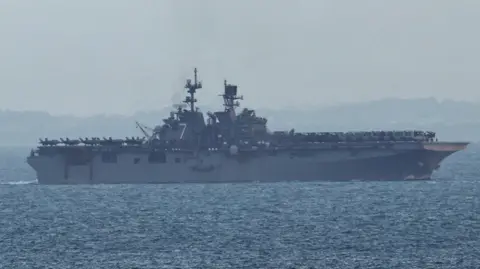
US Central Command said on X that the newly-arrived sailors and marines were part of a unit led by the warship USS Tripoli, which also includes assault and transport assets.
Its arrival came as the Washington Post reported that the Pentagon was preparing for weeks of ground operations in Iran. US officials have not confirmed whether ground troops will be deployed.
In his message, reported by Iranian state media, Ghalibaf also said "the enemy signals negotiation in public, while in secret it plots a ground attack".
There has been mixed messaging from US President Donald Trump about when the war could end. In recent days, he has said both that it was nearly over and that he was considering whether to take further action against Iran, including on energy .
Earlier this week, US media reported that his administration was preparing to ask Congress for $200bn (£150bn) in emergency funding for the ongoing Iranian military operation - suggesting he wanted it to continue.
Trump told reporters in the Oval Office last week that he was not sending ground troops to Iran, but added: "If I were, I certainly wouldn't tell you".
Secretary of State Marco Rubio, meanwhile, said on Friday that while the US could meet its war objectives without ground troops, Trump had "to be prepared for multiple contingencies".
According to the Washington Post, citing US officials, any potential ground operation approved by the White House could involve raids by a mixture of ordinary troops and Special Operations forces but would stop short of a full-scale invasion of Iran.
Axios has also reported that the Pentagon is developing military options to deal a "final blow" to Iran that could include the use of ground forces, as well as a bombing campaign.
The US had already deployed several military assets to the Middle East as part of its campaign against Iran. These include bombers and fighter jets, as well as aircraft carriers and missile interceptors.
The US Navy's most advanced aircraft carrier, the USS Gerald R Ford, arrived in Croatia for repairs on Saturday after a fire on board injured sailors and caused significant damage.
It is also unclear whether peace talks between the US and Iran have been happening.
Iran has denied that such discussions have taken place. However, Iran's foreign minister Abbas Araghchi has said messages have been exchanged with the US via intermediaries but these constituted "neither dialogue nor negotiation, nor anything of the sort".
Trump has said talks are happening and are going "very well", and has claimed that Iran is "afraid" to admit to discussions "because they figure they'll be killed by their own people".
The president is widely reported to have passed on to the Iranians - via Pakistan, which is acting as a mediator - an outline of a 15-point plan to end the conflict.
While an official text of this plan has not been published, it is reportedly a compilation of demands the US and Israel have made of Iran over many years, including for Iran to abandon its nuclear programme.
Tehran has responded with its own demands, including recognition of its control of the Strait of Hormuz, reparations for war damage, and the removal of American bases from the Middle East.
The US, "with a 15-point list, is setting out its wishes and pursuing what it failed to achieve in the war", Ghalibaf said on Sunday.
US and Israeli strikes on Iran, which began on 28 February, have killed Iran's Supreme Leader Ayatollah Ali Khamenei, as well as several other top Iranian officials. More than 1,551 Iranian civilians have also died so far as a result of the bombings, according to HRANA, a US-based group that monitors human rights violations in Iran.
Retaliatory Iranian strikes have targeted Israel and US military bases across the Middle East - disrupting major hubs for international air travel and causing the price of oil to soar.
