Fossil dating back 410 million years joins museum collection

 Neil Hanna
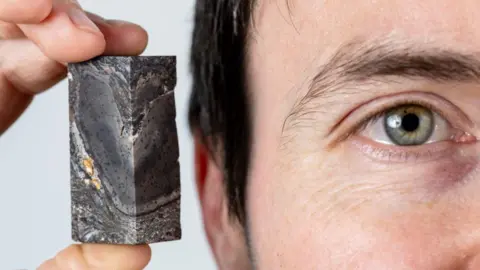
A 410-million-year-old fossil of a giant prehistoric organism which once loomed over north-east Scotland has been added to the collections of National Museums Scotland (NMS).
The example of Prototaxites was discovered in a sedimentary deposit near the village of Rhynie in Aberdeenshire.
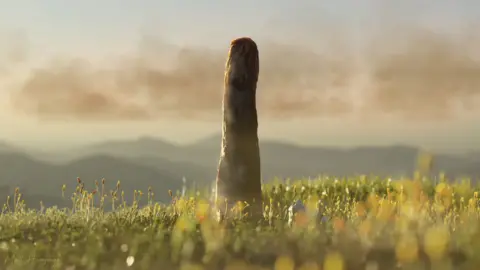
At 26ft (8m) high, it would have towered over other plants and animals.
Once thought to be a form of fungus, scientists now believe it to be a distinct evolutionary branch of life which is now extinct. The fossil will be kept and cared for at the NMS collection centre in Edinburgh.
The fossil was found by a local landowner in an area known as the Rhynie chert, a sedimentary deposit.
In a new paper, researchers said the fossilised sample backs up the theory that Prototaxites were an entirely different form of life no longer found on Earth.
Dr Sandy Hetherington, co-lead author and senior lecturer in biological sciences at the University of Edinburgh, said: "It's really exciting to make a major step forward in the debate over Prototaxites, which has been going on for around 165 years.
"They are life, but not as we now know it, displaying anatomical and chemical characteristics distinct from fungal or plant life, and therefore belonging to an entirely extinct evolutionary branch of life.
"Even from a site as loaded with palaeontological significance as Rhynie, these are remarkable specimens and it's great to add them to the national collection in the wake of this exciting research."
 Matt Humpage
Dr Nick Fraser, keeper of natural sciences at NMS, said the museum was delighted to add the fossil to its collections which "document Scotland's extraordinary place in the story of our natural world over billions of years to the present day".
"This study shows the value of museum collections in cutting-edge research as specimens collected over time are cared for and made available for study for direct comparison or through the use of new technologies," he added.
