More than 30 killed in blast at Pakistan mosque, officials say
At least 32 people have been killed and more than 160 injured in an explosion at a mosque during Friday prayers in Pakistan's capital, Islamabad, officials say.
A suicide bomber detonated a device after approaching the Shia mosque in the Tarlai area of the city, police said.
The Islamic State (IS) group claimed the attack, in a statement posted on its Telegram channel seen by the BBC. The group also issued a picture of the alleged bomber.
Condemning the attack, Pakistan's Prime Minister Shehbaz Sharif expressed "deep grief". The country's president, Asif Ali Zardari, said "targeting innocent civilians is a crime against humanity".
Before the claim by IS, Pakistani Defence Minister Khawaja Asif suggested India and Afghanistan had been behind the attack.
Asif said in a social media post that it had been "proven" the attacker had travelled to and from Afghanistan, and "collusion between India and Afghanistan is being revealed".
Afghanistan's Taliban government described Asif's comments as "regrettable", saying the Pakistani minister "hastily attempted to attribute the incident to Afghanistan without presenting any credible evidence".
Afghan foreign ministry spokesman Abdul Qahar Balkhi earlier called such attacks a "contradiction to Islamic and humanitarian values".
The Indian foreign ministry also condemned the bombing, calling the accusations it may be involved "baseless".
A spokesperson for United Nations Secretary-General Antonio Guterres said he condemned the attack in the "strongest terms" and called for those responsible to be "identified and brought to justice".
'We bowed - then there was an explosion'

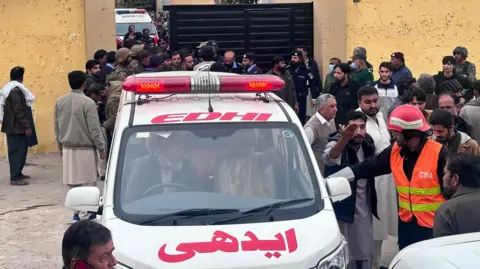 EPA
EPAZaheer Abbas was inside the Khadijatul Kubra Mosque praying when he first heard the sound of bullets.
"After that, we bowed and then prostrated, and then there was an explosion," he told BBC Urdu. "After which there were injured people lying everywhere."
Pictures from the mosque in the aftermath show footwear scattered across the floor, shattered glass, and people sat among the wreckage.
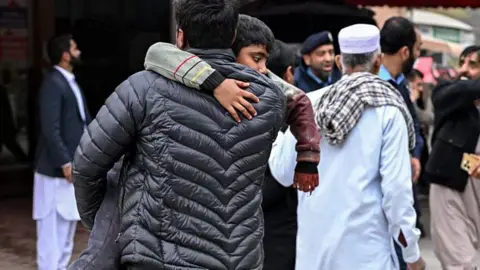 AFP via Getty Images
Abbas, who said he "lost his senses" in the moments after the explosion, was eventually pulled out by emergency services and taken to hospital, where he was quickly released.
"Fortunately, I did not suffer much injury," he said.
According to Pakistan's defence minister, the attacker opened fire and detonated the bomb after being challenged by security guards.
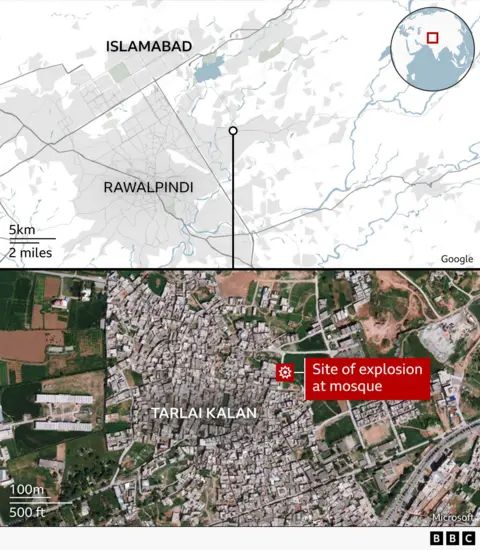
The mosque's caretaker Syed Ashfaq - who lives next door - also heard gunfire, and began running towards the mosque to help.
"By the time I reached it there had already been an explosion," he told the BBC. "Bodies were lying everywhere, some were missing arms, some missing legs. We took the most injured in our own vehicle [to hospital]."
Islamabad's deputy commissioner Irfan Memon said on X that the death toll stood at 31, with the injured numbering 169.
Pictures from local hospitals show the injured being brought by private vehicles and ambulances, with one photographer for news agency AFP saying they saw dozens of people arriving at hospital.
Attacks are relatively rare in the capital, although one in November left 12 dead. Another 27 were injured in the blast, outside a courthouse.
The blast on Friday comes after a week of violence which saw 58 civilians killed in coordinated attacks in the province of Balochistan.
The Balochistan Liberation Army (BLA) rebel group said it was behind the attacks. The military - which has been fighting an insurgency in the region for decades - said it had killed more than 200 militants in response.
Last year was also Pakistan's deadliest in over a decade as combat-related deaths surged 74%, with militants accounting for more than half the death toll, according to a new report released by an independent think tank.
The Pakistan Institute for Conflict and Security Studies (PICSS) said violence in Pakistan left 3,413 people dead - up from 1,950 in 2024 - with 2,138 militants killed.
IS claimed the attack in the name of its "Pakistan Province" branch on Friday, via the group's Telegram channels. IS's Amaq "news agency" issued a statement offering additional details.
Amaq alleged that the IS attacker arrived at the "central temple [mosque]" in Tarlai district in the Shahzad area. Guards at the location then tried to halt the attacker at the external gate, it claimed, but he fired his pistol at them, injuring two, before heading inside.
IS said the alleged attacker was named "Sayf Allah al-Ansari". The nom de guerre Ansari is often used to indicate somebody who is a local to the area. Amaq's report also shared a photo showing what it said was the alleged masked attacker.
Additional reporting Caroline Davies
