BTS turned millions on to K-pop. But now it's caught between Korea and the world

 Getty Images
"BTS 2.0 is just getting started!" J-Hope declared as he stood alongside the other six members of the world's biggest band.
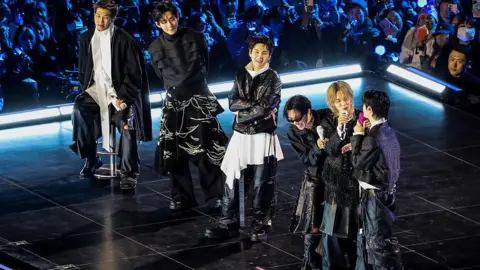
It was 21 March and, after a long break, J-Hope, RM, Suga, Jin, Jimin, V and Jung Kook had taken to the stage again - silhouettes against an arch of LED screens framing the historic gate to the royal palace in Seoul, as screaming crowds stretched for blocks.
Tens of thousands turned up to watch and more than 18 million people live-streamed the one-hour show - a slick teaser of the upcoming BTS world tour, with the group's easy camaraderie on display, almost as if they had not spent much of the last three years apart, doing mandatory military service and releasing solo albums.
And yet, in the days that followed, a more complicated story emerged, partly fuelled by a candid documentary about the making of the new album, showing members disagreeing with their powerful agency, Hybe, over the direction and identity of their music.
The group finds itself being pulled in so many directions: Between fandoms, old and new, Korean and global, between artistic identity and commercial expectations, between the creative instincts of its members and the broader strategy surrounding them. And then there is the small matter of being the face of South Korean soft power.
It boils down to a single, loaded question: Is BTS straying too far from K-pop in trying to woo the world?
 Getty Images
At home, some fans are debating how Korean the new album Arirang really is - despite being named after a beloved folk song, which is sampled in the hip-hop laden opener, Body to Body.
This heroing of rap is what those defending the album love - it reminds them of an older BTS - while others see the very Korean roots that so many argue are missing.
Still others question that very heavy use of English and the eclectic producer credits, from American DJ Diplo and Australian songwriter Kevin Parker to Spanish musician El Guincho. They blame Hybe and BTS for chasing a lucrative Western market at the expense of originality.
Abroad, however, fans seem less divided, while critics have largely welcomed what they see as an experimental turn. The BBC's review found the rap-heavy Hooligan audacious, the Jersey club-styled FYA "deliciously dark" and the album itself "a genuine return to form".
Arirang - and its lead single, Swim - climbed the charts swiftly, breaking streaming records and dominating Billboard. Hybe's PR game has been in overdrive, with BTS performing at the Guggenheim, cooking up a popular Korean noodle dish on GQ and appearing to rapturous applause on Jimmy Fallon's talk show - despite only RM speaking English comfortably, and the rest mainly sticking to Korean.
But language has never been a barrier for their global fandom. And they know it. "I am the only one who speaks English but that's how we kill," RM raps in the cheeky Aliens, switching between English and Korean.
That tension defines where BTS stands today, as they kick off the biggest world tour in K-pop history - 85 dates across five continents over the next 12 months.
What lies ahead is a high-stakes balancing act even for a band as polished as BTS, with more than 10 years experience of rarely putting a foot wrong.
Missing the Dark & Wild days
Starting on Thursday, the opening concerts in Goyang are estimated to draw more than 120,000 fans over three nights. They sold out almost instantly.
It's a staggering rise for BTS since 2013 when they began as seven very young men - three of them teens - assembled by a then relatively unknown company, far from the limelight of South Korea's top entertainment agencies.
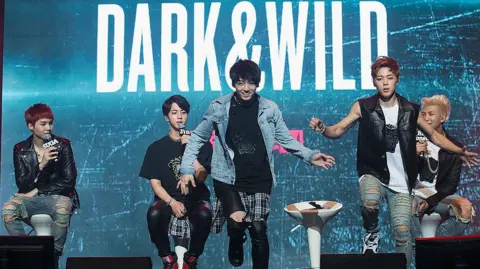
Their early music, often represented by their first full album Dark & Wild in 2014, leaned heavily on hip-hop, set to the tune of intense beats. The punchy Korean lyrics that spoke to young people's frustrations, pressures and dreams resonated with fans trying to make it through highly competitive and exhausting lives.
 Getty Images
The members have always said their music grew up with them - now, mostly in their 30s, they sing about the unflinching pressure of fame as weary adults in Normal: "Wish I had a minute just to turn me off".
"There wasn't any other [K-pop] group quite like BTS," says music critic Park Hee-ah. "No-one else leaned into authenticity in their music to that extent. They've consistently told their own story - writing and producing their music, and sharing the journey that brought them to where they are today."
When Dark & Wild was recorded in a makeshift studio in LA, BTS was an up-and-coming band, shooting a documentary about their life of hustle. Arirang, also recorded in LA, has drawn inevitable comparisons, because of its hip-hop-heavy style.
Some listeners find continuity in Arirang's polished and experimental sound co-created by American producers and engineers, but others say this album is too highly produced, missing the raw passion of Dark & Wild.
"Nothing about this comeback of theirs is bad necessarily, but it's getting pretty clear that they aren't really sure what BTS is any more, and they have no vision for what they want it to be," a user who claimed to be a long-time fan wrote on Reddit.
Hybe v BTS
Ironically, for some Koreans, the emphasis on Korean heritage has made it harder to connect to the album. Using Arirang as its central motif struck them as too deliberate.
That uncertainty is echoed in the documentary. "I don't know if this is right, to be honest," Jimin says at one point, after listening to an earlier version of the song, with a longer sample of Arirang. Suga says the agency wants Arirang "to be in your face", while RM says he has a "physical reaction" to linking the band to such a monumental song.
But the doubt and discomfort give way to arguments by Hybe chairman Bang Si-hyuk, the man who picked the seven of them to create BTS.
"It's impossible to deny that you're a once-in-a-generation kind of icon," he tells them. "And we can't deny that you are Koreans. So your target audience is now more and more a global one, no longer just Koreans, and that's also undeniable."
 Getty Images
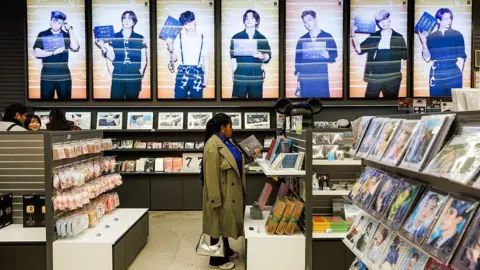
Hybe built BTS but then BTS single-handedly transformed Hybe into a powerhouse. South Korea has embraced their success as a form of diplomacy, with the group frequently positioned as national or even global ambassadors, from appearances at the White House and United Nations to high-profile state events.
BTS has generated billions in revenue, not just through music but through merchandising, endorsements, and relentless content, allowing Hybe to expand aggressively, and even go public.
In the world of K-pop where agencies are known to control stars, some see Hybe as the reason for the album's direction, with BTS giving in to their demands. But on the other side are those who see the album as evidence of the tricky negotiations the documentary captures.
"Personally, I didn't find the use of Arirang's traditional sound that weird," says one fan who is attending the Goyang concert. "And there are still a few songs on the album that I find interesting, including Body to Body."
A blogger who follows K-pop and pop culture writes: "While I respect the musical evolution of BTS as they constantly take on new challenges, it is also true that we miss their unique and sincere Korean lyrics that used to comfort our hearts."
The message for Army
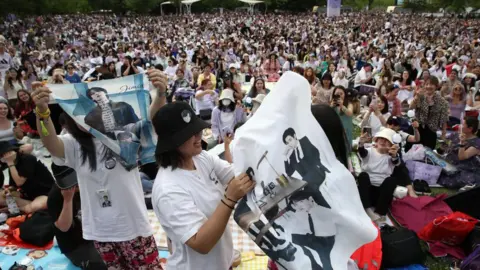
For BTS, these questions of authenticity and messaging sit at the heart of what has kept their fanbase - or Army - fiercely loyal.
While the new album "is great in terms of sound quality… the overarching message, such as Love yourself, of [earlier albums] doesn't come through as clearly," says Park, the critic. "That may be why Korean listeners are finding it hard."
The Love Yourself albums, which centered on self-love, mental health and personal growth resonated across cultures. It was a message that BTS delivered at the UN during the pandemic, telling young people everywhere that they too had struggled to accept who they were. Ami Ostrovskaia, a Russian university student living in Seoul, says BTS songs "saved her" from a mental breakdown.
From the start of their career, the members frequently appeared in vlogs, sharing their thoughts and directly addressing fans. In 2015, they launched the popular series Run BTS in which they play games and spend time together.
Their relationships played out in full view, developing online as much as they did offline. Fans saw them less like distant pop stars, more like talented, awkward and goofy boys - and feel like they watched them grow up.
"I've been watching BTS's social media content since early 2010s, when their Twitter followers were less than 1,000," Park says. "They were the leading figure in the K-pop scene to make aggressive use of social content, perhaps as an alternative, as it was difficult for idols from smaller agencies to secure TV appearances."
 Getty Images
As their fandom grew, BTS sold out venues everywhere, including Wembley, where they wept as tens of thousands of fans sang Young Forever in Korean: "Even if I fall, get hurt, and it aches, I keep running towards my dream."
By the time they released their fully English singles - the catchy, bubblegum-esque Dynamite and Butter - they were ready to bet on the bright, disco-inflected departure from their hip-hop roots. Those songs paved the way for Grammy performances and nominations, the first for a K-pop act, even though they did not win.
And now with Arirang, they appear to have taken yet another turn, but one with a far more obvious nod to their Korean roots. But the route here has involved individual detours during their hiatus.
RM and Suga, recognised for their songwriting and producing, leaned into experimental projects. Jung Kook and J-Hope focused on performance-led pop, while Jimin, V and Jin highlighted their vocals, with more emotive work.
That the seven of them have stuck together after more than 10 years is startling to many.
"It's hard to pinpoint one thing," says Rob Schwartz, formerly at Billboard. "Talents, looks, promotion… I think it's all of the things together.
"But I think really what it is is that they created this big movement for themselves and they've gathered so many fans. These passionate fans are continuing to push forward the BTS legend and popularity."
 Getty Images
Sometimes that image frays under the unforgiving glare of South Korean celebrity life, where there is rarely room for vulnerability.
Earlier this year, Jung Kook, the youngest in the group, caused a stir with a frank, drunken livestream in which he swore. "I just want to live as I want," he said. When concerned fans urged him to end the stream, he responded: "Please don't tell me what to do."
A few months before, RM apologised profusely after his own honest livestream about the anxiety of reuniting and returning to the stage.
"I wouldn't say the BTS members lack freedom," Park says. "But as a group, they've become something like a national brand. That inevitably places them under enormous pressure - and it may be why some feel they've lost a sense of identity."
For loyal fans like Park Su-bin, the opportunity to watch them again is exciting enough. "Honestly, I wasn't that into the title song, Swim. It's good, but I was expecting stronger choreography and more Korean lyrics, something more like Idol,'" she says, referring to the high-energy hit from 2018 that blends South African rhythms with traditional Korean music.
"It's been a while since I watched BTS perform. I'm excited to be going to a BTS concert, but it still seems a bit surreal."
Another "light" fan says, "I don't have many thoughts about it. I'm just excited for the concert".
As BTS takes to the stage again, and returns to Weverse, their fandom and their powerhouse performances will determine the verdict on their comeback.
The one thing critics do agree on is that their legacy is assured. "I was covering K-pop before it was this gigantic world phenomenon," Schwartz says. "And you know, at that time it was a question mark. Will K-pop become like a gigantic world phenomenon? Now there's no question because of BTS."
Rather, the question is how much further can they go?
