'No judgement, just joy' - inside London's relaxed pantomimes

 Ryan Dinham
For many families, Christmas isn't Christmas without a visit to the pantomime. But for some, that sparkle can feel out of reach.
Packed auditoriums, booming sound effects and glaring lights can all turn what should be magical into something overwhelming.
For children and adults with sensory or learning differences, traditional theatre can feel stressful rather than joyful.
Venues across London and elsewhere are therefore offering a solution with relaxed performances – shows specially adapted to make the magic of theatre accessible to families who might otherwise stay away.
What is a relaxed performance?
The shows are designed for anyone who would enjoy a gentler theatrical experience, including individuals with autism, ADHD, learning disabilities, sensory sensitivities, anxiety, or other conditions that may make traditionally strict theatre etiquette challenging.
The performances keep the same storyline and magic of a pantomime but introduce thoughtful adjustments such as softer lighting, lower sound levels and fewer sudden effects.
Audiences can often come and go as they want, talk or make noise during the show, and use breakout spaces if they need a pause from the magic.
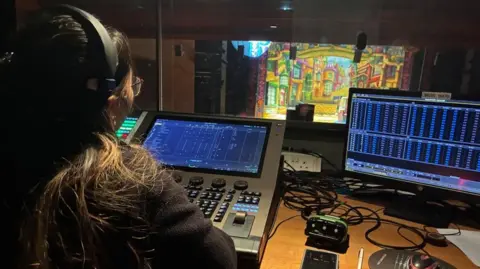
Heather O'Donnell, senior technician at Bromley's Churchill Theatre in south-east London, says there are various methods they use to help audiences feel comfortable.
"At the start of the show, the actors will come on and explain who they are – 'My name's Sam. I'm playing the enchantress. I'm not really a baddie. I'm just pretending,'" she explains.
"It's all those sorts of things you might take for granted. You know they're pretending, but some people may get lost in it and think there's a real threat."
Strobing lights and sudden flashes, which are often used for effects like thunder and lightning, are replaced with softer transitions between scenes. The pyrotechnics are also turned off for these performances.
Whilst not every London theatre offers the exact same adjustments for relaxed shows, most follow similar principles.
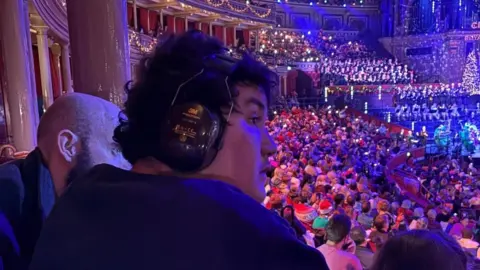
Lisha and her son Lumen, a 13-year-old who is non-verbal and has autism, live in Westminster and love attending relaxed performances across the capital.
Previously, the pair have seen various pantomimes at the Lyric Hammersmith, The Nutcracker at Sadler's Wells, and even Christmas carols at the Royal Albert Hall.
"The best thing for me is that there's no judgement from other attendees – everyone is on the same page. All the parents have gone through similar experiences.
"So if one of the children shouts out or starts clapping and dancing at the wrong time, it doesn't matter," she says.
For Lisha, the biggest help is preparation. She explains how before the day of the performance, detailed "social stories" are often sent out showing the venue layout, staff or actor details, and what will happen during the show.
At relaxed performances, the house lights are usually left on but turned down to a lower level so that people can easily dip in and out of a performance as needed.
"For my son, he doesn't understand social norms. He doesn't know people won't accept that you're going to stand up and sit down and walk out and come back in," says Lisha.
"So for us, the only way we can access these things is through the relaxed performances."
She adds that for many parents, these shows mean reclaiming festive traditions for their own families.
"Things that maybe they did in their childhood that brought them good memories or put them in the holiday mood – they can't necessarily do them with their own children unless their children can access it the way they can."
 Lisha
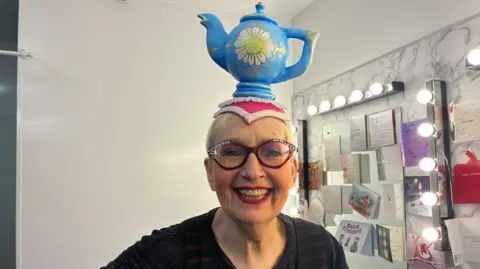
LishaSu Pollard, best known for her role in 1980s TV sitcom Hi-de-Hi!, plays Mrs Potty in this year's performance of Beauty and the Beast at the Churchill Theatre. She's a big believer in relaxed performances.
"It's lovely because you can see a lot of people's faces. Normally, it's complete darkness – you can probably see the first two rows and that's it.
"Here, you see them going in and out sometimes, but you try not to let that be a distraction. You're told about this beforehand, everyone is," she says.
For Su, the heart of pantomime remains the same whatever: "Good triumphs over evil – that's the basic story of any pantomime.
"These performances bring together like-minded children who then don't feel left out of a performance and they are in their own comfort zone."
At the New Wimbledon Theatre in south-west London, relaxed performances go beyond the stage with the lounge becoming a chill-out space with sensory toys.
Ear defenders are available at multiple points and clear pictorial signage helps guests navigate easily to toilets, bars and breakout areas.
Extra staff are stationed at doors to guide visitors and offer reassurance. For families who prefer to plan ahead, the theatre arranges familiarisation visits so guests can explore the space before the big day, reducing anxiety and making the experience feel predictable and safe.
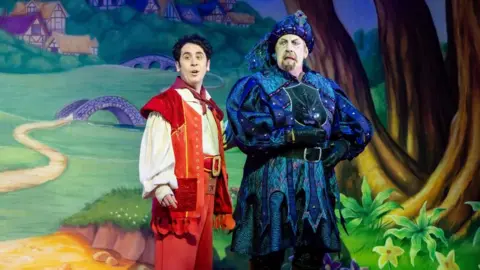
Magician and comedian Pete Firman, who stars in Wimbledon's performance of Robin Hood, says the shows have "a different feel because everything is subdued, from the sound to the special effects".
"A lot of my stuff is talking directly to the audience and a lot of interaction.
"I do a magic spot in the second half where I ordinarily get a couple of people up on stage, which we usually cut for the relaxed performance – sometimes we do it if we can find people who are keen to be involved," he says.
Front-of-house staff also speak to anyone who might come on stage before the show begins to ensure audience participation feels safe and comfortable.
 New Wimbledon Theatre
Behind the scenes, charities are playing a big role in making relaxed performances accessible to families who might otherwise miss out.
One supporter is John Lyon's Charity, which offered free tickets for Send young people in nine London boroughs, including Camden, Brent and Kensington and Chelsea.
Anna Hodinott, director of strategic grants, says the best venues consult families before and after the shows.
"It works really well when families are consulted before putting on relaxed performances and co-production and co-creating that kind of experience is so important to make sure that no one can think of everything, particularly those that don't have lived experience."
But Ms Hodinott says inclusion should go beyond one-off events and true inclusion means flexibility across all performances. For her, the principle is clear: choice matters.
"I think what we advocate for is choice. Choice for parents to either choose the specific relaxed performance that their child can access or to also still feel welcome to access other shows and other performances as well," she says.
"True inclusion would be a really flexible space at all times, which is tricky and not necessarily where we are yet as a society – but it's a really positive start to have more relaxed performances."
Listen to the best of BBC Radio London on Sounds and follow BBC London on Facebook, X and Instagram. Send your story ideas to [email protected]
