D-Day veteran who survived PoW camp celebrates 100th birthday

 BBC
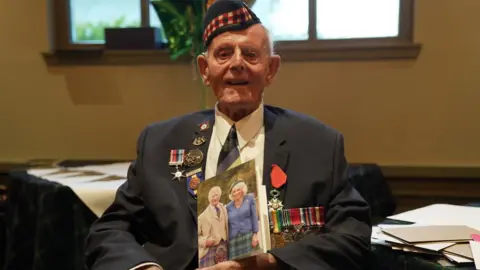
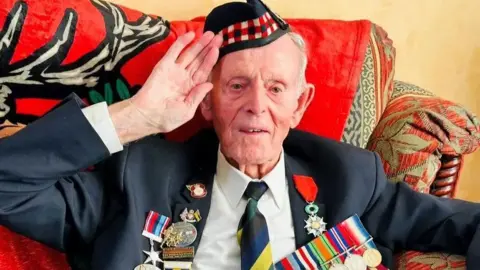
BBCOne of Scotland's last surviving veterans of the D-Day landings is celebrating his 100th birthday.
Soldier Jim Glennie was just 18 when he took part in Operation Overlord on 6 June 1944 to liberate Europe from Hitler's Nazi regime.
It was the largest air and sea invasion in history.
The veteran, from Aberdeenshire, modestly puts his survival down to "sheer luck".
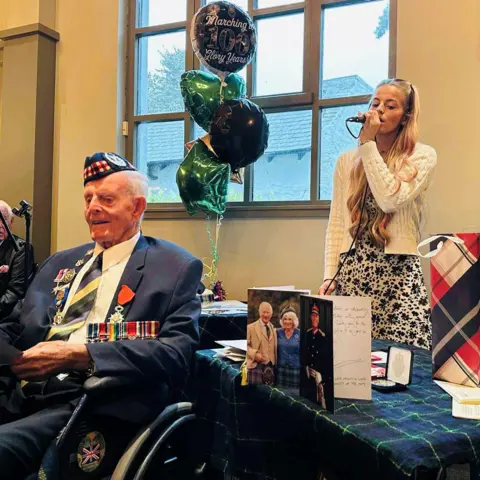
On his birthday he also received a British Empire Medal, to recognise the veteran's ongoing volunteering at the Gordon Highlanders Museum - something he has been doing for 30 years.
His granddaughter Erin sang the 1939 Vera Lynn song We'll Meet Again.
Speaking to BBC Scotland News, Mr Glennie said he felt happy.
Of his age, he said: "I'm feeling just fine. I just keep fit."
 Glennie family
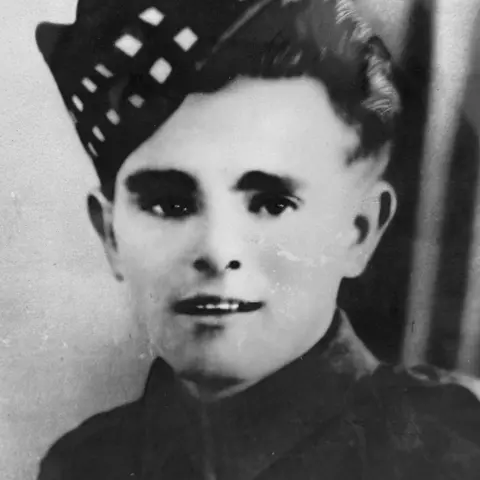
When he was called up, Pte Glennie began his military service at the Bridge of Don Barracks in Aberdeen.
"If you weren't fit it was hard, but if you were fit it was alright," he said.
When Allied forces began landing on the beaches of Northern France on 6 June 1944, Pte Glennie, from Turriff, was with the Gordon Highlanders.
Mr Glennie has previously told how he saw the body of a fallen soldier as he entered the water from a landing craft, but knew he must continue.
"I remember getting into the water, my two mates couldn't swim, they stuck to me like glue," he said.
"But the water was just up to the knees, so it was alright.
"This body came up with the waves. I just carried on.
"Boys were getting shot. There were shells and everything. You had to keep your heid doon (head down). You never stopped. You had to carry on."
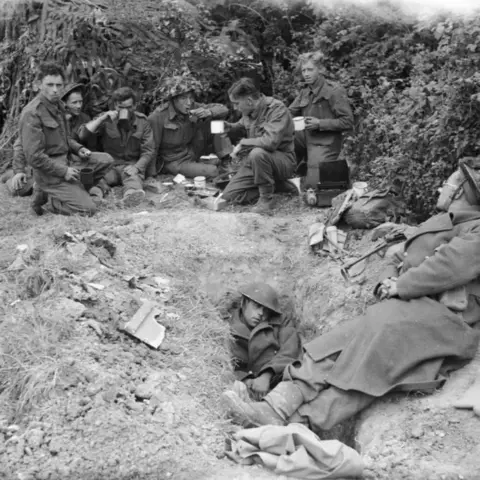
Amid heavy German resistance, Mr Glennie and comrades managed to advance inland.
He said they faced Germans coming at them from different angles.
However, combat was almost over for the teenager.
"We were shooting at them and they were shooting at us," he said. "And eventually I was shot in the arm.
"When I got captured, you had to take off your watch. My mother had given me a ring, they took off the ring. I said 'no, no' but the boy was going to punch me.
"But I was lucky, I got into the hospital."
 Imperial War Museum
Mr Glennie said his German doctor was "golf daft" and had asked him if he played the sport.
The young soldier replied that he played football.
"He used to ask me about Aberdeen," he said.
"He says 'Aberdeen, there's supposed to be a lot of golf courses'. I said 'oh yes, I can't tell you them all, but I can tell you a lot of them'.
"He says 'I'm going to come to Aberdeen when the war finishes'."
Meanwhile, on his 19th birthday, Mr Glennie found himself at Stalag IV-B - one of Germany's largest prisoner of war camps.
"You were always hungry, always hungry," he recalls.
He was filling bomb holes as part of his prisoner duties when his German captors vanished in early 1945.
After leaving, he managed to meet up with American soldiers.
He had a shower and got an American uniform.
He was due to deploy to Japan once Europe was liberated, but the war ended before he was sent.
Returning to Turiff, Mr Glennie swapped the life of a soldier to be a welder.
He would later marry Winifred, and the couple had two children.
They were married for more than 40 years before her death about 15 years ago.
Asked what his secret to long life was, he said: "Just lucky I think. I feel I was a very lucky loon (boy), I was only 18.
"I was just a soldier. It was an experience."
 PA Media
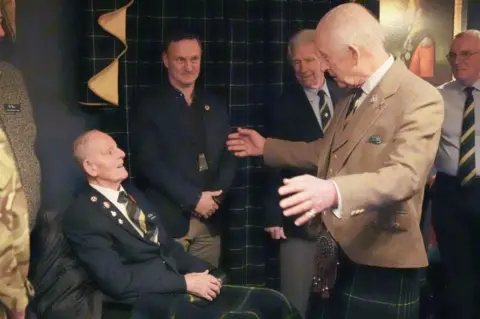
King Charles spoke with Mr Glennie in January when he was inspecting renovations at the Gordon Highlanders Museum in Aberdeen.
Mr Glennie greeted the monarch with the words "long time no see".
The two had previously met several years ago.
The King promised to send him a message for when he turned 100, saying: "You're a great example to us all, if I may say so, you really are."
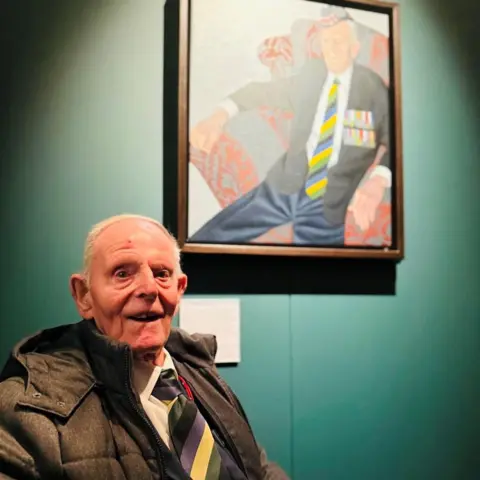
Mr Glennie's daughter Juliet Gallacher said: "We're very proud of him."
On her dad's age, she said: "It's clean living. He has never smoked or drank. He just eats simple food.
"Hopefully today he realises that everyone is here for him and it is quite a big deal reaching 100."
Ian Pithie, head of visitor experience at the Gordon Highlanders Museum, described Mr Glennie as a living legend.
"He is an example to all of us, Jim is a lovely and warm person," he said.
"He still has a twinkle and a smile. He is a family person and that's what the museum and the Gordon Highlanders are all about.
"He is almost like the godfather of the family."
Mr Glennie hopes future generations will remember the sacrifices which were made in the war.
