Welsh secretary is anti-devolution, former minister claims

 EPA
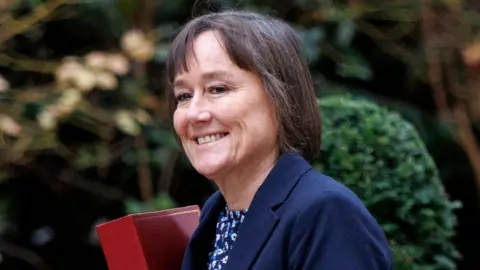
EPAJo Stevens is the most "anti-devolution" Labour Welsh secretary in half a century, according to a former Welsh government minister.
Labour Member of the Senedd (MS) Lee Waters told a podcast that Stevens was not "somebody who believes in devolution particularly".
Separately, a former head of the first minister's office in Cardiff said Stevens "appears clueless" about Wales.
The UK government's Wales Office declined to comment, but a Labour MP said the Welsh secretary was "delivering" for Wales.
It comes amid tensions between some Welsh Labour MSs and their colleagues in Westminster ahead of the Senedd election in May.
In an interview with the Senedd Sources podcast, Llanelli MS Waters said Stevens was "a classic example of a unionist politician".
"Her politics are the politics of many people in Labour history - Neil Kinnock, Aneurin Bevan - it's a proud tradition in Labour thinking where they essentially think there shouldn't be differences," he said.
"It's a reasonable view, it's just not Labour policy."
Waters also questioned Stevens' strategy, claiming her view is at odds with "most people in Wales".
Waters said while he had always had a "cordial" relationship with Stevens, "she is probably the most anti-devolution Labour Welsh secretary we've had since George Thomas".
Former Cardiff West MP George Thomas was the secretary of state for Wales in Harold Wilson's government between 1968 and 1970.
Thomas was a prominent opponent of Welsh devolution and was president of the "no" campaign ahead of the 1997 devolution referendum, with that vote leading to the establishment of the National Assembly for Wales, now the Senedd.
Waters was one of 11 Labour MSs who recently wrote to Prime Minister Sir Keir Starmer to accuse him of "rolling back" devolution, something Starmer denied on a recent visit to Cardiff.
The letter claimed the UK government was bypassing Welsh ministers and failing to deliver on promises to transfer more powers to Cardiff, and highlighted disagreements within Welsh Labour ahead of the Senedd election.
The tension within the party comes as polling suggests Labour's unbroken record of success in Wales could come to an end at the election in May.
Waters insisted that the relationship between the Welsh and UK governments was "much better" now compared to when the Conservatives were in power, but said "it's always going to be a contested relationship because we're trying to do different things".
He added that the party "will obviously come together as the election gets closer".
Responding to the criticism of Stevens, a Labour source described Waters as "an aspiring shock jock desperate for attention", to which Waters replied that those who wanted to stay in power needed "to be self-critical" and ask "unsettling questions about how you can do better".
"The voters understand this, we need to show we do too," Waters added.
On Wednesday in a column for the Nation Cymru website, the former head of the Welsh first minister's office in Cardiff, Des Clifford, said Labour in Wales was being "sidelined by a UK government taking Wales for granted".
Clifford, who also used to work for the UK government, added that Starmer had "foisted on Wales the worst secretary of state since John Redwood".
"Jo Stevens appears clueless about the country whose name features on her office's brass plate," Clifford wrote.
"There is no credible voice for Wales in the UK government; small wonder they're so ill-informed and prone to misjudgement.
"Nearly two years in, there's no sign that the UK government has the slightest interest in Wales or even basic respect for it."
A Welsh Labour MP, who did not want to be named, said in response to the latest criticism that the UK government was "delivering generational investment in Wales and any suggestion to the contrary is completely absurd".
"We have announced the largest public investment in Welsh history with three small modular reactors at Wylfa, and we have returned decision-making power and over half a billion pounds to the Welsh government through the local growth fund," they said.
"That's in addition to nearly half a billion pounds for rail investment and hundreds of millions of pounds for coal tip safety.
"None of this would have happened without Jo Stevens sitting at the UK cabinet table, delivering for Wales as Welsh secretary."
What is devolution?
Devolution is the transfer of powers from a central government to a more local administration.
In Wales, devolution has seen responsibility for areas such as health, education, the environment and transport transferred from Westminster to Cardiff after the birth of the National Assembly for Wales (now the Senedd) in 1999.
Decisions over those areas are now taken by Welsh ministers rather than UK ministers in London.
In the years since 1999, further powers have made their way down the M4, including certain taxation powers.
