Potato 'obstacle' pauses crisp factory rebuild

 John Devine/BBC
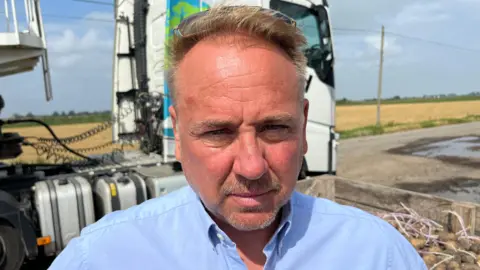
A crisp manufacturer said he could not rebuild his business after a devastating fire due to a planning "obstacle".
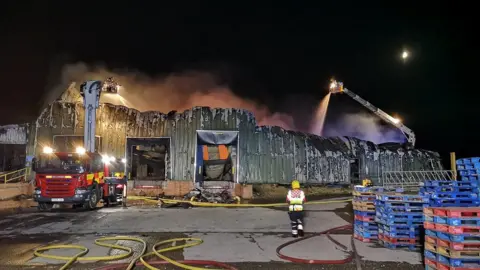
Ross Taylor runs family-firm Corkers Crisps, based at Willow Farm in Pymoor, Ely, Cambridgeshire, whose factory burned down in 2020.
Plans to rebuild have been approved nearly five years after submission, but with the condition that the factory can only use crops grown at Willow Farm, owned by Mr Taylor.
He argued this would make the business unviable, but East Cambridgeshire District Council said this was a similar condition to that in the factory's original planning permissions.
 John Devine/BBC
The gourmet crisp business was founded in 2010 to diversify the farm's income and grew to employ 100 people and turn over £10m a year.
Aiming to restart the business, Mr Taylor submitted a planning application.
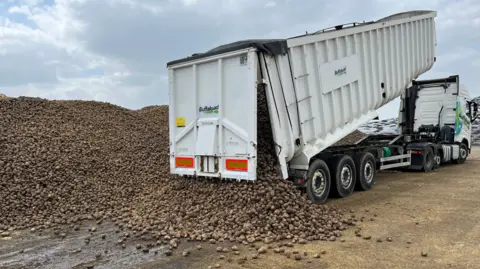
But he said the approved plan limited the firm to using potatoes grown on just 20 acres (eight hectares), yielding about 70 tonnes, enough for two days of production.
"We wouldn't be able to buy from other local farmers or import from elsewhere," he said.
Mr Taylor added that this felt like a "vendetta" and that the council was "trying to put obstacles in the way".
 Cambridgeshire Fire & Rescue Service
The council previously accused the company of breaching planning rules by using imported crops.
It also accused it of depositing waste at the site, a claim Mr Taylor disputed, saying these items were building materials that were later moved.
"I always thought we would be [back] up and running within two years," Mr Taylor said.
"We have been through seven planning officers, dozens of changes of legislation which has held things up, and we feel like we have been put to the back of the pile and no-one's really wanted us to have it back."
He added: "They do not want any rural agricultural developments; they want everything up on the industrial estate and that's as far as it goes.
"Us poor old farmers who are trying to make a living can't afford to have businesses up on industrial estates because we are committed to our farms."
Mr Taylor warned the decision could "finish" the business and hurt local farmers struggling to sell their crops.
He said this was produce that could have been used by the factory.
 John Devine/BBC
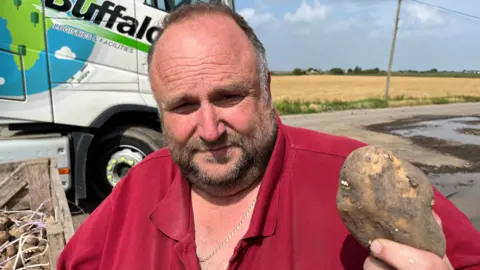
Local farmer Dale Parson said he had been forced to store his potatoes for a year in the hope of finding a buyer, paying up to £1,000 a month in electricity costs.
Eventually, he had to send them for anaerobic digestion.
"It's a job to get out the house sometimes in the morning. This is one of the loneliest jobs," he said.
"You're damned if you do and damned if you don't.
"If [crops] get diseases in a field, that you can stomach because you can put it down to something, but when you have grown product in good condition, it's heart-breaking."
The council said Corkers Crisps had stated one of its "key selling points" was "the unique flavour" from potatoes grown in soil surrounding the factory.
It added on-site growing also reduced traffic through local villages and the condition that only farm-grown produce be used was similar to a 2013 clause in its planning permission supporting farm diversification.
A spokesperson said importing goods would count as a change of use and would need a change-of-use application to assess the potential effects.
Follow Cambridgeshire news on BBC Sounds, Facebook, Instagram and X.
