'I cried when the railway shut - it was like a family'

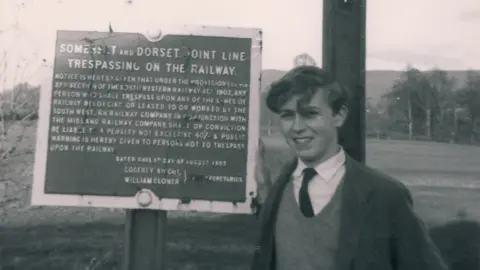 Paul Antell Collection
"The atmosphere it created was hard to explain. It was like one big family," said Paul Antell, describing the community of a railway that ran through his village.
It has been 60 years since Somerset and Dorset Joint Railway closed, along with the station at Shillingstone, Dorset, where Antell has lived his whole life.
As a boy, he would deliberately miss his bus to school so he could plead an excuse to ride the footplate to Sturminster Newton, arriving late for assembly with soot-covered hands.
But on 7 March 1966, the 136-mile line that had been woven into the fabric of life for more than a century closed permanently and the tracks were ripped up.
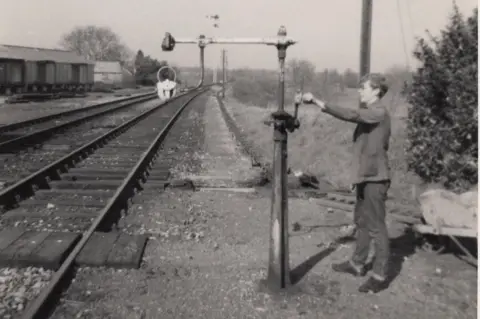 Paul Antell Collection
"I cried the day it shut," said Antell. "I think a lot of people did - it was such an emotional time."
Now the station is busy once again because, for the last two decades, an army of volunteers has been lovingly restoring and rebuilding it to create a free-to-enter museum and cafe - and, in 2025, a steam locomotive ran for the first time on half a mile of re-laid track.
Antell, now 73, will be marking the anniversary at the station, along with the many other enthusiasts who have been working to bring the line back to life.
The weekend-long event will include traction engines, vintage buses and guided tours around the station and signal box. The resident steam loco 30075 will also be on the platform so visitors can look inside.
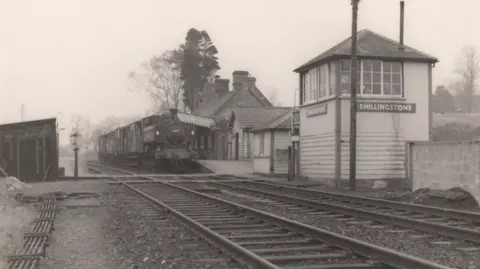 Paul Antell Collection
Dorset Central Railway opened in 1860, merging two years later with Somerset Central Railway.
In August 1863, a connecting line between Blandford and Templecombe was built, creating single route linking the south coast with the Bristol channel.
One of the new stops was Shillingstone, which later became a through route for long-distance passenger trains from Manchester to Bournemouth, carrying factory workers on their holidays.
"It had always been there. It was part of life," said Antell of the railway.
"You didn't need to wear a watch, we used the trains as a way of telling the time."
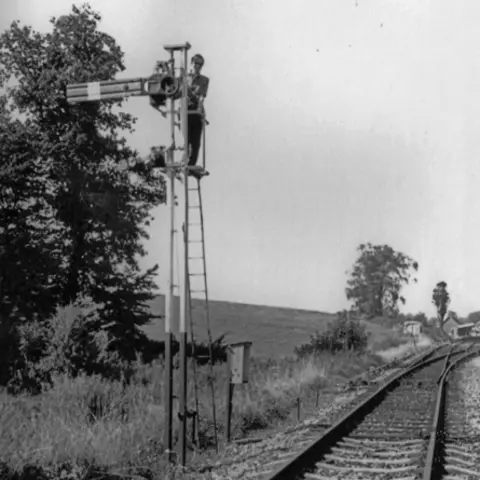 Paul Antell Collection
Antell said his first memory of the railway was catching a train to Bournemouth with his brothers and mother when he was about nine years old.
"Dad was working so he didn't come," he said. "We used to go to Alum Chine and we'd be on the beach all day and get the train home."
He also wangled a ride to school, with the driver letting him ride the footplate for the short hop between stations, although he admits his mother was not always aware.
"They would say 'give this boy a lift to school, he's missed the bus'.
"I deliberately missed the bus."
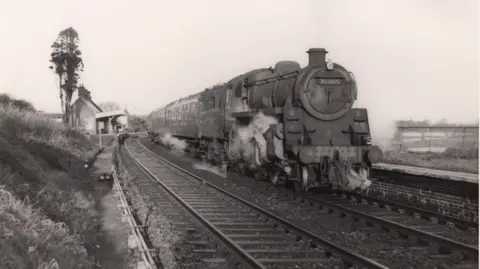 Paul Antell Collection
On winter evenings, Antell would help station porter Bob Downes as he lit the platforms because the only electric light was in the station building.
"The platform didn't have any lights so we had paraffin Tilley lamps," explained Antell.
"You had to fill them up by hand and pump them up. They had them each side of the platform so if anybody got out of the train they could see."
By the 1960s, with car use on the rise and the nationalised railways running at a loss, huge cuts were made to the network, recommended by British Railways Board chairman Richard Beeching.
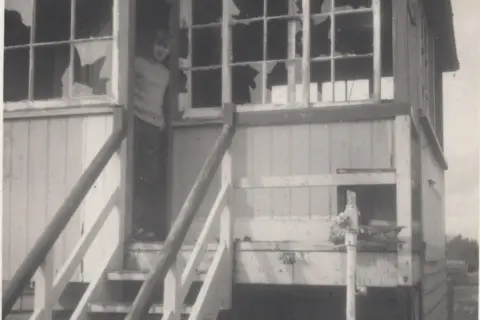 Paul Antell Collection
Parts of the line serving Wells and Bridgwater had already closed in the 1950s then, on 7 March 1966, the whole Somerset and Dorset line was permanently shut and, in the years that followed, most of the infrastructure was removed or demolished.
Despite the arrival of diesel trains elsewhere, services through Shillingstone remained steam powered until the end and Antell still has a precious reminder of those days.
He said: "In 1965 and 1966, I spent a lot of time with the signalman in the signal box. I used to take my tape recorder and tape the trains coming to and from Shillingstone.
"I've still got the tape recorder with the recording of the last train. I put new batteries in it and it's perfect. It's like it was yesterday."
