Reeves says her plan is working as growth forecast cut for this year

 Getty Images
Chancellor Rachel Reeves has said her economic plan is working in an "uncertain" world, although the growth estimate for the UK has been lowered for this year.
The government's official forecaster, the Office for Budget Responsibility (OBR), cut its expected growth rate for 2026 to 1.1% from the 1.4% it predicted in last year's Budget, but has upgraded estimates for later years.
Reeves announced the figures in her Spring Statement, adding the OBR now expected inflation to be lower this year than previously thought.
The forecasts were made before the conflict in the Middle East broke out, and the OBR said such an outbreak could have a "very significant" impact on the global and UK economies.
Reeves insisted the government had "the right economic plan" for the country, adding it was the government's duty to "secure our economy against shocks and protect families from the turbulence that we see beyond our borders".
Since Israel and the US launched strikes on Iran on Saturday morning and Tehran retaliated, oil and gas prices have risen significantly.
In its forecast, the OBR now expects inflation - the rate at which prices rise - to fall to 2.3% through the year, down from its estimate of 2.5% in November, before reaching the Bank of England's target rate of 2% by the end of 2026.
But the big rises in the price of oil and gas over the past couple of days have raised questions over whether inflation will start to increase again if energy costs remain high.
If so, it could mean fewer interest rate cuts by the Bank of England this year.
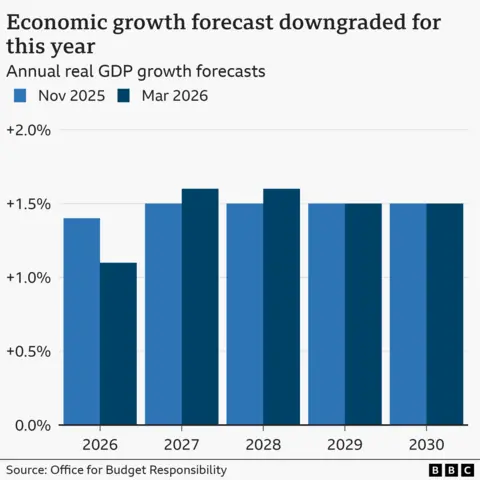
The latest OBR forecast also showed:
- growth estimates for both 2027 and 2028 have been revised up to 1.6%, from 1.5% previously
- GDP per person - an indicator of changes in living standards - is "marginally higher" than in the November forecast, and is now forecast to grow by an average of 1.1% a year between 2026 and 2030
- the unemployment rate is expected to peak at 5.3% this year, up from 4.9% predicted at the Budget
- the government's total tax take is forecast to hit a "historic high" by 2030-31, rising to almost 38% of GDP
- the "headroom", or buffer, Reeves has against her rule not to borrow to fund day-to-day spending in five years' time has increased from £21.7bn to £23.6bn.
This increase in the "headroom" could give Reeves "a bit more money to play with come the Budget in the autumn," said Paul Dales, chief UK economist at Capital Economics.
"But that could be swamped by events in the Middle East raising UK inflation and weakening UK GDP growth."
Shevaun Haviland, director general of the British Chambers of Commerce, said the Spring Statement showed the economy was "heading in the right direction, but a further acceleration is needed".
"With GDP expected to grow well below 2% a year until 2030, unemployment set to rise in the near term and net trade remaining anaemic there is more to do."
Tina McKenzie, policy chair at the Federation of Small Businesses, said the chancellor "missed the chance" to address a wave of cost increases - including business rates - facing firms next month.
She also said the government must "stand ready" to provide a package of help for small businesses if the conflict in the Middle East causes another energy price crisis.
The Labour government has made boosting growth in the economy one of its key priorities.
When an economy grows, businesses on average have more money to spend to create more jobs or give pay rises and workers have more cash to spend.
As a result, more tax is paid to the government, which can be used to increase funding to public services, such as schools, hospitals and the police.
At a news conference, David Miles, a member of the OBR's Budget Responsibility Committee, said growth at the end of last year was "disappointingly weak" and "doesn't seem to have picked up very strongly" in the first few months of 2026.
The chancellor did not set out any new policies in the Spring Statement as she only wants to make a major announcement on tax and spending measures once a year at the autumn Budget.
But Reeves said that later this month she would use a speech to set out "three major choices that will determine the course of our economy into the future".
She says this will include strengthening global relationships, breaking down trade barriers, and harnessing the power of artificial intelligence.
In her speech to the Commons, Reeves took aim at previous Conservative governments saying: "Five prime ministers, seven chancellors, 11 plans for growth."
Their legacy, she said, was to leave living standards "worse at the end than they were at the start".
But shadow chancellor Mel Stride said Reeves's plan was not working.
He said the chancellor was "fond of saying she is simply asking people to pay a little more" when it comes to tax.
This meant staff were being laid off and people were leaving the UK for other countries, he said.
Liberal Democrat deputy leader Daisy Cooper said the country was "stuck in a rut, stuck in a doom loop of low economic growth" and she called on the chancellor to "focus on getting a better trade and defence deal with Europe".
Reform UK's economic spokesman Robert Jenrick said Reeves was "like a rogue landlord who keeps squeezing the tenant with higher and higher rent", while Sian Berry from the Green Party said voters wanted bolder action against high bills and rent.
