Will food delivery robots help or hinder workers?

 BBC/Jim Scott
Self-driving food delivery robots will be able to help out during busy periods and staff shortages, according to a restaurant boss, but there are fears about the impact on jobs.
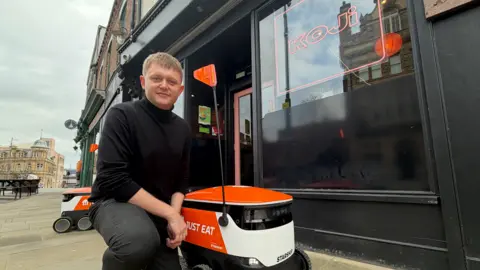
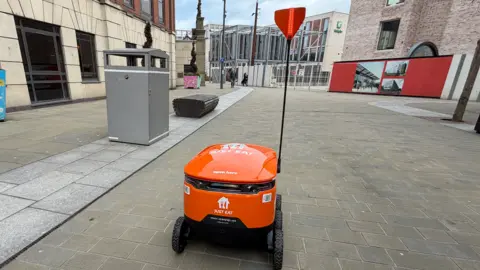
Several automated vehicles are being trialled by online delivery firm Just Eat with real customer orders from 12 restaurants in Sunderland.
However, the Independent Workers' Union of Great Britain (IWGB) said it "rings out like a warning alarm" to members and echoed a "worrying wider trend" in the automation of roles.
But Starship Technologies, which developed the vehicles, said they would not replace humans and would one day allow couriers to focus on deliveries further out of city centres.
The vehicles are fully autonomous and have been designed to navigate paths and busy roads safely, often using pedestrian crossings.
Asian restaurant Koji, on High Street West, is among those taking part in the trial and said the response had been positive and, so far, a success.
"It was really important, it's such a unique thing and not something you expect to see," said general manager Peter Richardson.
"We have been a lot more popular, we've had queues outside, people coming in just for questions, it has brought a lot more footfall."
 BBC/Jim Scott
However, some in the city raised concerns over the potential impact on jobs and risk of vandalism if the project becomes permanent.
Resident Eugene Murphy said he understood "you've got to move with technology" but questioned whether it was needed.
Rachael Atkinson, whose young son Teddy was taken aback by the robots, said they were a "bit crazy" and worried they would take "a lot of people's jobs".
Others said they were "pleased" to see Sunderland being used for the trial, with Shaun Taylor adding the city was "just changing with the times."
Richardson said it could overcome a problem many businesses, especially independents, had with staffing during busy periods.
He said: "If one day something did go wrong and drivers went, there you've got that back-up, so you can still get that food out.
"It's not taking away from the human side, because there's always the option, but if you think about Christmas, New Year, Ramadan, then you've got things where the robots can take over when people want time off."
 BBC/Jim Scott
IWGB president Alex Marshall voiced concern over the introduction of the vehicles, describing them as "dystopian", adding hard work from humans was being made "redundant, with no reward".
However, Estonian-based Starship Technologies said there were "not enough couriers in the world" and it would help those "less mobile" and "unable to leave home" access deliveries.
Ahti Heinla, its founder and chief executive, said it would not replace jobs.
He said: "I think there will be more and more both human couriers and delivery robots.
"Robots have a key role to play in the delivery of infrastructure to help meet the growing demand and certain routes will still require people to complete deliveries.
"We are adding a new delivery option and it doesn't replace people".
