'Trump's psyche': The aide driving president's most controversial policies

 Getty Images
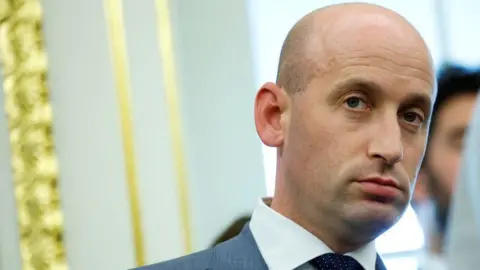
For years Stephen Miller has been a conservative firebrand in Donald Trump's political orbit. Now, he has become a lightning rod.
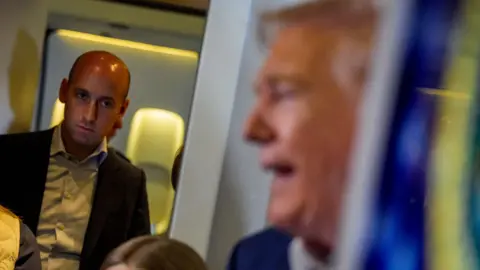
His relentless, combative style at the policymaking helm of the White House has set the president's hardline immigration agenda in motion, and he has developed a growing influence in expanding US power across the Western Hemisphere.
The high-velocity start to 2026 by the Trump administration, at home and abroad, has only cemented his position as one of its most powerful figures.
But for many on the left, he is a villain.
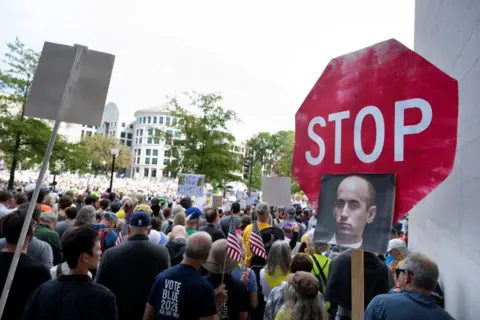
In Washington DC, posters of Miller's face have been plastered in public spaces with the caption "Fascism ain't pretty". Democrats have called for his resignation. Even some members of his own party have publicly questioned his political judgement and effectiveness.
And over the last few weeks, Miller has found himself in unfamiliar territory - a behind-the-scenes operator suddenly in the national spotlight, whose words and actions are being scrutinised. He has had to back away - at least temporarily - from the kind of fight he has frequently relished.
 Getty Images
'Always strong, never back down'
Shortly after two federal immigration officers shot and killed Alex Pretti in Minneapolis last month, Miller posted several messages on the social media site X accusing the Minneapolis nurse of being a "domestic terrorist" and an "assassin".
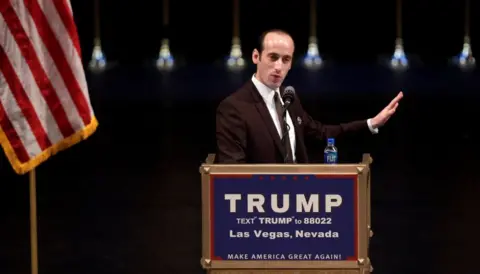
It was typical red-meat invective for a man who used to serve as a warm-up act for Trump at his 2016 campaign rallies. He accused Democrats of "fanning the flames of insurrection". His assertions were also objectively false.
Video evidence subsequently revealed that Pretti, although carrying a licensed handgun, did not threaten the Customs and Border Patrol (CBP) officials prior to being pepper-sprayed, tackled and shot 10 times.
 Getty Images
Days later, Miller provided a statement to the media contending that the administration's initial assessment of the shooting was "based on reports" from "on the ground" immigration officers - and that those agents "may not have been following" proper protocol.
It was a rare walk-back from the combative aide - but one that has not satisfied his Democratic critics, who accuse him of encouraging Immigration and Customs Enforcement (ICE) to violently respond to protests.
"It wasn't enough for Stephen Miller that these American citizens were murdered by ICE and CBP, he had to slander them with lies after their deaths," Congressman Don Beyer of Virginia wrote in a post on social media website Bluesky.
"Miller is a deranged, bloodthirsty bigot, and his policies put lives at risk every day he remains in power."
In May, it was Miller who demanded that immigration enforcement officials do more to detain and deport undocumented migrants in American cities. He told Fox News the administration had set a target of 3,000 arrests a day - a figure that dwarfed previous numbers.
According to the Washington Examiner, Miller at one meeting "eviscerated" federal immigration officials for not doing enough to detain undocumented migrants across the US. Since then, the administration has ramped up enforcement in a growing list of major American cities, including Washington DC, Charlotte, Chicago and, most recently, Minneapolis.
"Everything I've done, I've done at the direction of the president and Stephen," Homeland Security Secretary Kristi Noem told Axios recently, in part as a defence of criticism that she was the driving force behind the administration's forceful immigration enforcement actions.
Support for ICE tactics falls
Miller has denied being animated by racism or bigotry. He defends Trump's immigration policy as a reflection of what voters elected Trump to accomplish.
Yet, in what is being seen as a break with Miller's aggressive approach, Trump said this week his crackdown needed a "softer touch" following the deaths of Pretti and Renee Good, another US citizen killed by immigration officers in Minneapolis.
Approval of his immigration policy overall has fallen to 39%, its lowest level since he returned to the White House, according to a poll by Reuters-Ipsos. And a clear majority, 58%, say the enforcement tactics by ICE agents have gone "too far".
This trend puts Miller squarely in the crosshairs of criticism as Republicans prepare for November's midterm congressional elections.
Miller is the architect of this mass deportation policy, said Bryan Lanza, a conservative strategist who worked on Trump's 2016 and 2024 presidential campaigns. "We'll know in November whether he's to blame for it. The voters, at the end of the day, can be very unforgiving."
 Getty Images
Miller, however, has proven over the years to be a survivor. An outspoken conservative from his high school days in liberal California, he rose from Senate staffer to campaign aide to the White House, where he navigated the various personal intrigues and backbiting of the first Trump administration.
In 2019, he told the Washington Post he felt a "jolt of electricity to my soul" when Trump announced his presidential bid.
Miller stuck by the president in his darkest days, following the 2020 election defeat, the attack by his supporters on the US Capitol and his political exile from Washington. And he followed Trump back into power last year.
"Stephen Miller is critical to Trump's psyche," said Lanza. "Always go strong; never back down. He can always count on Stephen to support that position on any issue."
Speaking for the president
Miller's official title in the White House is deputy chief of staff for policy and homeland security adviser.
"Stephen Miller has faithfully served President Trump for years because he's intelligent, hardworking, and loyal," White House Press Secretary Karoline Leavitt told the BBC.
"Stephen brings together all corners of the government to ensure every single policy, both foreign and domestic, is implemented at record speed. The results over the course of the past year speak for themselves."
At one point last year, Miller was floated as a potential White House national security adviser, replacing the ousted Michael Waltz - rumours that the president summarily dismissed.
"Stephen is much higher on the totem pole than that," Trump said.
Last March, as the United States was preparing to launch airstrikes on Houthi rebels in Yemen, a series of Signal text messages inadvertently shared with The Atlantic editor Jeffrey Goldberg revealed Miller at the centre of White House planning, speaking for the president's desire to go ahead with the attack.
"As I heard it, the president was clear: green light," he wrote to the group of senior aides, including Vice-President JD Vance, Defence Secretary Pete Hegseth and Secretary of State Marco Rubio.
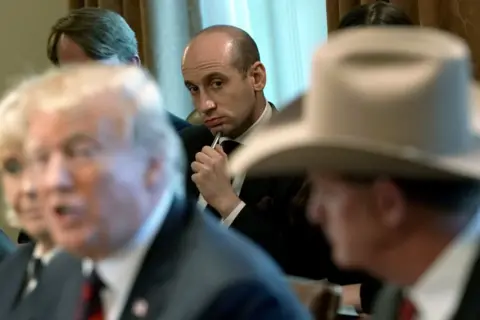 Getty Images
Last autumn, Miller was reportedly put in charge of overseeing military operations in the Caribbean to locate and destroy boats suspected of engaging in narcotics trafficking - which expanded into the successful effort to remove Venezuelan President Nicolás Maduro from power in early January.
When Trump at his Mar-a-Lago resort announced the successful operation that captured Maduro, Miller was among the few top officials standing behind the president.
Miller's role in foreign policy, notes Lanza, is unusual – but in keeping with an unorthodox White House.
"Stephen's smart enough to know that Donald Trump is not a traditional president, and he will gravitate to who's around him for advice and for input," Lanza said.
"Stephen's done a good job of being around him and providing that input. Stephen would not have had the same success under a more traditional president."
Early political foray in California
Miller developed his taste for controversy and provocation at a relatively early age.
He went to high school in Santa Monica, a coastal enclave in greater Los Angeles, where he advocated English-only education and other conservative issues. He started in 1999, a year after a federal court struck down California's ban on social services for undocumented migrants. It was also a time when immigration encounters on the US-Mexico border spiked to levels not matched until the post-Covid surge during Joe Biden's presidency.
In one videotaped speech during a high school student government campaign, he complains of being told to pick up his trash, saying that should be the work of paid janitors.
"I'm the only candidate up here who stands out," he said, showcasing an early ability to grab attention. "I would say and I would do things that no one else in their right mind would say or do."
Miller studied political science at Duke University, where he wrote a right-wing column in the student newspaper and became executive director of the Duke Conservative Union. He gained some national attention in defending three white members of the Duke lacrosse team who had been accused of rape - wrongly, it was later revealed - by a black woman.
It was Miller's proudest moment in university, he would later tell The Atlantic magazine, and it would help launch Miller's career in politics. Shortly after graduation, he took a job as press secretary for Michele Bachmann, an outspoken conservative congresswoman from rural Minnesota.
The 'iron laws' of strength and force
Over the course of Trump's first year back at the White House, Miller has been in the middle of some of the administration's greatest political undertakings. And with that influence comes a higher profile – and greater risk.
In the aftermath of the Venezuela raid, Miller appeared on CNN to defend what has become an expansive Trump administration worldview that positions America as the dominant power over the entirety of the Western hemisphere - even when it means clashing with traditional allies.
It was Miller's wife, influential podcaster and former Trump staffer Katie Miller, whose X post of an America-flag-draped Greenland put the president's desire to acquire the Danish territory back in the news just hours after the Venezuela attack.
And it was Stephen Miller who stood in front of the camera, offering a cold-eyed view of American power and how it related to the president's desire for the Danish territory.
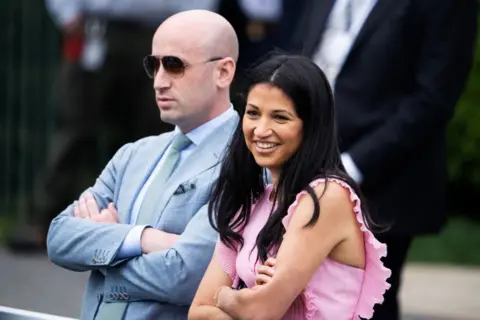 Getty Images
"By what right does Denmark assert control over Greenland?" Miller asked. "Nobody is going to fight the United States militarily over the future of Greenland."
He went on to assert that there are "iron laws of the world".
"We live in a world, in the real world... that is governed by strength, that is governed by force, that is governed by power," he said.
It was heady stuff coming on the heels of America's surgically precise use of military force in Venezuela. And, for a president who a few days later would tell the New York Times that the only limit on his global powers are "my own morality" and "my own mind", it may have been warmly received.
But it rankled some in Trump's own party.
"Either Stephen Miller needs to get into a lane where he knows what he's talking about or get out of this job," Republican Senator Thom Tillis of North Carolina, a frequent Trump critic of late, told CNN.
A battle for civilisation
Miller's comments may have prompted some pushback from veteran Republican foreign policy hands like Tillis, but his international outlook is in step with Trump's "America First" movement.
"What defines an America First policy is something that is in the direct interest of the American citizenry," said Joshua Trevino, a senior fellow for the Western Hemisphere Initiative at the America First Policy Institute.
"We face a world situation that has changed and the institutions and practices and the reflexes that were honed and very successful in the past no longer are," he said. "And the Trump administration is trying to correct for that."
For Miller, and for Trump, that has meant using raw US military, political and economic power to advance domestic priorities on topics including immigration, crime, narcotics trafficking and trade.
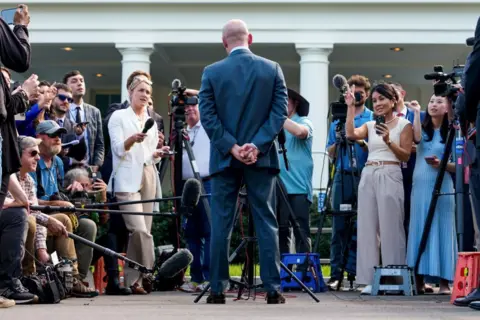 Getty Images
They cite Latin America as a source of much of the fentanyl and other dangerous drugs that have led to deaths in the US, and allege that "narco-terorrists" have contributed to violent crime in US cities. They also accuse Canada of taking advantage of trade imbalances with the US in order to bolster its own economy.
Their global outlook also involves positioning America on the world stage as a defender of certain cultural and political values - protectors of "Western Civilization", as Miller has described it.
"Our lineage and our legacy hails back to Athens, to Rome, to Philadelphia, to Monticello," Miller said at a memorial service for the slain right-wing activist Charlie Kirk last September.
"Our ancestors built the cities. They produced the art and architecture. They built the industry. We stand for what is good, what is virtuous and what is noble."
That's a sentiment Trump himself has expressed during his time in the White House, having "the courage to preserve our civilisation in the face of those who would subvert and destroy it," the president said in a 2017 speech in Poland.
By framing the stakes in terms of an existential crisis, Trump and Miller are able to advocate for solutions that otherwise would appear extreme or unneeded.
When the clock strikes 12
Experts in drug trafficking may point out that attacking Venezuelan boats does little to stem the flow of fentanyl, which largely comes across the US border from Mexico. They might rebut allegations that Latin American migrants are more prone to criminality or mental illness.
They could cite figures that show US-Canada trade is mutually beneficial. But if cultural preservation is the objective, then any steps to insulate America from foreign influence in immigration or trade could be justified in their view.
It also, however, has opened Miller - and Trump - up to accusations of racism and ethno-nationalism.
"Stephen Miller is a central figure in shaping the Trump administration's agenda," the liberal group Common Cause wrote in a 2025 blog post. "From enabling state violence against immigrant families to promoting white nationalist rhetoric in government, his career is a warning of what happens when bigotry gains institutional power."
For all the controversy Miller has generated, however, his bond with Trump is why his position in the president's inner circle still appears secure.
"To my colleagues who believe you can convince Donald Trump that Stephen Miller is a liability for him, good luck with that," said South Carolina Senator Lindsey Graham last week.
"When the clock strikes 12 on the Trump era, there will be a few people walking out the door with Donald Trump. Stephen Miller will be in that group.
