'Guidance not followed' in rock fall death at beach

 Facebook
Rescue efforts to try to save a mother who was stuck headfirst in sea defence rocks as the tide was coming in did not follow guidance, an inquest has heard.
Saffron Cole-Nottage, 32, of Lowestoft, Suffolk, was with her daughter walking their dog near The Esplanade in the town when she fell from the promenade on 2 February 2025.
Prof Richard Lyon, a consultant in emergency medicine, told the inquest that a "30-minute clock" for rescue efforts should start once a responder arrived on scene and confirmed a person was submerged.
"I do not think the guidance was followed in this case," he said.
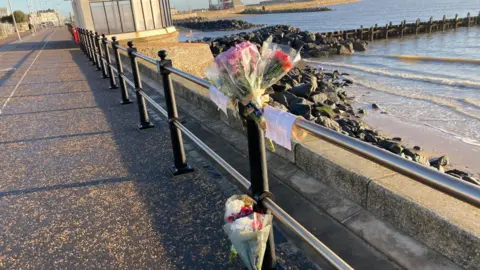 Luke Deal/BBC
The inquest in Ipswich heard that an initial 999 call was made at 19:52 BST and a paramedic arrived on scene at 20:10.
At 20:13, the ambulance service told police Cole-Nottage was believed to have died. Her medical cause of death was later given as drowning.
Lyon said: "The guidance is quite clear that the clock starts when the responder arrives on scene… and submersion is confirmed."
He questioned how responders could have confirmed that Cole-Nottage was submerged at 20:13 as the decision seemed to have been made from above the railings on the seafront.
He also cautioned that timings given by any eyewitness could be inaccurate.
"This is a stressful situation for a bystander," he said.
"The guidance is very clear that the time should be from the arrival of the first rescuer – there's no ambiguity about that time.
"The whole purpose of the guideline is to maximise the chance of a life-saving rescue."
Lyon estimated Cole-Nottage's window for "probable survival" was five minutes after submersion began.
He said that because she was upside down it would have made breathing "harder".
He also acknowledged that the complexity of the rescue operation made the assessment challenging, given the personal dangers posed to emergency workers, the lack of daylight and the fact Cole-Nottage's head was obscured by rocks.
The inquest was earlier told that a level of 271mg of alcohol per 100ml of blood was recorded for Cole-Nottage, which would be more than three times the legal limit had she been driving.
Lyon, from NHS Scotland and the University of Surrey, said the effect of the alcohol was "most relevant in terms of it would make her more likely to stumble, more likely to trip".
He said Cole-Nottage's "protective reflex would have been diminished" and she may not have put an arm out as she fell.
"When she was between the rocks her ability to move … and try to push herself out would have been impaired as well.
"For Saffron to have had a probable survival, she would have needed to be rescued within five minutes of submersion and, if required, for CPR to start within that time."
He said that "survival was possible up until about the 15-minute mark", but she may have sustained a brain injury.
"In my opinion, beyond 25 minutes, survival would not have been possible," he said.
"I should stress, all of these numbers are a best possible expert opinion."
The inquest continues.
Do you have a story suggestion for Suffolk? Contact us below.
Follow Suffolk news on BBC Sounds, Facebook, Instagram and X.
