Memorial to child abuse victims makes survivors feel 'believed'

 BBC
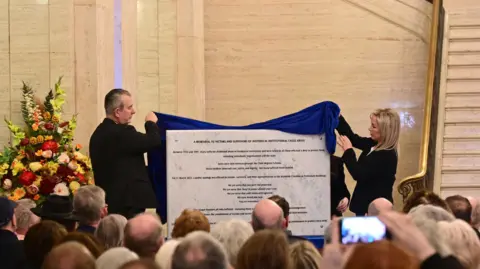
BBCA memorial to victims and survivors of historical and institutional child abuse in Northern Ireland has been unveiled at a ceremony in Stormont.
It acknowledges the suffering caused to thousands of people who were abused in children's homes and other residential institutions.
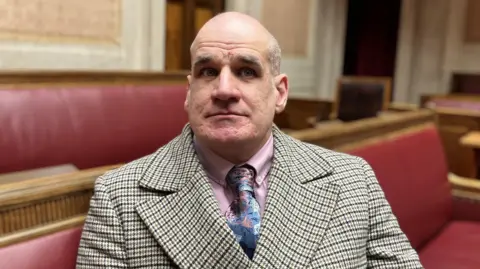
Dozens of survivors attended the event, including Leo Quinn, who said "it was like they were saying, 'you're believed, this is true, this actually happened to you.'"
Victims and survivors groups have been critical of the time it has taken to get to this point, nine years after it was recommended by Sir Anthony Hart, chair of the Historical Institutional Abuse (HIA) Inquiry.
 Pacemaker
His 2017 report also recommended a public apology and compensation scheme, both of which have already been implemented, but some institutions criticised by the public inquiry have not yet made redress payments.
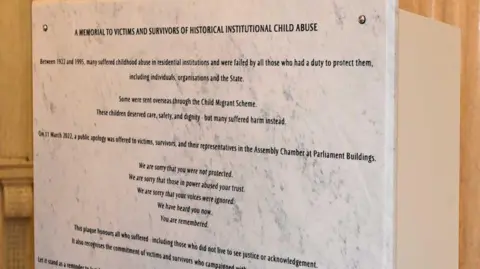
The Stormont memorial takes the form of a plaque in the entrance hall at Parliament Buildings.
'I was just trying to survive'
Mr Quinn, 55, is from the Newtownabbey area, and spent many years in children's homes and other institutions in the 1980s.
He was separated from his siblings, and endured emotional, physical and sexual abuse.
He said he felt emotional watching the plaque being unveiled on Friday, and was thinking of his family.
"It was like they were saying, 'you're believed, this is true this actually happened to you.'
"There's things that I would waken up and think did I dream that? I would waken up and fight people to get them off me."
Mr Quinn said when he was 11-years-old, a judge promised him and his siblings that they would be kept together in care, they would get an education and they would be looked after.
He said they failed on all three counts.
"There was no love, there was no care. I was just trying to survive.
"I haven't seen my younger brother in years, I really miss him and I want to develop a relationship with him. I lost my older brother, I lost a lot through this. We should have been kept together.
"The greatest abuse was separating me and my siblings from each other," he continued.
'A black mark against the state'
 Pacemaker
Northern Ireland First Minister Michelle O'Neill said the memorial would stand "as a permanent acknowledgement and reminder that children were failed by the state and by others who had a duty to protect them".
Deputy First Minister Emma Little-Pengelly said: "We are all so deeply sorry that you were failed by so many people for so long."
The speaker of the devolved assembly, Edwin Poots, said the abuse would "forever be a black mark against the state of Northern Ireland".
'We were failed'
 Liam McBurney/PA Wire
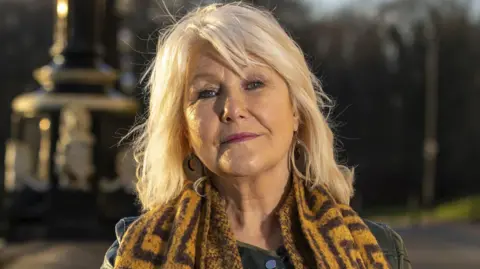
Earlier, Margaret McGuckin from the group Survivors and Victims of Institutional Abuse (SAVIA) said the unveiling of the memorial would be a significant moment.
"Where the plaque will be placed, it is in the seat of government," she said.
"When these politicians see it daily, and all these visiting dignitaries from around the world enter into that building, they will see what happened.
"We were failed, children were failed by the state and church."
The Commissioner for the Survivors of Childhood Institutional Abuse, Fiona Ryan, said the memorial was the result of the "courage and conviction" of campaigners.
What was the HIA Inquiry?
The HIA Inquiry examined allegations of abuse in 22 homes and other institutions between 1922 to 1995 and found there was widespread abuse of young residents.
Its final report identified six religious and charitable organisations which, it said, were required to contribute towards the cost of the redress scheme and support services.
So far, payments have been received from the De La Salle Order, the Good Shepherd Sisters and Barnardo's.
The Catholic Diocese of Down and Connor has also made a payment regarding the institutions which it ran with the De La Salle Order.
Stormont officials said they have had "constructive discussions" with the three remaining organisations.
They are the Irish Church Missions, the Sisters of Nazareth, and the Sisters of Saint Louis.
Almost 5,500 applications for compensation
The redress board considered the final application for compensation this week.
The total amount of payments is about £116m and there were almost 5,500 applications.
Payments have been made in relation to around 4,200 of the cases.
It is understood that the completion of this stage will allow negotiations with the organisations to be finalised.
The amount which each institution has contributed will be published when the process is finished.
What does the memorial plaque say?
The text on the plaque includes: "Between 1922 and 1995, many suffered childhood abuse in residential institutions and were failed by all those who had a duty to protect them, including individuals, organisations and the State.
"Some were sent overseas through the Child Migrant Scheme. These children deserved care, safety, and dignity — but many suffered harm instead."
Concerns had been raised by campaigners when the words "the State" were removed, but it emerged last week that they have been reinstated.
Nine-year delay has 'taken its toll on all of us'
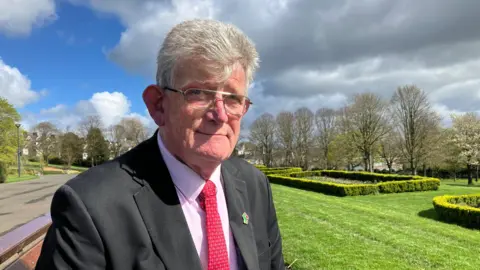
Jon McCourt, from the group Survivors North West, said it had been "a very long road" to get to this point.
"This should not have taken this length of time and it's taken its toll on all of us.
"I have lost my sister and my younger brother since then," he said.
"If it hadn't been for the Assembly collapses we had, and the disagreements, this would have been done within a year."
A spokesperson for The Executive Office (TEO) said the plaque will stand as "a permanent acknowledgement" of the children who suffered abuse in residential institutions.
