Irish language signs backed overwhelmingly by QUB students

 Getty Images
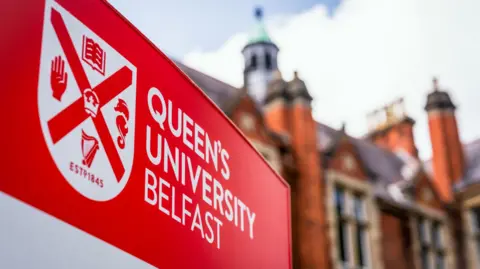
Students have voted overwhelmingly to reinstate signage in Irish and English at Queen's University Belfast Students' Union (QUBSU).
They have also voted in favour of Irish and English being given equal status by the university.
But the vote does not, in itself, compel the university to act.
Queen's University Belfast (QUB) said it will work with Northern Ireland's Irish language and Ulster-Scots commissioners to inform its next steps.
Bilingual signage was previously in place at QUBSU until 1997, when Irish signs were removed after opposition from some unionist students and a recommendation by the Fair Employment Commission for a more neutral working environment.
It also asked students whether the university's name and official logo should be in English and Irish, and whether they back QUB adopting "an Irish language policy that gives the Irish language equal status to the English language as an official language of the university".
Further, it asks students whether they support a "bilingual corporate identity" and logo for the university and students' union, and bilingual signs throughout the campus.
The students' union also said that "a monolingual, English-only campus does not allow for the promotion of good relations and neglects the promotion of the Irish language as a living language used daily by members of the university community".
How did students vote?
The referendum ran for over a week from Tuesday 10 March until Thursday 19 March, and only QUB students were eligible to vote.
In the results published by QUBSU, 4,607 students voted in favour of the changes to the union and university's signage and Irish language policy, while 407 voted against.
There were 5,088 students who voted, with 91% in favour of the changes.
QUB has approximately 25,000 students.
The university's Irish language society, An Cumann Gaelach, had campaigned for bilingual signage at QUB.
But some unionist students had raised concerns about bilingual signage.
New language laws have recently come into effect in Northern Ireland.
Commissioners for the Irish language and Ulster-Scots/Ulster-British tradition have also taken office.
 Eoghan Ó Conghaile
Eoghan Ó Conghaile from An Cumann Gaelach, a student group dedicated to promoting the Irish language, called for the "immediate" reinstatement of dual language signage.
"This result reinforces what we, as a Cumann, already knew; that there is significant interest, demand and support for the Irish language right across Queen's campus and beyond," he said.
Ó Conghaile added Cumann was extremely grateful for all those who took the "opportunity to make their voices heard".
He urged QUB Vice-Chancellor, Professor Ian Greer, to provide a public timeframe and commitment for the development and implementation of a comprehensive Irish language policy.
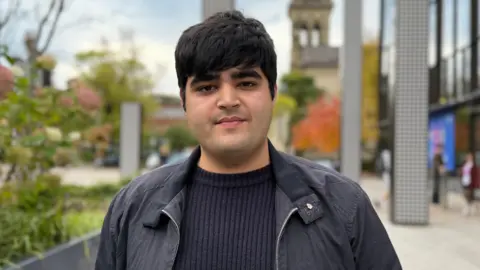
Jay Basra, chairman of QUB Young Unionists, said throughout the campaign leading up to the referendum, he and his group clearly outlined their concerns around dual language signage at the university.
"And we firmly stand by them," he said.
Basra has previously said he thinks the university has become a "cold house" for unionists.
He said while QUB Young Unionists respect the outcome of the democratic vote, he pointed out only about a fifth of the student body took part.
"This policy, in practice, changes little from what already exists within the policy file and cannot be binding on the university," he said.
A QUB spokesperson said the outcome of the referendum reflected strong student engagement.
"Student perspectives are a valued part of the University community and contribute to ongoing discussions around inclusion, identity and cultural expression,"they said.
"The University already has strong Irish language provision and will continue to support and promote it as part of campus life."
The spokesperson added that the university has proactively engaged with both the Irish Language Commissioner and the Commissioner for Ulster Scots and the Ulster British Tradition.
"We look forward to working with both commissioners on their proposals to the Northern Ireland Executive, which will help guide the university as it progresses work relating to language, culture and identity and inform our next steps."
