Satellite images show Iranian navy and nuclear sites hit by US-Israeli strikes

 BBC
BBCA wave of US and Israeli strikes has destroyed or damaged at least 11 Iranian naval vessels since Saturday, new satellite images reviewed by BBC Verify show, with missile bases and nuclear sites also hit by attacks.
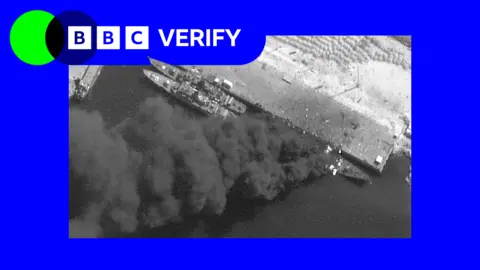
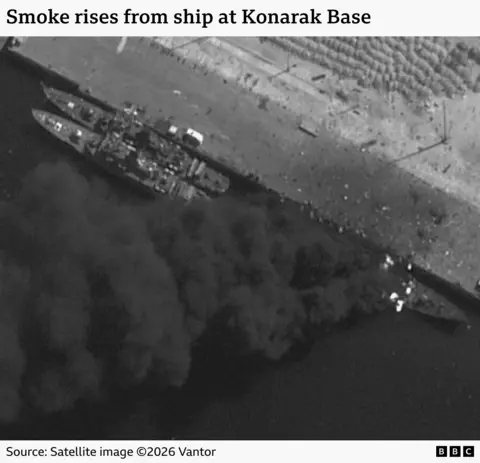
Images of the southern Konarak naval base and the Bandar Abbas facility, which sits on the Strait of Hormuz and houses the headquarters of the Iranian navy, show smoke billowing from multiple ships on Monday and Tuesday.
US President Donald Trump said on Monday that the US was "annihilating" the Iranian navy, listing the force's destruction as one of America's three main goals. His Defence Secretary Pete Hegseth confirmed that a US submarine had fired on an Iranian warship in the Indian Ocean on Wednesday.
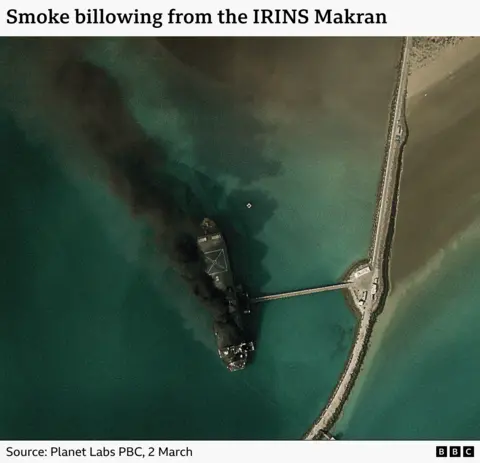
Among the vessels destroyed was the IRINS Makran, Iran's largest naval vessel, which had served as a drone carrier. Satellite images showed black smoke pouring from the ship which had been docked at Bandar Abbas base.
Maritime security firm Vanguard said that the IRIS Bayandor, IRIS Naghdi, and the IRIS Jamaran were also among the ships destroyed in the strikes. The firm also claimed that the IRIS Shahid Bagheri, a state-of-the-art drone carrier ship launched by Iran last year, had been sunk - although BBC Verify cannot independently confirm this.
Analysts at the intelligence firm MAIAR said at least five ships at Bandar Abbas were "hit or sunk". Satellite images of the southern end of the port show smoke rising from Makran, while two other vessels appear to be damaged, one visibly ablaze.
At Konarak, images show multiple damaged vessels, with MAIAR telling BBC Verify that they had identified damage to six vessels.
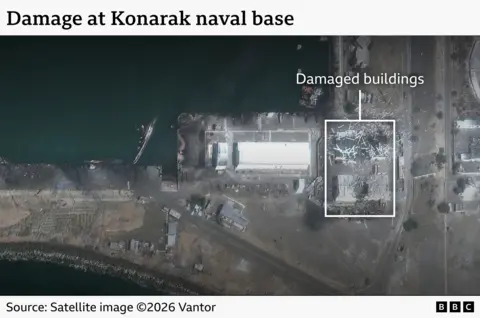
The photos taken on Monday show that multiple buildings at the base have also been demolished.
The head of US Central Command (Centcom), which oversees American military operations in the Middle East, claimed that 17 Iranian vessels, including its "most operational" submarine, have been destroyed.
"For decades the Iranian regime has harassed international shipping," Adm Brad Cooper said in a video posted to X. "Today, there is not a single Iranian vessel underway in the Arabian Gulf, Strait of Hormuz or Gulf of Oman, and we will not stop."
Some vessels reportedly destroyed may have been obscured in satellite images by cloud or smoke, or struck at sea, and have not been independently verified by BBC Verify.
Sri Lankan officials said on Wednesday that one Iranian ship was sinking near its waters and that it launched a rescue operation, with 140 people currently missing. US Defence Secretary Pete Hegseth later said that a US submarine struck an Iranian ship with a torpedo in the Indian Ocean.
Vice-Admiral Mark Mellett, ex-head of the Irish military, told BBC Verify that the US and Israeli attacks appeared to have "largely neutralised for now or at least suppressed" the Iranian navy's ability to sustain conventional attacks using its biggest warships.
But he emphasised that Iran retains the ability to launch unconventional attacks at sea through the use of drones, mini-submarines and shadow fleet vessels - a network of tankers sailing under obscured ownership. MAIAR analysts also told BBC Verify that Tehran could turn to smaller, fast-attack vessels armed with anti-ship missiles in the coming days as Iran's largest warships continue to be targeted by US and Israeli strikes.
Iran also has the ability to disrupt commercial shipping, with Mellett observing that it could plant mines in key shipping lanes in the Strait of Hormuz or launch drone attacks on tankers and key ports.
Images show damage to missile sites
President Trump listed the destruction of Iranian missile bases and the prevention of nuclear weapons development as the other objectives of the American air campaign.
In his statement on Tuesday night, Adm Cooper said that hundreds of air defence sites, ballistic missiles and drones had been destroyed by US strikes. Satellite images also showed damage at the southern Khorgu and north-western Tabriz missile bases, and at the Konarak air base, missile storage facilities and bunkers were hit.
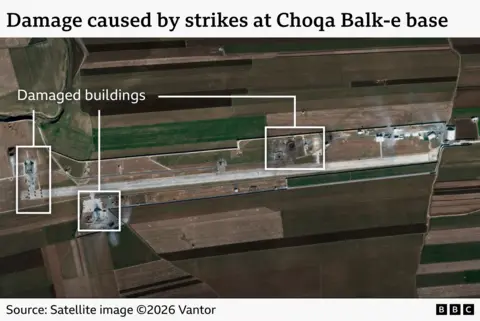
At the Choqa Balk-e drone base west of Kermanshah, extensive damage was seen to storage buildings, bunkers and drone launch equipment.
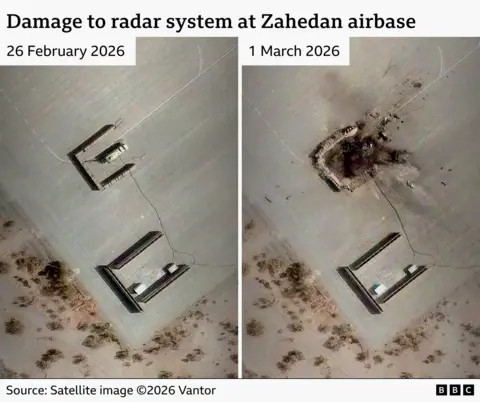
Destruction was also seen to a radar installation at the Zahedan airbase in eastern Iran, near the border with Afghanistan and Pakistan.
Satellite images show that the latest wave of strikes have targeted facilities at Natanz - long said to be at the heart of Iran's nuclear programme and which were both targeted by the US last year.
Following those attacks last summer Iran denied Trump's claims that the US had "obliterated" the nuclear sites.
The International Atomic Energy Agency (IAEA) said the buildings were used for pedestrian and vehicular access to the site's underground enrichment facility and that "no radiological consequence" was expected as a result of the damage.
The total scale of the damage caused to Iranian military facilities remains unclear, with strikes continuing on Tuesday night and Israeli attacks targeting what it called "security headquarters" in the capital Tehran.
The Institute for the Study of War (ISW) said that the "decrease in Iranian missile attacks against Israel and the UAE strongly suggests that the effort to destroy ballistic missile launchers has had considerable success".
Imagery shows extensive damage to the headquarters of the Islamic Revolutionary Guard Corps (IRGC). Pictures captured by intelligence firm Vantor on 3 March shows damage to at least six structures. There are also signs of damage at the National Defence University and Intelligence Ministry.
Gen Jospeh Vettel, ex-head of Centcom, told the BBC that many strikes had targeted Iran's "internal security apparatus" and sought to degrade "the ability of the regime to control the population".
A large number of civilian buildings also appear to have been hit in the capital and across Iran since the conflict began on 28 February. At least 160 people, including children, were reported killed after a school in Minab in southern Iran was hit, according to Iranian officials.
The US-based Human Rights Activists News Agency (HRANA) says 1,097 civilians have been reported killed since Saturday.
BBC Verify will continue to monitor satellite images as the situation develops.
Additional reporting by Thomas Spencer.

