'Queer experiences deserve to be in any museum'

 Josh Heeley/Royal Armouries
A series of events at a national museum are uncovering the little-known stories of "queer" figures from history, as part of LGBT+ History Month.
Queerying the Museum is a series of demonstrations, workshops and talks at Leeds's Royal Armouries taking place across Saturday and Sunday.
Organised by creative lead and historian Kit Heyam, the stories told include a bisexual opera singer who duelled with male love rivals, lesbian campaigners at RAF Greenham Common and Henry VIII's skirt.
Heyam has been working with the Royal Armouries on uncovering its LGBT+ history since 2022.
"It started with discovering they had an amazing and really unsung piece of trans history in their collection, which is a sword that was commissioned by the 18th-Century spy and diplomat, the Chevalier d'Eon, who was assigned male at birth but lived most of her adult life as a woman.
"Not only was it commissioned by her, but it has her female self-identification inscribed on the blade. So, it's one of the only museum objects that has that kind of trans self-identification in physical form," they say.
'Pinnacle of masculinity'
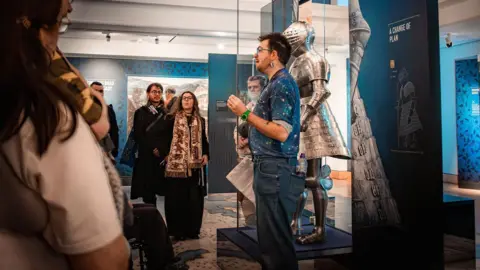
During Heyam's tour of the museum, they talked about a 16th-Century gun with two men's portraits on it, Chevalier d'Eon - a French trans spy - and an armour skirt worn by Henry VIII.
"Skirts could be incredibly masculine. He used that for a jousting tournament, which was like the pinnacle of masculinity in the 16th Century," they said.
"Wearing a skirt was very practical at a tournament because it stops people getting too close to you with a lance."
Heyam's work with the collection started with the discovery of sword used by La Chevalier which is in the weapon gallery.
"She really managed to create a niche for herself by convincing everyone she had actually been assigned female at birth and had been disguised as a man the whole time and that she was going back to her true sex.
"She wanted to leave the French Secret Service, and she got the King to agree to pay her a pension and to get her to live as a woman full time and he provided an outfit for her created by Marie Antoinette's designer," they explain.
Heyam said it was important to highlight queer stories in the museum's collections as it combated the narrative that gay and trans people were not present in the past.
"Queer experience has been part of the spectrum of human experience for as long as there have been human beings and so it deserves to be in any museum," they said.
"Also, in our contemporary world, a lot of anti-queer narratives are based on the idea this is something new. So doing historical work is a really important way to combat those narratives."
 Josh Heeley/Royal Armouries
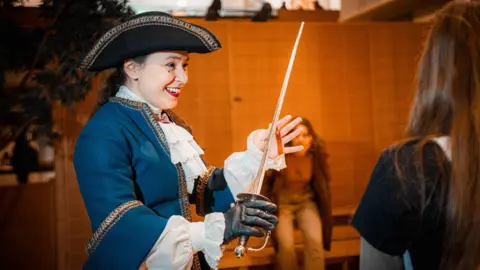
Live interpretation officer India Mckenzie performed a duel as 17th-Century French opera singer and fencer, Julie d'Aubigny or La Maupin.
"Julie is fantastic. I'm surprised there isn't more feature films about her because she famously dated men and women. Around this time, it's not something that was 'okay', but you're not going to be prosecuted for it. It was happening in the French court, a lot," says Mckenzie.
"She was taught how to use a sword, taught how to ride a horse, liked dressing in men's clothing, had a fantastic singing voice, became a famous opera singer.
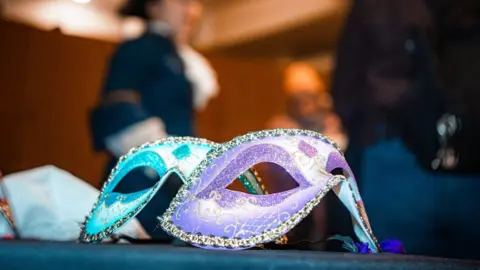
"In this particular show, we talk about a moment where she was invited to a masked ball with the opera company.
"She flirted with a woman openly, which then got the backs up of some male suitors who weren't happy about that. So, she was like, 'right, come on then, let's go outside and we'll settle this like gentlemen.' And she duelled them."
La Maupin lived with her female lover "remarked to be one of the most beautiful women in Paris", before she died aged 33, says Mckenzie.
"It's been really lovely to have people engaging with this story. They laughed in all the right places. I got a few little whoops, especially when I talk about how Julie openly wooed men and women."
 Josh Heeley/Royal Armouries
Telling stories from more recent history, "immersive" historian Jude Kershaw explores the lesbian and feminist stories behind RAF Greenham Common, a 19-year, women-only anti-nuclear protest in Berkshire that started in 1981.
"You inhabit a person from history, and you enact with everyone else like it's a normal day," she explains.
"The premise for our little bit today is I'm about to go and everyone's got to help me get ready. So, I've been up to Menwith Hill and I've cut my teeth but now it's time for the big guns. I'm going down to Greenham and I need to get ready.
"So, I've got some nice big bits of cardboard here, sporting slogans like 'coal not dole' and 'women are revolting', so I need some help making placards and sending me on my way."
Her character was inspired by former Lord Mayor of Leeds Al Garthwaite, who was involved with the first Reclaim the Night campaigns – a feminist march that started in Leeds in 1977 in response to the Yorkshire Ripper murders.
"I like to work outside of heritage institutions - so we do street performance, we do immersive theatre events and being in a museum is quite a change for me," she says.
"It's really important I feel to work within those spaces and boundaries between where history is and how it can be taught, so bringing some peace to life in a museum full of weapons is quite the challenge."
Listen to highlights from West Yorkshire on BBC Sounds, catch up with the latest episode of Look North.
