Monkey can hold its baby thanks to pioneering op

 Chester Zoo/PA Media
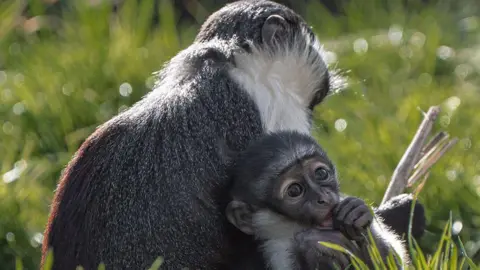
An endangered monkey is able to hold its offspring thanks to a pioneering op.
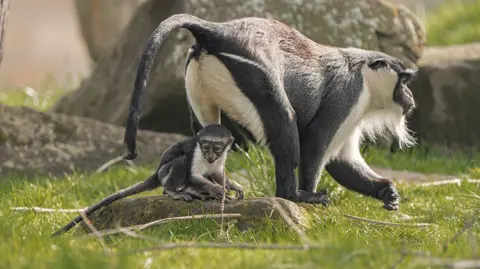
Fifteen-year-old roloway monkey Masaya at Chester Zoo welcomed infant Lagertha months after a complex operation to remove a golf ball-sized mass from her foot.
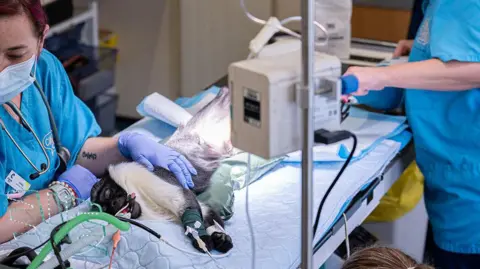
Despite finding no previous examples of the surgery on roloway monkeys, the zoo's vets teamed up with surgeons from the University of Liverpool and adapted surgical techniques for the procedure last summer, and saved all but one of Masaya's toes.
Zoe Edwards, primate keeper at the zoo, said Masaya was doing "magnificently" and it was a "huge relief" to save her foot because she may not have been able to hold her offspring otherwise.
 Chester Zoo/PA Media
Edwards said: "Masaya is a very experienced mum and she's parenting magnificently.
"Lagertha is only a few weeks old and is very dinky but already curious about the roloway monkey habitat and inquisitive about us.
"The fact Masaya's foot has healed so well is a huge relief. If she'd had an amputation, we'd have been left with real questions about whether she could hold her offspring or continue with her normal behaviours."
Lagertha, named after a Viking queen, is just over four weeks old and about the size of a tennis ball.
The zoo is one of two places in the UK where roloway monkeys can be found and there are only a few breeding females in Europe, Edwards said.
Fewer than 2,000 of the monkeys live in the wild in Ghana and the Ivory Coast, where they face habitat loss and poaching, according to the International Union for Conservation of Nature.
Masaya, now a mother-of-three, had been suffering recurring problems with her foot since she arrived in Chester in 2023 and vets believe the abscess may have been caused by an old thorn injury.
When swelling worsened last year she was taken to the University of Liverpool Small Animal Teaching Hospital for a CT scan.
 Chester Zoo/PA Media
Charlotte Bentley, veterinary officer at the zoo's animal health centre, said: "It's not every day you take a monkey to vet school. We had to bring everything she might need, from anaesthesia equipment to medications and blankets.
"Following the scan, we decided an operation was the way forward. She's been an absolute trooper all the way through and I'm just glad we were able to do something for her."
Rachel Burrow, vet and lecturer at the University of Liverpool, added: "Working with primates is completely different from my usual patients, who are typically cats and dogs, and it was a real privilege to care for such a rare animal.
"It's great to see the surgery was a success - she's comfortable, active and using the limb well."
Listen to the best of BBC Radio Merseyside on Sounds and follow BBC Merseyside on Facebook, X, and Instagram. You can also send story ideas via Whatsapp to 0808 100 2230.
