What counts as a pothole and when are they fixed?

 BBC
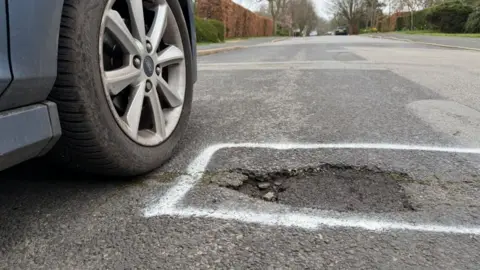
BBCNavigating potholes and crumbling tarmac has become something of a habit for drivers and cyclists in the South East over the last few months.
Cold weather followed by weeks of persistent rain have been blamed for an epidemic of potholes pitting the roads.
Our highways authorities have a legal duty to maintain the roads to a reasonable standard but exactly how they do it is up to them.
As a result, how quickly a pothole gets fixed depends on where it is and, in some counties, whether it qualifies for a repair at all.
Size matters
There is no legal definition of a pothole so it is up to each county council or unitary council to decide how big a hole needs to get before repairing it.
Across the South East, there is variation.
In Surrey, the county council will generally only repair potholes that are "approaching 40mm" in depth.
In West Sussex, East Sussex and Brighton and Hove, a hole needs to actually get to 40mm before it is fixed.
While in Kent and Medway, a pothole would usually need to be 50mm deep before it is slated for repair.
Unless a hole is particularly deep, some councils also have criteria for how wide a pothole should be.
In Surrey and West Sussex, it is 150mm in diameter, while in East Sussex and Brighton and Hove it is 300mm, about the size of a dinner plate.
The severity of a pothole also dictates how long a council will take to repair it, which often ranges from two hours to 28 days.
Consumer lawyer Gary Rycroft said there was no legal timeframe in which a council had to repair a pothole but authorities did have to "act reasonably".
He said the definition of reasonable would be connected not only to the pothole's depth but also other factors such as how busy the road was and "whether they have been put on notice about the pothole being there".
Much smaller holes will be repaired if they are on a pedestrian crossing, a footway or a cycle path.
Why not just fix every hole?
A recent survey by the Asphalt Industry Alliance estimated that the cost of fixing the backlog of road repairs across England and Wales would be £18.6bn.
Councils are trying new methods of patching but say they simply cannot afford to fix every hole.
The Local Government Association said many councils took a "risk-based approach" to assessing potholes, their severity and the order in which to address them.
A spokesperson said different councils faced "very different" circumstances, including condition roads, volume of traffic, terrain and weather conditions.
It said "sufficient funding" and "longer-term certainty" would help councils to focus more on preventative measures.
Not everything is a pothole
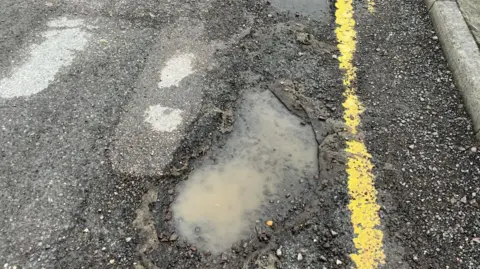
Potholes are usually formed when water gets under the asphalt and freezes, and what we might sometimes think of as potholes are actually other road defects.
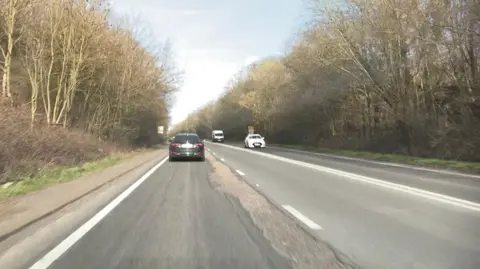
On a stretch of the A26 between Boarshead and Eridge in East Sussex, the road surface has become so poor that a temporary 40mph speed limit has been put in place.
The top of the road surface has worn away exposing the stone in the asphalt, meaning a bumpy ride for drivers but the road needing more extensive work.
East Sussex Highways said there were plans to resurface the road "in the new financial year".
In the meantime, the authority said it was closely monitoring the situation and repairing any potholes that formed.
Dr Benyi Cao, a senior lecturer in civil engineering at the University of Surrey, said most roads across the UK were "designed decades ago" and not designed to fit today's use
"We're seeing heavier vehicles, we're seeing climate change," he added.
As a result, he said, local authorities often had to "prioritise short term repairs instead of long term resurfacing programmes, which are more effective but are more expensive".
What the political parties say
At elections on 7 May voters in Surrey, East Sussex and West Sussex will vote for authorities which have responsibility for maintaining the roads.
The Green Party of England and Wales says it won't support any new road building and would focus instead on repairing existing roads.
The Liberal Democrats say the government needs to relieve pressure on local council finances by sorting out social care and SEND provision so it can give more funding to councils.
Reform UK says it is committed to "bringing councils back to the fundamentals such as fixing potholes and collecting bins instead of wasting time and money on vanity projects".
Labour and the Conservatives have been contacted for their policies ahead of the elections.
The government previously said it had given councils £7.3bn over four years to spend on highways maintenance and introduced mandatory progress reports.
Conservative shadow transport secretary Richard Holden previously promised that the Tories would deliver "real action" for motorists who, he said, were being "squeezed tight by Labour."
Follow BBC Surrey on Facebook, on X. Send your story ideas to southeasttoday@bbc.co.uk or WhatsApp us on 08081 002250.
