Shetland man's lucky escape after drone attacks in Iraq

 Ross Slater
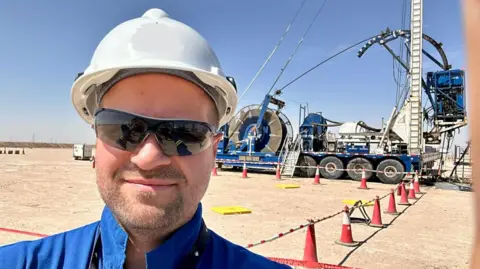
A Shetland man working in Iraq has had a lucky escape after a drone landed 100m (328ft) from his accommodation at an oil field, but failed to explode.
Ross Slater was evacuated along with hundreds of other workers from the oil field near Basra after it came under attack from Iranian drones.
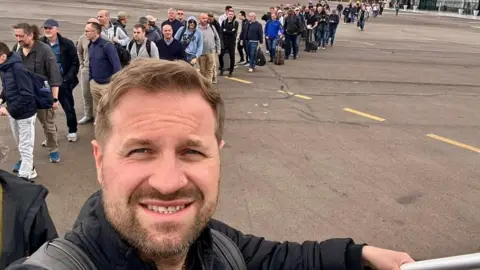
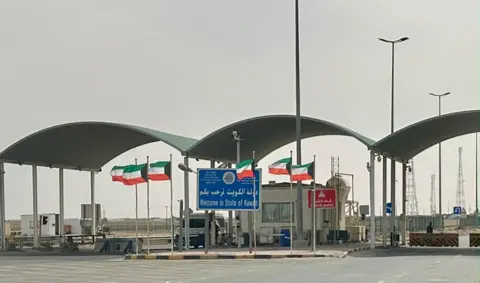
The 44-year-old married father-of-three spent three days traveling through Kuwait, Saudi Arabia, and Amsterdam before finally making it back to Scotland.
Iran has been launching strikes across the Middle East in response to ongoing attacks by the US and Israel.
Ross was halfway through a four-week shift when the drone hit at 04:00.
He said: "Thankfully when it flew in it didn't manage to explode. It kind of ricocheted, so the detonation device didn't go off.
"That came into where all our accommodation is.
"The following day we had evacuated about half the camp, but we still had more folk to leave.
"A second (drone) came in and again through good luck it didn't explode."
He said the second drone landed about 100m from where he was staying.
He said: "It was very close. I don't know the blast radius of these drones are, but I wouldn't want to think it would be too promising."
 Ross Slater
Ross said that the attacks came as a surprise as the information he and his colleagues were receiving was that the Iraqi oil fields were not a target.
He said: "That was absolutely true in that first five days, where other countries and other cities were being hit.
"So we were continuing to do our job.
"When it did start to come in it became very surreal, because you're looking around at the what-ifs and what could have happened."
He said that no alarm went off following the first drone strike.
He said: "I came out and everybody was walking about wearing bulletproof vests and their helmets to go around the camp.
"Everybody was quite quiet and sombre at what had gone on."
 Ross Slater
Ross had been working in Iraq for three years in one of the major oil fields in the south of the country.
He said the field covers an area that would stretch "from Aberdeen to Dundee".
He described the oil field as "a big busy operation" with a "huge road infrastructure" and thousands of workers.
But following the start of the war, most of the production has been suspended.
"The field I work in is almost shut down and it actually produces more than the entire UK oil sector," he said.
"It is a huge impact on a country that is basically a 90% oil-based economy."
'Very close to home'
Ross found the most concerning part of his experience was that the primary exit route for oil workers working there was by air to either Doha or Dubai.
He said: "Even in Saudi, it was a small regional airport about the same size as Sumburgh, and you have this big jumbo jet sitting on the runway waiting for us to go.
"There were folk in Kuwait, and the hotel and government buildings getting hit were only two streets away from the hotel that all our guys were in, so it was all very close to home."
Ross said he is not sure what the immediate future holds back in Iraq.
He said: "Every company is looking at it. Nobody knows what is going to happen next because it's almost like World War III breaking out.
"So before anybody is able to return to these fields and camps, they're going to need to get assurances it's safe."
He said the major issue was that the camps were built "prior to drones being a thing."
He added: "So it means everything is designed around stopping vehicles and people trying to get into a camp, it's not designed for things that fly in from the air.
"So it's going to be quite complicated to determine what a safe set of circumstances is for people to start working locally again."
In the meantime, he's glad to be back in Scotland, even with "all the wind and rain."
