'I almost died after a touch-and-go C-section'

 BBC
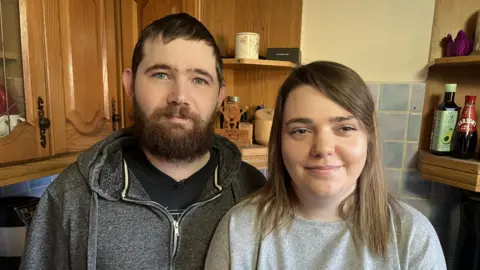
BBCWhen she was 26, Abi fell pregnant with her second child. But what should have been a joyous experience left her on the brink of death and with long-term trauma.
"You kind of sit back and think, well that happened to me. It's a scary situation to think about," she said at her home in Yeovil, Somerset.
"That obviously had a big impact on my family. I'm very, very protective over my children. I have health anxieties, so if one needs to go into hospital, I get very triggered.
"Hospitals should be a safe place."
Abi is one of 20 women the BBC has spoken to who experienced poor care at Yeovil District Hospital between 2011 and 2025.
WARNING: This article contains details that some may find distressing.
The hospital is one of 12 NHS Trusts whose maternity and neonatal care is under investigation by Baroness Valerie Amos.
In May 2025, after a critical Care Quality Commission (CQC) report, Yeovil's NHS Trust acknowledged it could not safely provide care during labour and birth and temporarily closed its doors.
'A panicked situation'
Abi had a caesarean section booked in Bristol in the summer of 2022 for her son Logan. She was high risk as her son was attached to her old C-section scar.
Days before she was due to travel, Abi haemorrhaged at home and was transferred by ambulance to Yeovil District Hospital, which was managing her care.
"I think they panicked. I don't think they were prepared for that sort of situation," she said.
Abi's draft incident report, seen by the BBC, said the expectation was that she would be transferred to Bristol for her baby's delivery.
An emergency ambulance transfer was arranged on the day, but clinicians had differing opinions which led to the transfer being cancelled, meaning the procedure happened at Yeovil.
"There was a lot of arguing in theatre, a lot of noise," Abi said. "There was no order to what they were doing, definitely a panicked situation."
 Abi
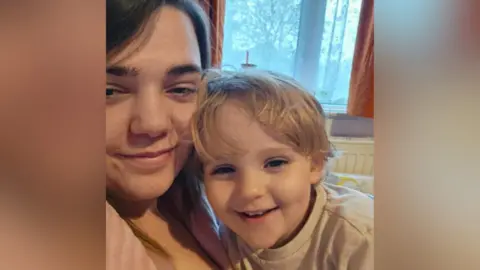
AbiAccording to her draft incident report, the procedure "did not comply with the surgical plan or advice from specialist clinicians" about where to make the incision, leading to "more blood loss".
Abi lost 10.8 litres of blood and the surgical team was unable to say whether she would survive.
She said: "During the C-section [my husband] was told it was touch-and-go.
"We had that conversation when I was better, he said everything was going through his mind, what would he do about the house, the children. I can't imagine that."
A partial hysterectomy was carried out at Yeovil before Abi was transferred mid-surgery to Bristol for the operation to be completed.
Four days later, she met her son Logan, now a thriving three-year-old, for the first time.
"When I woke up, I didn't comprehend how serious it was and how I almost lost my life," she said.
"I'm not fine, not OK. So many days I think what if I wasn't here for my kids, to see them grow up, and that scares me.
"You go in [to hospital] thinking they will look after you, and when that doesn't happen... you think 'I almost lost my life that day'. It's scary."
Yeovil's NHS Trust has said it has taken "decisive action when failings are identified" and will act on any findings from the national investigation into maternity and neonatal services.
"It is very difficult to hear the experiences of women and families who have had a traumatic experience and been let down by our services - and we say sorry to them," a spokesperson said.
They added that the trust had done a "huge amount of work" to address concerns about paediatric services including making a Somerset-wide service and recruiting five paediatric consultants.
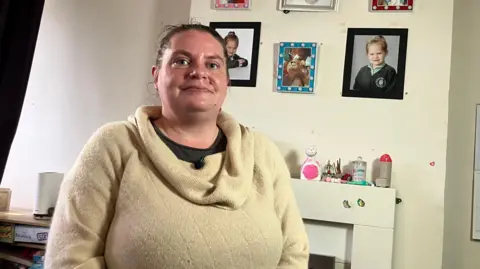
In common with many women the BBC has spoken to, the trauma Abi experienced has had a long-lasting impact.
Many have said they no longer trust health professionals, and chose to give birth away from Yeovil after their experiences there.
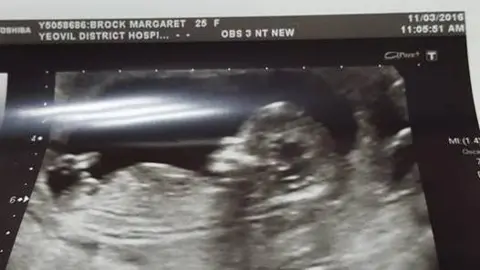
Maggie was 25 when she gave birth to her son Keegan in Yeovil. He died two days later as a result of breathing in meconium, a newborn baby's first stool, and suffering a serious brain injury during the birth.
"He passed in my arms," Maggie said. "I was numb."
"I still live with it every day. Even when my daughter sleeps, I still look in on her. It's like reliving that every day and making sure she is safe," Maggie added.
 Maggie
When she was 37 weeks pregnant, Maggie went into hospital because her son was not moving.
"I knew something was wrong," she said. "They popped my waters. [There was] meconium in my waters. It was loads... but the consultant said leave me for two hours to see if I dilate any more."
Meconium within amniotic fluid is a sign of stress, which was picked up by a midwife and Maggie was taken in for an emergency C-section.
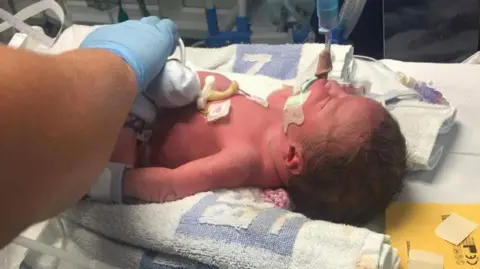 Maggie
Yeovil NHS Trust apologised after Maggie began legal action. It admitted that Keegan's death "could have been avoided" if it had arranged a C-section earlier, or inducted Maggie differently.
"I don't think I was cared for that much," Maggie said. "I just felt like they just wanted me in and out.
"They've admitted it, which is good, but it shouldn't have happened in the first place."
The BBC can reveal that a year after Logan's birth, another woman had a life-threatening heavy bleed during labour because of a lack of surgical equipment, according to a Care Quality Commission report into the unit in November 2023.
In 2024, two-week-old Brendon Staddon was murdered on a neonatal ward at Yeovil Hospital by his father Daniel Gunter. A child safeguarding practice review is ongoing.
A BBC freedom of information request also revealed that in 2022, the same year that Abi gave birth, the maternity unit reported seven serious untoward incidents (SUIs).
SUIs can include an event that has contributed to a death, or serious or life-threatening injury. There were another seven SUIs at the unit in 2023, five in 2021, two in 2020 and five in 2019.
'Alarming'
An obstetrician linked to Yeovil, who wants to remain anonymous, said having 5.2 SUIs on average over a five-year period was considered high, especially for a very small unit.
They said when the SUIs incidents were combined with 'never events' - largely preventable incidents that should not ever occur - the statistics were "reasonably alarming".
A spokesperson for the Somerset NHS Foundation Trust said: "We have taken, and will continue to take, decisive action when failings are identified.
"We acted quickly in response to the CQC's inspection of our maternity services. We have strengthened our processes to provide ongoing review of quality, performance and governance."
In an interim report published earlier, Baroness Amos said maternity and neonatal services across England were not consistently delivering safe care for "too many women, babies, families and staff".
She identified problems with the mix, seniority and continuity of staffing and said black and Asian women experienced poorer care than others alongside women from low-income backgrounds.
It also noted that families faced defensive and inadequate responses from the NHS after traumatic events, which were not properly investigated, and added that families struggled to get independent answers after babies die.
Baroness Amos will make national recommendations in the spring.
Follow BBC Somerset on Facebook and X. Send your story ideas to us on email or via WhatsApp on 0800 313 4630.
