London crime concerns outweigh reality, study suggests

 PA Media
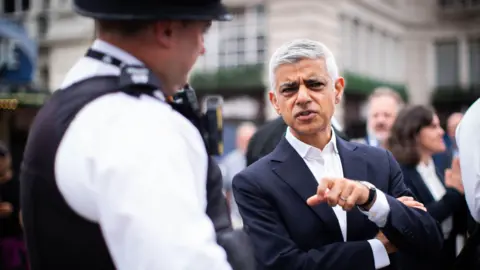
People are overestimating how much crime takes place in London and how unsafe residents feel, according to research by King's College London.
Researchers found that respondents thought that 30% of Londoners had personally experienced a crime in the year between October 2024 and September 2025, when the reality was 12.2%, according to ONS figures.
Londoners involved in the survey also overestimated the risk, putting the figure at 25%.
While perceptions did not always match the data, the figures suggest many Londoners continue to have concerns about safety.
The 12.2% figure still means roughly one in eight people had been the victim of a crime, while 37% of residents say they do not feel safe walking alone in their area after dark.
So what does the research tell us about the gap between how safe London actually is and how safe people think it is?
What the figures show
The findings are based on two YouGov surveys of 2,164 and 3,969 adults carried out between 23 and 27 March 2026 as part of the Mistaken Britain research programme.
Researchers compared respondents' perceptions with data from the Crime Survey for England and Wales, Home Office crime figures and official surveys on how safe Londoners feel in their local areas.
Half of respondents thought London had the highest rate of violent crime of any region in the year to September 2025.
In fact, the research found that police-recorded crime data showed London had the lowest rate of violent crime of any region in England and Wales.
Nearly two-thirds of people (62%) believed overall crime in London had increased between 2019 and 2025 when in reality, it had fallen slightly by 1.4%.
Four in 10 thought murders had risen, despite the number falling by around 15% over the same period.
Respondents also overestimated how unsafe Londoners feel.
They believed 60% of residents do not feel safe walking alone in their local area after dark, when in reality, this figure was 37%.
Londoners themselves slightly overestimated the level of concern, with residents estimating that half of Londoners feel unsafe in those circumstances.
'Lies and hatred'
However, the research found people were often right about rises in specific offences.
Most correctly identified increases in shoplifting and theft from the person, both of which more than doubled between 2019 and 2025.
A majority also correctly said they felt sexual offences and violence against the person had increased.
More recent Metropolitan Police figures show sexual offences rose by 4.2% and violence against the person by 7.0% in the year to July 2026.
The Metropolitan Police has recently stepped up efforts to tackle phone theft, saying offences in the West End halved between June 2025 and June 2026 following a crackdown and a doubling of patrols in the area.
The force said its largest-ever operation targeting phone theft resulted in 13,000 fewer mobile phones being stolen across London.
 Getty Images
The mayor of London and the Greater London Authority (GLA) had previously raised concerns about the way the capital is portrayed online.
A GLA report published in March found social media users were being targeted by "disinformation" about the capital.
It said online activity describing London as a dangerous city in decline increased by between 150% and 200% between March 2024 and March 2026, while migration-related narratives referencing London rose by more than 350%.
Sir Sadiq launched a £7m campaign in June to showcase London to the world and tackle online disinformation.
Susan Hall, the leader of the City Hall Tories, previously said that the mayor "should spend more time trying to fix things as opposed to saying, 'La la la la la', I'm not listening, everything's fine.'"
Sir Sadiq said the city had been subjected to a "relentless and unprecedented attack of lies and hatred" on social media.
The mayor said of the new study: "This latest research from King's College is a sad indictment of the volume of misinformation and organised disinformation being peddled against our capital.
"For too long we have seen foreign state actors, politicians, bots and others regularly talking down London, taking advantage of the outrage economy which allows people to profit from the poison, algorithms and rage-baiting spread online."
The mayor said investment in the Met and the Violence Reduction Unit had helped drive a 14% fall in neighbourhood crime.
"But I'm clear that one crime is one too many and am determined to build on the progress we have achieved by being tough on crime", adding that this would be backed by "record investment in front-line policing".
UK's 'most polarising city'
The findings come amid a wider debate about how London is portrayed in politics, the media and online.
In an interview with GB News last week, US President Donald Trump claimed London was a "much different place", with "crime that's very high".
He went on to say: "You have areas in Paris and London where the police don't want to even go in them, there's no law and order. They're afraid to go in them.
"Either they're afraid or they just don't, you know, they don't want to lose their life."
London is described by the King's College London report as the UK's most polarising city.
While 42% of respondents view it favourably, 36% view it unfavourably, a much narrower gap than for other major UK cities.
More than half (54%) think London has changed for the worse since 2016, while only 16% think it has changed for the better.
Listen to the best of BBC Radio London on Sounds and follow BBC London on Facebook, X and Instagram. Send your story ideas to hello.bbclondon@bbc.co.uk
