Why are flares at public events so dangerous?

 Reuters
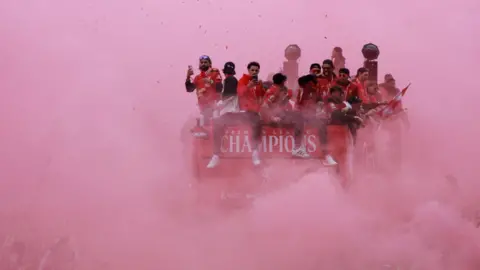
The dangers of flares and smoke bombs have been highlighted in a report looking at the planning and management of the Liverpool FC victory parade in May last year.
The report was written by Eric Stuart, a UK crowd-safety expert with more than 40 years of experience in policing, global event safety evaluations and major inquiries.
He explains why using flares and smoke bombs at such large-scale events needs reviewing, and what needs to be done to tackle the problem.
What is the difference between a flare and a smoke bomb?
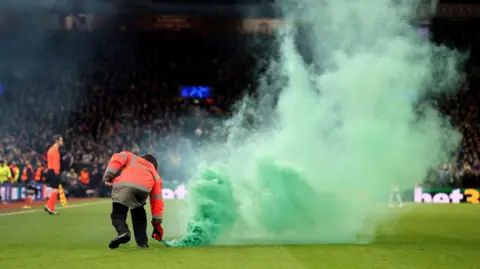
Flares are devices that produce bright light or intense, non-explosive fire, and are commonly used for signalling distress - for example at sea - or for the purposes of illumination.
Smoke bombs are devices, often in the form of a canister, designed to produce a thick, continuous cloud of smoke upon ignition. They are primarily used to create smoke screens or signals, mark positions, or for photographic effect.
Smoke bombs contain different chemicals depending on their intended use, but generally rely on a mixture of fuel, oxidiser, and a colouring agent.
What are the risks?
Stuart described flares as "very, very dangerous pieces of equipment".
"Flares are the worst because of the temperature that they burn at," he said.
"Very brief contact or even proximity to the skin is going to lead to injuries."
"You wouldn't walk around the streets with an Arc Welding Torch, waving it in the air, but somehow, it's ok if it's a flare.
"The problem is there are so many that it becomes impossible for the police or the authorities to deal with it, and the only way I perceive that we can start tackling this is government legislation that makes it much more difficult to import these flares."
 Reuters
"The levels and volumes and density of the smoke, at times, at this victory parade were greater than any I've seen before," Stuart said.
While some maintained the smoke looked worse because the colour made it more visible, his report suggested the air was so thick with smoke that at times it was very hard for people to breathe.
"If you were a person there with asthma, or other breathing difficulties, that would have been quite difficult," Stuart said.
At one point the smoke was so thick the parade vehicles took a wrong turn because visibility was obscured.
"At one point, because the density of the smoke is so great that you can't see your hand in front of your face, you can barely see the bonnet of your car in front of you, the smoke is so thick that someone actually takes a wrong turn... that's pretty indicative that we have a problem that we need to do something about," he said.
It's not just football fans
"It's not a football problem. It's not even a UK problem," he said.
"But we need to try to do something to stop the number of these things, these devices coming into the UK, and that can only be led by government."
He cited recent successful campaigns clamping down on the availability of weapons including samurai swords and certain knives.
"We need to do something along similar lines in terms of flares and smoke," he said.
He accepted most people "don't see it as being dangerous, they don't intend to cause harm to others".
"But it's almost inevitable that somewhere along the way someone is going to get hurt."
"So we have to try and do something about it."
 Liverpool City Council
How do you stop it?
"At the moment they are treated, more or less, like a firework, so any over 18 at any time of the year can order these things online and get them relatively easily.
"And they're so small. They are very easy to hide, that's why they keep popping up in football clubs," he explained.
"And even though they're banned also now at music concerts and festivals, they are still appearing.
"Some legislation around the flares would be a priority for me," he said.
Listen to the best of BBC Radio Merseyside on Sounds and follow BBC Merseyside on Facebook, X, and Instagram. You can also send story ideas via Whatsapp to 0808 100 2230.
