Murder suspects found in 1960s missing miner case

 Nottinghamshire Police
Police have identified two murder suspects thought to have been involved in the death of a miner whose remains were discovered more than 50 years after he went missing.
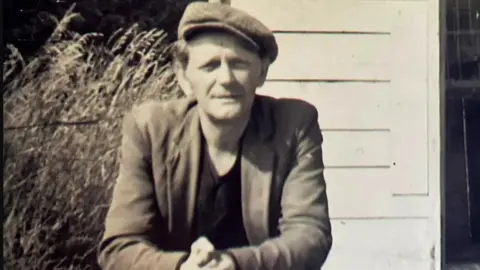
Alfred Swinscoe’s remains were found in a field on farmland in Nottinghamshire in April 2023, after the father of six was last seen drinking at a pub on 27 January 1967.
Work on Mr Swinscoe's bones has found he sustained a "significant" stab injury and blunt force trauma, and police say he died with a broken hand.
Now officers have identified two suspects, both of whom are no longer alive.
Nottinghamshire Police launched a murder inquiry following the discovery of the remains, later confirmed as belonging to the 54-year-old.
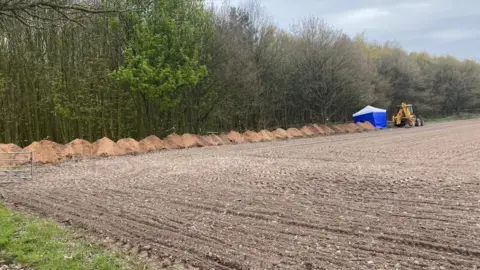
They were found off Coxmoor Road in Sutton-in-Ashfield, on 26 April, when digging work was being carried out on farmland.
Officers believe Mr Swinscoe – who was last seen at the former Pinxton Miners Arms in Derbyshire – was murdered and then buried in a grave between 4ft (1.2m) and 6ft (1.8m) deep.
 Nottinghamshire Police
Police said since the remains were found, scientists had carried out "extensive" work on Mr Swinscoe's bones to determine a cause of death.
It is thought Mr Swinscoe could have sustained his broken hand while fighting his attacker or attackers off.
One of the suspects had a history of violence, police added.
Some of the injuries the suspect had inflicted on another man he was convicted of assaulting in April 1966, were similar to those found on Mr Swinscoe.
As some of the bones were missing, experts believe it was "highly likely" Mr Swinscoe was killed at a different location, and then moved to where his remains were found "at a much later date".
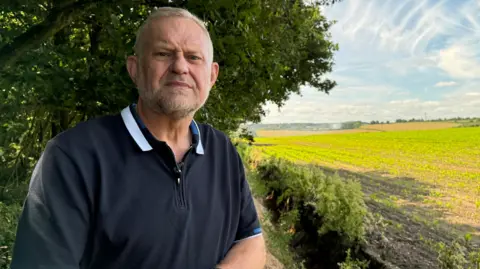
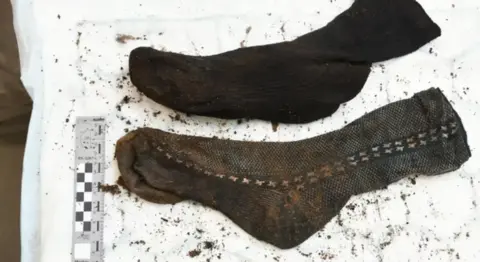
Mr Swinscoe's grandson, Russell Lowbridge, told the BBC he recognised the former miner's sock that was found with the remains.
"Finding out he was murdered was a shock. It took some sinking in," Mr Lowbridge said. "It's all a bit disturbing and upsetting.
"Anybody that knew anything, they've kept it a secret. It would be wonderful if [people] did come forward - it would help put our minds at rest.
"It will always haunt us; we'll always be left wondering. We have got some closure, but not full closure. There are still questions to be answered."
 Nottinghamshire Police
 Nottinghamshire Police
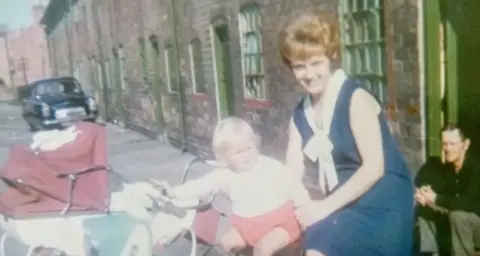
Since the age of 14, Mr Swinscoe had worked at Langton Colliery as a "cutter", known for operating a machine that cut large chunks of coal out of the coal face for others to then break down.
He had the nickname "Sparrow", and was also known as "Champion Pigeon Man of Pinxton", due to his love of pigeon racing.
Four of his six children are still alive and he has a number of grandchildren.
It is believed Mr Swinscoe was drinking with his two sons and friends on the night of his disappearance.
He was last seen giving money to son Gary to buy a round, and then left to use the outside toilet.
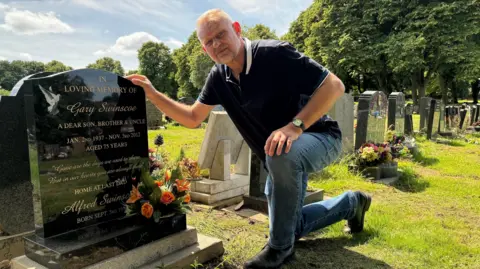
Mr Lowbridge previously told the BBC that the disappearance had "tormented" Gary, who died in 2012 "never knowing what happened to his dad".
Detectives believe a vehicle would have been used in the killing, as it was "some distance" between the pub and where Mr Swinscoe was buried.
They added it "would have been rare" to own a car in the village of Pinxton in 1967.
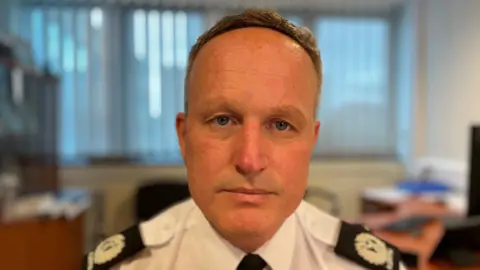
Assistant Chief Constable Rob Griffin said many of the people who were with Mr Swinscoe at the time he went missing were no longer alive, adding "we may never get the full picture" of what happened.
"That certainly hasn't stifled our determination to investigate this crime and leave no stone unturned to find his killer or killers," he said.
"We will continue to investigate this crime and continue to look at all new and existing avenues available to us."
Mr Swincoe's cause of death will be determined by a pathologist ahead of an inquest.
Police are continuing to appeal for information, with Mr Swinscoe's final movements recreated as part of a BBC Crimewatch appeal in October.
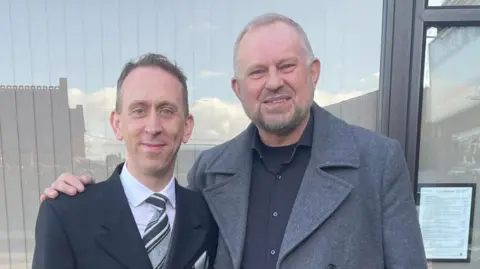 Russell Lowbridge
The family held a small funeral for Mr Swinscoe in Sutton-in-Ashfield in January.
The service - arranged by A Wass Funeral Directors - wasofficiated by Stephen Blakeley, a celebrity celebrant who was known for playing PC Younger in the television series Heartbeat.
"He did a nice talk about grandad for us and it was lovely," Mr Lowbridge said.
"It's good to have him back home buried properly with his family and we feel content that he's not lost any more."
Follow BBC Nottingham on Facebook, on X, or on Instagram. Send your story ideas to [email protected] or via WhatsApp on 0808 100 2210.