Jim Wallace: Lib Dem who repeatedly stepped in as first minister

 Getty Images
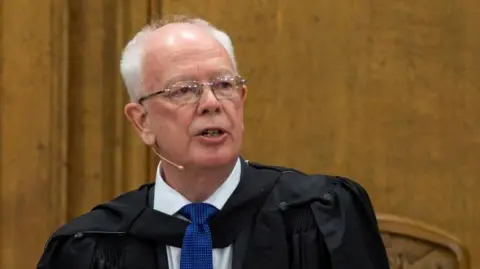
Jim Wallace, later known as Baron Wallace of Tankerness, enjoyed the unique historical achievement of stepping into the role of first minister on three occasions.
The illness and then death of Donald Dewar in 2000 and the resignation of his successor Henry McLeish a year later were major crises in the early days of the Scottish Parliament.
It fell to the Liberal Democrat Wallace, as leader of the junior coalition partners and deputy to both men, to become the head of the then Scottish executive and try to steady the ship.
His calm manner and canny judgement gained him widespread respect and admiration after almost 20 years on the geographical and political edges.
Wallace, who has died aged 71, is associated with the most northerly parts of Scotland, having first been elected as MP for Orkney and Shetland in 1983.
But he was born at the opposite end of the country, in the Dumfriesshire county town of Annan in 1954.
He was brought up in the Church of Scotland - in which his accountant father was an elder - and religion and politics were inter-related interests and influences throughout his life.
He explained how this worked for him in a 2022 interview with Holyrood magazine.
"I was very much brought up as a Presbyterian and church has been a big part of my life," he said.
"I found that it meshed with my political life... it was probably faith that prompted me to take up politics, although I've never had much time for people who believed that God was on the side of their political party."
 PA Media
After studying economics and law at Downing College, Cambridge, he took a further law degree at the University of Edinburgh before working as an advocate at the Scottish Bar.
A liberal after a student flirtation with conservatism, he became active in politics back home, unsuccessfully contesting the Dumfriesshire constituency in the 1979 election.
But his luck changed four years later. Selected to fight Orkney and Shetland, which was being vacated by the former Liberal leader Jo Grimond after 33 years as MP, he inherited one of his party's safest seats and the most northerly UK constituency.
Wallace settled in Orkney, where he became a member of the choir and Kirk session at St Magnus Cathedral.
The first decade of his long political career saw him join the Liberal front bench as employment spokesman before becoming their chief whip.
The 1980s were a difficult time for his party, which first went into a pact and then merged with the SDP, becoming the Social and Liberal Democrats in 1988 and, more simply, the Liberal Democrats in 1989.
They won 20 seats in the 1992 general election, nine of them in Scotland, and Wallace stood unopposed to lead the largely autonomous Scottish Liberal Democrats, a role he would hold for the next 13 years.
 PA Media
And so began one of the most important phases of Wallace's career, though most of what he achieved over the rest of the 1990s was behind the scenes.
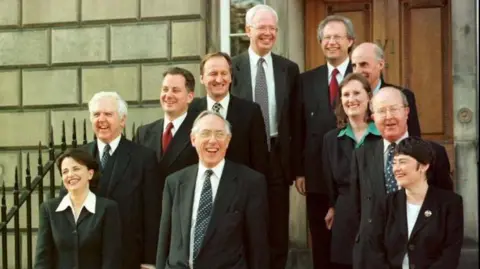
He led his party in the Scottish Constitutional Convention (SCC), the group of political parties, churches, trade unions and civic groups which was set up to campaign and lay the foundations for a future Scottish parliament.
Home rule, constitutional change and proportional representation had long been core Liberal and Lib Dem causes and the fight for devolution was the perfect opportunity to make their case for a new political settlement within the UK.
Labour and the Lib Dems were the biggest parties in the SCC and would play decisive roles in shaping what would eventually become Holyrood.
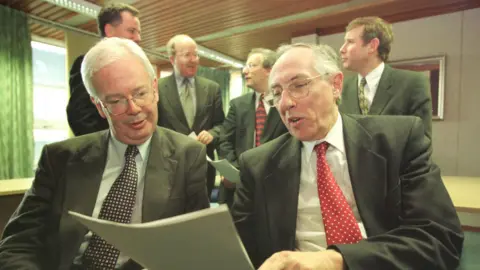
Wallace's role in this brought him into a close working relationship with Labour's Donald Dewar and George Robertson, two men who would prove important allies in the run up to devolution and later in government in Edinburgh.
His relationship with Robertson was strained by Labour's decision to hold a referendum on devolution after coming to power at Westminster in 1997. Wallace felt let down, believing the convention had settled the debate without the need for putting the question to voters.
By the time of the Scottish parliamentary elections in May 1999, it was clear that Labour would be the biggest party in the new chamber.
The parliament was designed to encourage coalition and that's what came to pass when, after a week of sometimes tense negotiations, Labour and the Lib Dems agreed to govern together.
Wallace became deputy first minister, the first politician from the Liberal tradition to sit in government in the UK since the Second World War.
 PA Media
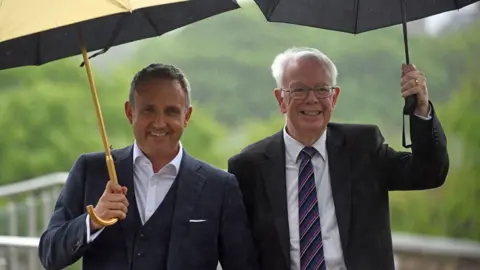
He held the justice brief in the new administration and his years round the cabinet table were characterised by a pragmatic approach to policy and shared interests which saw him serve alongside three Labour first ministers.
There were sticking points around the introduction of anti-social behaviour orders (Asbos) and tuition fees - but overall, and over the course of eight years as partners-in-power, Wallace's steady and calm presence contributed greatly to the stability of the coalition.
Following his departure from Holyrood in 2007, Wallace went to the Lords. He sat on Sir Kenneth Calman's commission on devolution, which recommended extending Holyrood's powers.
And there was a surprise return to government, this time as part of the Conservative-Lib Dem coalition under David Cameron and Nick Clegg.
Wallace became Advocate General for Scotland, advising the UK government on Scots law. Later, he served for three years as his party's leader in the Lords.
As well as his political roles, he served from 2021-2022 as Moderator of the General Assembly of the Church of Scotland, making him only the second non-ordained person to fill the role since the Reformation.
During that time, his liberal credentials were to the fore when he supported same-sex marriage.
And his background in forming coalitions came in handy when he guided the Kirk towards the St Andrew Declaration in November 2021 and the St Margaret Declaration a year later. These two documents cemented collaborations with the Episcopal and Roman Catholic churches.
But that same liberalism saw him support the less progressively fashionable cause of fox hunting, and he was a strong defender of Kate Forbes when she came under attack for her religious beliefs during her 2023 SNP leadership bid.
After stepping down from the church role in late 2022, Wallace was struck by a period of severe ill-heath. After months of feeling unwell he was diagnosed with a dissected aorta and had to undergo emergency cardiac surgery.
It was a condition which could have killed him at any time, and afterwards he somewhat wound down his public engagements. While remaining a peer, he spent more time in Orkney and, as a devoted family man with two daughters, was an enthusiastic grandparent.
Wallace was a major figure in Scottish politics and was, alongside Donald Dewar, a leading architect of the devolution era. The parliament at Holyrood is as much his legacy as any political figure of the past 50 years.
His was a life spent at the centre of politics and it took him to the centre of power in Scotland. Through it all, his religious faith and liberal political instincts guided his hand.
