Assisted dying law doesn't have enough safeguards, says Welsh health minister

 PA Media
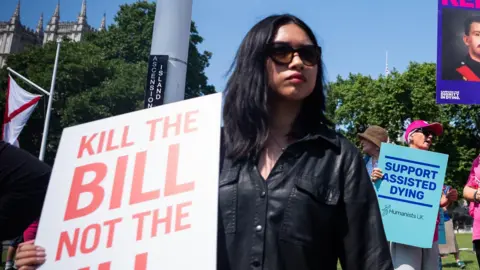
Wales' health minister says he voted against a landmark bill to legalise medically assisted deaths because he was unhappy with the legislation's safeguards.
Late on Tuesday the Senedd gave its consent for Westminster to pass a law that would give the Welsh government powers to set up an NHS assisted dying service.
While most Labour MSs supported the plans five ministers said no, including Health Secretary Jeremy Miles and the First Minister Eluned Morgan.
Miles told the Senedd debate on Tuesday that the motion was "not a referendum on legalising assisted dying" with only the UK Parliament able to make that decision.
A day after the vote, Miles told BBC Wales he "didn't contribute to the pros and cons in the debate because the government's position on the bill is neutral".
He said the Welsh government had worked hard to ensure the "voice of Wales" was heard.
"But I'm also clear in my own mind that the fundamentals of the bill, as it's going through Westminster, don't provide sufficient safeguards for patients.
"Although the vote yesterday was on the devolved areas... the net effect is to give powers in Wales to deliver a service that I don't think I would support if I was operating over the border."
Asked why it could not be deferred to the next Welsh Parliament, he said every MS had a "mass of correspondents from constituents as well as other organisations and families getting in touch".
"They were looking to the Senedd to express a view.
"I don't think it was tenable for us to say that we should not take a view and allow the next Senedd the only voice on it."
The assisted dying bill has been backed by MPs and is currently in the House of Lords.
On Tuesday evening the Senedd was asked whether it would give consent to parts of the law allowing Welsh ministers to set up rules for an assisted dying service.
Politicians were told that if they rejected the motion, and it is passed by Westminster, the practice would be legalised in Wales but patients would need to go to England or use a private provider.
The motion was backed by 28 Senedd members, with 23 against and two abstentions.
Voting tables show that while 21 Labour and seven Plaid Cymru MSs backed the vote, five Labour ministers and four Plaid politicians opposed the decision.
Mabon ap Gwynfor, Plaid's spokesperson on the NHS, voted against it, as did deputy Plaid leader Delyth Jewell.
All Conservative MSs and the Welsh Lib Dem Jane Dodds opposed. Reform's two MSs abstained.
