'Bogus' snail farms set up to avoid business rates

 Getty
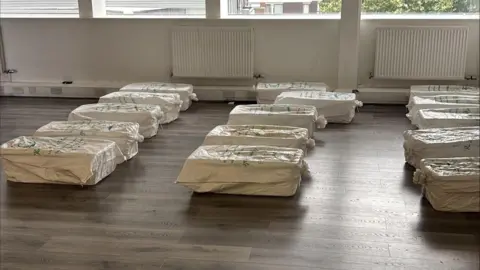
GettyBoxes of snails have been found in central London offices by council officers investigating tax avoidance schemes.
Crates of gastropods have been discovered in the past in what Westminster City Council described as "unscrupulous traders" trying to claim agricultural business tax exemptions by saying they were running snail farms.
Council leader Adam Hug says the recent discovery, at two buildings in Old Marylebone Road, "vividly illustrates an issue of business rates avoidance based on a ludicrous notion".
Under UK tax law, agricultural buildings and fish farms are exempt from paying business rates if they are viable commercial businesses. The government has been asked for comment.
To date, the council says it has lost about £370,000 due to this avoidance scheme, which it says building landlords are also "complicit" in.
Four such "snail farms" have been liquidated by Westminster City Council for non-payment of business rates and the authority said it was trying to wind up a further two through a legal process.
 Westminster City Council
The council said it had also asked the Insolvency Service to consider banning the directors of these companies from any other future directorships.
But Hug said a new law was needed to give councils the power to shut down avoidance scams quickly, rather than by going to court.
"Rather than unscrupulous traders dropping on one avoidance scheme after another, it would be good to see a general clause on business rate avoidance and evasion which stops these kinds of activities in their tracks," said Hug.
The Ministry for Housing, Communities and Local Government, which sets tax policy, has been approached for comment.
Although local authorities are responsible for collecting business rates, The Valuation Office Agency (VOA) is responsible for deciding whether a property is exempt.
It also carries out checks to assess if properties are being used for legitimate agricultural purposes.
As such, Westminster Council said it was unlikely the VOA would consider these premises to be exempt.
Listen to the best of BBC Radio London on Sounds and follow BBC London on Facebook, X and Instagram. Send your story ideas to hello.bbclondon@bbc.co.uk
