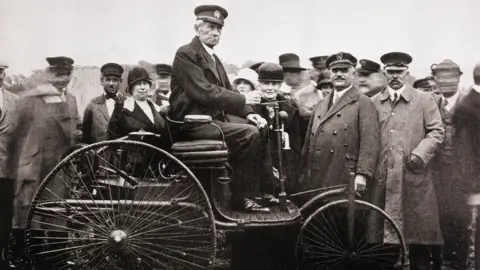
The world's first car and its first lady driver

 Getty Images
It had no pedals or steering wheel and boasted a top speed of 10mph…
But the Benz Patent-Motorwagen would change everything.
Built by German engineer Carl Benz 140 years ago, it marked the first time an internal combustion engine had been mounted to a carriage, and is widely regarded as the world's first car.
Now the vehicle will be front and centre of an upcoming display at the National Motor Museum at Beaulieu.
 National Motor Museum
Benz created his first stationary engine in 1880 before turning his attention to the development of a motorised vehicle.
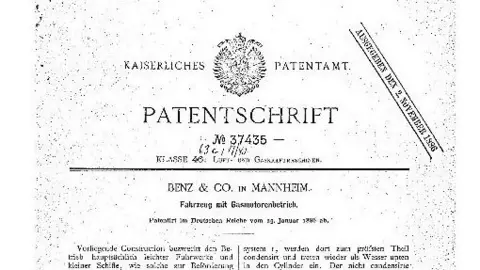
The Motorwagen was built in 1885 and granted a patent on 29 January 1886, after which Benz unveiled his creation to the world.
Chief executive at the National Motor Museum, Jon Murden, said: "Before this, if you wanted to travel, it was the train, horse or walking.
"This vehicle is the birth of motoring as we understand it. As a personalised piece of transport that you could take anywhere you wanted, whenever you wanted, this was the beginning of that."
The three-wheeled vehicle was directed by a tiller arrangement rather than a steering wheel.
A lever allowed the driver to move forwards and backwards and a knob adjusted the fuel to control speed.

It was actually Benz's wife, Bertha, who took the vehicle on its first long-distance journey.
Shelley Kimber, learning officer at the museum, described her as a "pioneer of motoring".
"Before dawn one morning, she left a note for her husband saying 'I've taken the children and I've gone to go and visit my parents' who lived about 106km [66 miles] away.
"It was a while before he worked out that they hadn't taken the train and that they'd actually gone in their 'car'."
Bertha, who was also an engineer, was able to make quick fixes to the Motorwagen while on the road in order to ensure the journey's success.
Kimber continued: "There was a blockage in the fuel pipe so she used her hat pin to unblock it. Every Victorian lady would've had a hat pin."
A four-wheeled motor vehicle was patented about seven months later by fellow German pioneers Gottlieb Daimler and Wilhelm Maybach.
Benz's company later merged with Daimler's to form what became Mercedes-Benz.
The Motorwagen will feature in the National Motor Museum's exhibition, 'Driven: Britain's Motoring Story', which will open in Easter.
You can follow BBC Hampshire & Isle of Wight on Facebook, X (Twitter), or Instagram.
