Iranian missiles injure 180 in towns near Israeli nuclear site
Israel's health ministry says 180 people were injured - some seriously - in Iranian missile strikes on two southern Israeli towns close to a nuclear facility.
The ministry says 116 people were injured in Arad and another 64 in Dimona, after ballistic missiles hit the towns on Saturday evening.
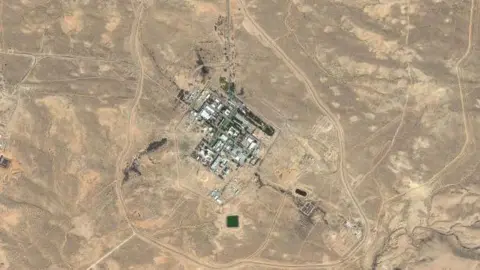
The International Atomic Energy Agency (IAEA) says it is not aware of any damage to the nuclear research facility located about 13km (eight miles) outside Dimona.
Iranian state TV earlier said the strikes were in response to an attack on Iran's Natanz nuclear facility on Saturday.
On Sunday, at least seven people were injured in an Iranian missile attack on Tel Aviv, emergency services say.

 EPA
EPAThe Israeli Air Force says Tehran has fired 400 missiles at Israel since the US-Israeli attack on Iran on 28 February. Of these, 92% were intercepted, it adds.
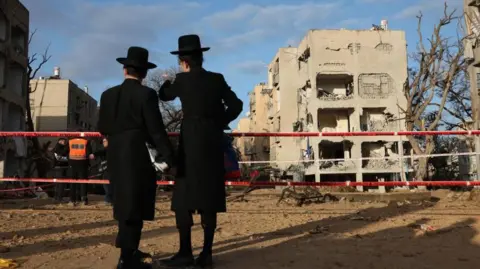
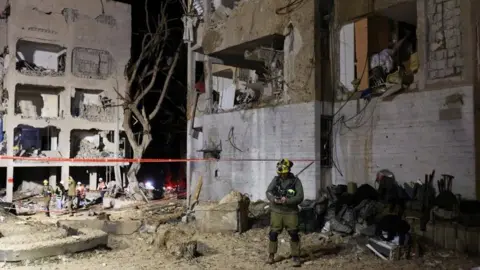
In Arad, local residents said the blasts they heard on Saturday were terrifying. The missile badly damaged several buildings, leaving a deep crater.
Naram Zaid, a paramedic in the town, told BBC News she had seen a "lot of children with head and chest injuries" after being crushed by objects inside a damaged building.
"I was trying to reassure a 10-year-old girl with head injuries, with blood on her face from broken glass," she added.
"She was refusing to get into the ambulance as her parents were still inside the building, and we waited for her parents to be evacuated from the destroyed apartment block and then we sent them all to hospital."
The outside walls of two residential apartment buildings were gouged out by the impact.
Crowds of dark-suited men stood staring at the damage in this Ultra-Orthodox town in the Negev desert.
 Reuters
The nearby town of Dimona experienced a similar missile strike.
Among the many injured there was a 10-year-old boy. Medics described his condition as serious.
"In both Dimona and Arad, interceptors were launched that failed to hit the threats, resulting in two direct hits by ballistic missiles with warheads weighing hundreds of kilograms," Israeli firefighters said.
Ahmadiel Ben Yehuda lives a two-minute walk from the street where the missile hit in Dimona and says he was on the steps to the bomb shelter when it struck.
"There is damage to all the houses in our community - many collapsed ceilings and windows blow in - including in my own house."
Ben Yehuda says he went to visit the street where the missile landed and "the entire area is just devastated, including a kindergarten". He knows several people whose apartments were completely destroyed.
"I felt horror. I just can't believe the power of what a missile can do to concrete, to see the devastation is hard to comprehend."
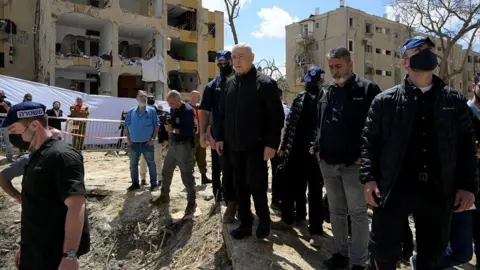
Both Israeli Prime Minister Benjamin Netanyahu and President Isaac Herzog visited the impacted sites on Sunday.
 Getty Images
The ability of Iran to keep inflicting this kind of damage inside Israel is a reminder of the human cost of the war.
Urgent investigations are taking place to ascertain how the missiles breached Israel's air defence system.
But as in the 12-day war last summer, Israelis know that the system is not infallible.
As then, such attacks are more likely to harden the public's resolve rather than weaken it.
The Shimon Peres Negev Nuclear Research Center - located in the Negev desert - is often referred to colloquially as the "Dimona reactor". It is long accepted as holding Israel's undeclared arsenal of nuclear weapons.
Officially, the site is said to focus solely on research but for about six decades, it has been an open secret that Israel developed a nuclear bomb there, even if each succeeding government has maintained a position of ambiguity over this.
It has meant that Israel is the only nuclear power in the Middle East. So any indication that it is being targeted is taken with the utmost gravity by Israel.
 Maxar
MaxarBoth Israel and the US have set the elimination of any possible Iranian capacity to develop a nuclear bomb as the key aim of the war.
Iran's own Atomic Energy Organisation described the attack on Natanz as a violation of the Treaty on the Non-Proliferation of Nuclear Weapons, though it said "no leakage of radioactive materials" was reported and there was "no danger to residents of the surrounding areas".
Natanz was also targeted in the first days of the war, which started on 28 February, by US-Israeli strikes, as well as during the 12-day war last June.
Asked about Natanz on Saturday, the Israel Defense Forces told Israeli and international media that they were not aware of a strike in the area.
Additional reporting by Tom Bennett and Gabriela Pomeroy
