Could war in the Middle East lead to rising food costs in NI?

 BBC
BBCFirst energy bills, then petrol prices.
Now the cost of food could be the next price jump as a result of the war in the Middle East.
Nitrogen-based fertilisers are an essential part of modern farming – farms globally would produce about half the amount of food they do without it.
About one third of all global fertiliser normally passes through the Strait of Hormuz – at least, it did.
How is fertiliser affected?
Iran has effectively blocked the Strait of Hormuz since the US and Israel attacked the country on 28 February.
About one-fifth of the world's oil and liquefied natural gas also passes through this shipping lane.
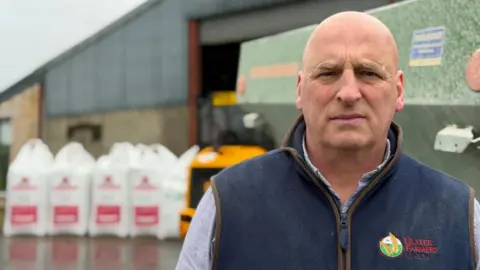
John McLenaghan of the Ulster Farmers' Union is one of those dealing with the fallout.
"Fertiliser prices have been skyrocketing; we can't even get prices quoted. It's not just price actually, it's about availability.
"You just can't get it, it's as simple as that."
Although his fertiliser delivery arrived as scheduled, there's no guarantee he'll get all he needs this planting season.
"This is a time we need to be applying it and we just can't get it. It has come at the worst possible time.
"Farmers have had fertiliser on order and they're not getting their full order. They're going to order more and they are not getting it."

Crops have specific nutrient demands
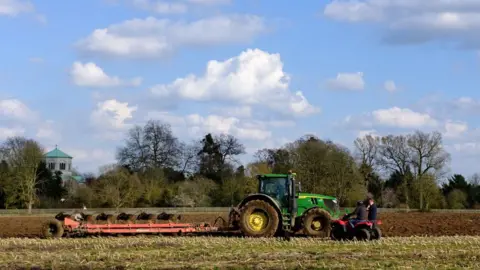
Spring is when newly-sown crops are most in need of fertiliser; if all the delayed supplies arrive in a month's time, it will be too late for them to do much good.
Alexis Maxwell, a senior analyst at Bloomberg specialising in fertiliser and agriculture markets, said growing crops was a "bit like growing children".
"They have very specific nutrient demands in a very short window – we are in that window in the northern hemisphere now."
Maxwell says that price spikes in commodities like urea and ammonia, essential for fertiliser, show the scale of the challenge.
If fertiliser costs rise high enough, farmers may decide they won't be able to make the cost back in higher food prices. That would mean choosing to produce less.
"We are just shy of the all-time record for costliness of nitrogen fertiliser, set in 2005. So, it's very expensive and some farmers will go without, some farmers will have to pay quite a bit."
 Getty Images
Food inflation
Either choice is likely to be bad news for consumers.
Be it from higher costs for farmers from fertiliser, or from less production, consumers are likely to find themselves paying more for food in the years to come.
Farmers will already face higher costs for other components as a result of the conflict, like red diesel.
Maxwell thinks the damage has already been done.
It will raise the cost to produce food, and then also the cost to bring the material from farm to consumer will rise as well.
Unfortunately, those together signal more food inflation ahead.
"This is something I anticipate to continue into next year, even if the war ends while we're having this conversation."
What if the war continues?
McClenaghan agrees.
"This is all for producing food. There is an inevitability as those costs to produce it go up and the amount you can produce goes down. You have a supply-demand situation which will pull the price up."
Should the conflict continue, he fears an even worse shock to food prices than that seen at the beginning of the war in Ukraine.
Whenever Russia invaded Ukraine there was a similar shortage of supply and "a significant increase in price".
"This time it's actually worse because at that time we had an alternative source of the product," he said.
"Whether it's bread, whether it's vegetables, whether its your strawberries or your avocados, it doesn't really matter.
"All of them rely on fertilisers to grow and they're going to be affected by the situation we now have."
He added that this latest shock must spark change in the approach to fertiliser production.
"Over 60% of the fertiliser we use in the UK is imported, so only 40% is produced here. We used to have a significant the fertiliser industry in Northern Ireland that is now not completely disappeared but is much smaller than it used to be," he said.
"We have the opportunity to look to use those resources which we have in forms of organic natural manures and utilise those to produce our own fertilisers again and become more self-sufficient and become more sustainable at the same time."
