Is the government meeting its pledges on illegal immigration and asylum?

 Getty Images
The prime minister has made tackling illegal immigration and "restoring order" to the asylum system a priority for the government.
Sir Keir Starmer has promised to "smash the gangs". It follows predecessor Rishi Sunak's pledge to "stop the boats".
BBC Verify looks at key government pledges - including tackling small-boat crossings, ending the use of asylum hotels and returning more people with no right to be in the country.
'End asylum hotels'
Labour promised to "end asylum hotels, saving the taxpayer billions of pounds" in its general election manifesto.
The government wants to fulfil this pledge by 2029.
However, recent figures show there were slightly more asylum seekers staying in hotels in December 2025 compared with just before the last general election.
At the end of December 2025, there were 30,657 people in hotels.
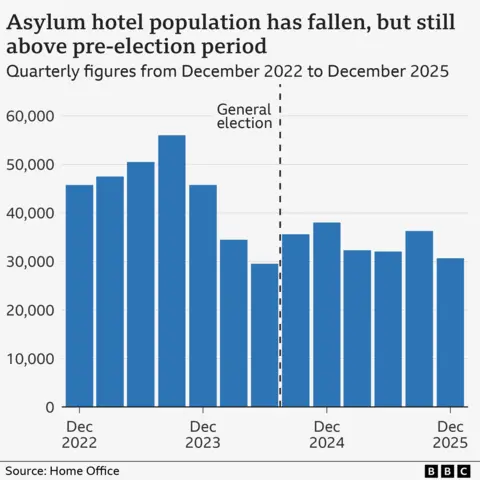
The government does not regularly publish figures on the number of actual hotels in use, but government sources have suggested there are "fewer than 200" asylum hotels. This was down from a peak of more than 400 in the summer of 2023.
The asylum process determines whether a person can remain in the UK because they have a "well-founded fear of persecution" in their home country.
Once someone applies for asylum, they gain legal protections while awaiting a decision - including accommodation if they cannot support themselves financially.
Almost everyone who arrives by small boat claims asylum - they made up 41% of all asylum applications in 2025. Another large group of claimants were people already in the UK who previously entered legally on a student, work or visitor's visa.
Since 2020, the government has been increasingly reliant on hotels, partly because the supply of other types of asylum accommodation has not kept up with the numbers arriving in small boats.
But using asylum hotels is expensive - costing £5.7m per day in 2024-25. The government has started to save money by adding beds to rooms in hotels to maximise the number of people in each site.
'Smash the gangs'
As of 25 February, 2,209 people had arrived in the UK in small boats in 2026 - up by about 7% compared with the same period in 2025.
To reduce the number of crossings, the government has pledged to disrupt the people-smuggling gangs behind them.
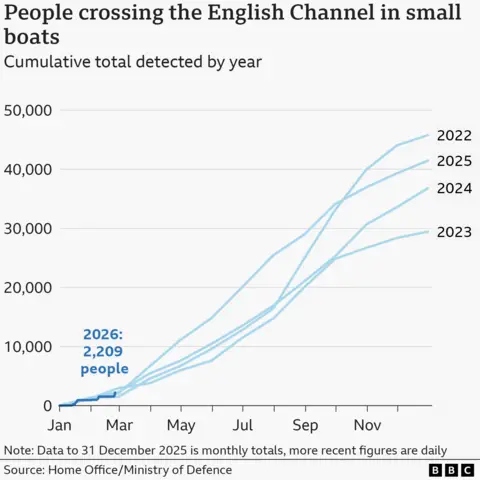
But it is unclear how the government plans to measure its progress, or when this goal will be met.
The Home Office has begun publishing data on how often agencies such as Border Force and the National Crime Agency take action against gangs involved in organised immigration crime. Each intervention is recorded as a "disruption".
According to the latest figures, there were 3,625 disruptions in 2025.
This was a 37% increase on the previous year. The actions recorded range from major disruptions, such as imprisoning key members of people-smuggling gangs, to measures like seizing criminal assets.
There is also some information on efforts to prevent small boat crossings by French authorities - who, under a 2023 deal, are receiving £476m from the UK over three years.
They say about 21,677 people were prevented from crossing between 17 February 2025 and 15 February 2026. We do not know what happened to them or whether they tried to cross again.
There have been high-profile cases of UK-based smugglers being sentenced, including a man who helped smuggle more than 3,000 people.
In July, the UK and France agreed to a "one in, one out" pilot. Under the scheme, for each migrant the UK returns to France, another migrant with a strong case for asylum in Britain will come the other way.
As of 4 February, 305 people have been returned through this arrangement.
The vast majority of UK immigration, however, is legal - this includes people who have been granted permission to come to work, study, claim asylum or for other authorised purposes.
'Clear the asylum backlog'
The government has also promised "to clear the asylum backlog".
This refers to the backlog of claims by asylum seekers who are waiting to hear whether they will be granted refugee status and be allowed to remain in the UK.
There has been a 56% increase in the processing of asylum cases in 2025, compared with 2024.
More applications were dealt with by the Home Office than new applications submitted, meaning the overall backlog of outstanding cases has fallen.
About 42% of asylum claims were granted in 2025. This is lower than the previous year, when about 47% of claims were granted.
Some cases are withdrawn or taken out of the backlog for other reasons, such as being suspended or void.
Another backlog the government wants to clear is the high number of court appeals from asylum seekers following rejected claims.
That backlog had worsened in the most recent figures to September 2025. There were nearly 70,000 open appeals cases at that point - a record high.
'Increase returns'
The government has also promised to "increase returns" of people with no legal right to be in the UK. It said it would set up a new returns and enforcement unit with 1,000 extra staff.
There were 37,918 returns recorded by the Home Office in 2025. This is up 9% compared with the same period 12 months ago.
So the government is meeting this pledge so far, but it is worth noting that just under 10,000 people were forcibly removed - which could involve being escorted on a plane by an immigration official.
The figures also show 11,631 former asylum seekers were returned in this period, 70% of them voluntarily.
The majority of people who were returned from the UK left voluntarily, and many did so independently without government assistance or even its knowledge at the time, as BBC Verify has previously pointed out.
This is despite repeated claims from ministers that the government has "removed" or even "deported" this many people.
The Home Office says all returns outcomes are the result of collective efforts by the department.

