What really happened in Norwich Castle's dungeons?

 Emma Craig/BBC
The real story behind a 900-year-old castle's dungeons has been revealed, as part of a £27.5m restoration and rebuild programme.
Generations of visitors to Norwich Castle Museum have heard gruesome tales of medieval people thrown down a chute to torture chambers in its dungeons.
However, the evidence now points to the dungeons being holding cells for men, women and children, held in grim conditions while awaiting trial, execution or deportation.
"It was overcrowded, disease ran riot and there was always between an inch or two (up to 5cm) of water on the floor," said Joolz Bailey, visitor services manager.
"People would be supplied with a bucket, but other than that there are no other conveniences, so I'm sure you can understand what would also be in the water," she added.
 Emma Craig/BBC
Norwich Castle became a jail after Edward III decided it was too expensive to repair and gave it to the county of Norfolk in 1345.
The building reopened in the summer of 2025 after an extensive revamp, which included restoring original floor levels in the Grade I-listed keep, recreating the Great Hall, and creating step-free access from the basement to the rooftop battlements.
This lengthy closure gave staff the opportunity to examine how the basement had really been used, according to Jan Pitman, the museum's learning manager.
One key clue was a series of steps going into the ground, which was the main access to the prison, while the chute was actually used for coal.
 Emma Craig/BBC
Pitman said: "Our typical view of a dungeon is somewhere people are locked in chains - and that's hardly going to happen if you've got a series of steps going into the ground."
Once they decided the dungeons - which has been its name since the 18th Century - were in fact holding cells, staff switched their focus to tell tales of crime and punishment.
"We can still tell really important stories and stories about people - maybe who were innocent - but ended up being executed on the castle mound," he said.
Crime and punishment
 Emma Craig/BBC
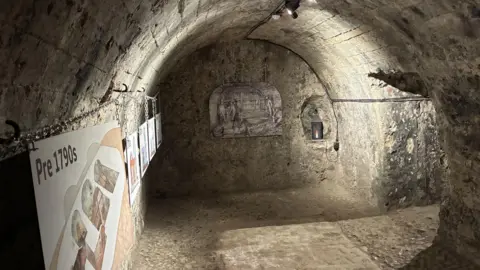
Bailey takes visitors on tours of the dank spaces, focusing on some of those stories.
Hundreds of people were held there over the centuries at "a time when you are guilty until proven innocent", she said.
One example is the sorry fate of John Flodders, his wife and a woman they met called Margaret Byx.
The trio were accused of setting fire to Wymondham in 1615, destroying 300 homes.
"These three people were travellers, there was no reason whatsoever for them to set fire to Wymondham," said Bailey.
And there was another reason to point the finger at Flodders; he was Roman Catholic at a time of strong anti-Catholic feeling after the Gunpowder Plot in 1605.
Flodders and Byx were sent to the gallows, but his wife was pregnant and after giving birth to her child, her sentence was commuted and she disappeared from the records.
Up to 30 men, women and children awaiting trial could be held in the basement at any one time, alongside up to 30 debtors, held until they could pay what they owed.
 Emma Craig/BBC
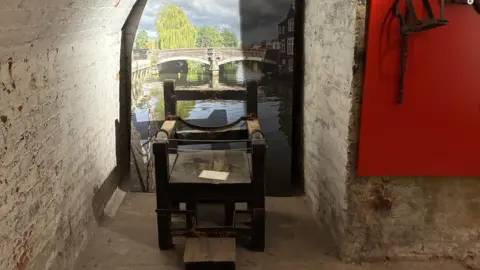
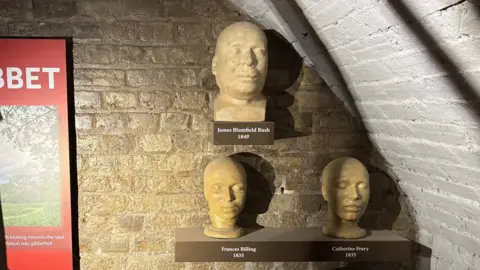
The crime and punishment theme continues with exhibits of the death masks of various notorious 19th Century criminals, as well as instruments used to punish people such as the ducking stool, the nag's bridle, the stocks, a whipping post and a gibbet used to display a body after execution.
"The purpose of the ducking stool was punishment for people who were maybe an unscrupulous trader, but the majority of people who were placed in it were women," said Bailey.
The accused would be paraded through the streets with a basin banged before her to attract crowds, explained Bailey.
"She'd be dunked into the water and no doubt, the more cheers that the dunk-er got from the screams from the people who were watching, the dunk-ee would be held underwater longer - it was an absolutely awful thing.
"How on earth would a woman be able to prove that she was innocent of being a scold or a nag... [it was a] really awful gender-based type of torture."
 Emma Craig/BBC
Pitman believes there is still more to find out about the people who were once held in the castle's dungeons.
"We're very strong when it comes from the 19th Century onwards, because a lot of records are kept, but from the period from the 18th Century and earlier, our knowledge is still very sketchy," he said.
Do you have a story suggestion for Norfolk? Contact us below.
Follow Norfolk news on BBC Sounds, Facebook, Instagram and X.
