Family stranded in Doha hotel as conflict erupts

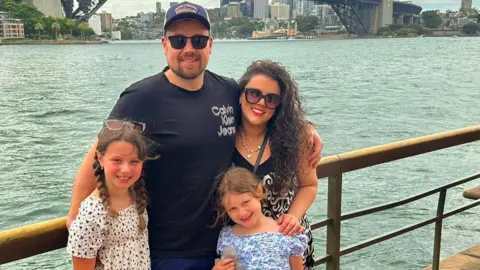 Family
A family stranded in Doha after war broke out in the Middle East have said they are without their luggage, running low on essential medication and have received no help.
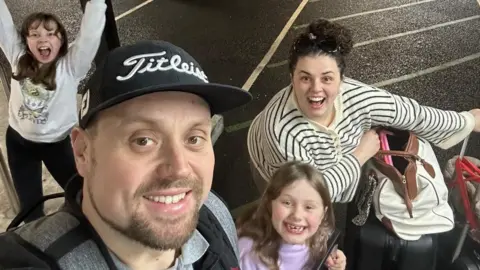
Harry, 36, and Brydee, 34, from Rainham, were travelling home from Australia with their daughters, Eliza, nine, and Lillie, six, when a stopover in Qatar coincided with the outbreak of the conflict.
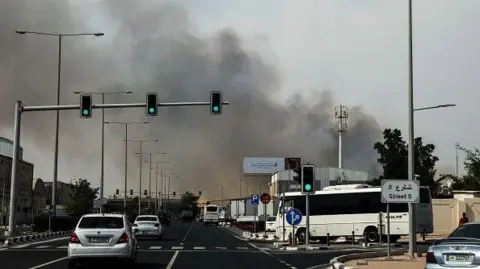
They are at the Radisson Blu, where they said they had seen explosions at a military base three miles away.
The government said officials were "working around the clock" with airlines, travel firms and regional governments to find safe routes home for people. British Airways said a team would contact the family directly.
The airline has not yet commented further to the BBC.
Harry and Brydee said other nations were arranging evacuations, but the UK embassy had sent only standard emails advising people to follow local guidance, and they said nobody could get through on the emergency line.
'Shrapnel and debris'
Harry said the family should have flown from Doha to London Heathrow on 28 February, but a technical issue with an aircraft turned their stopover into a one-night hotel stay.
During that time, conflict escalated in the US-Israel war with Iran, and airspace closed.
They were about to swim in the pool when they heard an explosion.
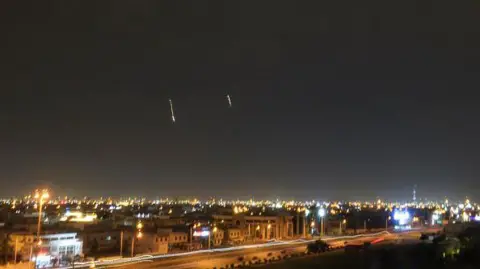
"You can't really describe the sound," Brydee said. "You can feel it - like thunder - and then a crash. There are lines in the sky and circles as things are being intercepted."
Eliza immediately asked whether they were going to die, her parents said, but they managed to convince both girls the noise was thunder.
Brydee said there was glass in the building and, being high up, they felt exposed.
"We haven't slept," Brydee said. "We haven't been leaving each other. There are emergency alarms at night - sirens last night."
The family have spent the week sleeping fully clothed, with shoes on and go-bags with passports, water and snacks by the door in case they have to leave quickly.
 Getty Images
"It's incredible how insane things become normal," Harry said. "There have been explosions, cloud formations in the sky, hotel staff picking up shrapnel and debris, smashed windows. The pool is now damaged and drained."
The family have lived out of hand luggage for a week and are washing clothes in the bathroom, but had each packed a tracksuit, toothbrushes and toothpaste and eczema cream for the girls.
Harry, a residential surveyor, said he was reassured knowing their room was near the fire escape, which he believed would be the most structurally secure area.
 Family
To combat the initial fear and isolation, Harry set up a WhatsApp group for others stranded in the hotel.
The group currently has 120 members of different nationalities. A handful, mostly people sponsored by employers, have left.
The family say British Airways suggested a refund, but Harry said: "We're looking for a rescheduled flight."
He said others stranded in Doha were heading to Riyadh to fly from there.
"Just get us home," Brydee said. "The hotel is looking after us – they've been very good. They are doing the best they can. We are OK, but we're not."
 Getty Images
Guidance from the Foreign, Commonwealth & Development Office (FCDO) said staff had taken thousands of calls from British nationals and travel advice for the region had been viewed over 127,000 times.
Officials said pages were being constantly reviewed and updated.
The FCDO said because of airspace closures and restrictions, it was "extremely difficult" for many people to get home, but they were working to find safe routes and the security and safety of British citizens was their top priority.
People are being encouraged to stay in touch with airlines so they can depart on commercial flights when it is safe.
The FCDO is in close contact with airline chiefs.
Follow BBC Kent on Facebook, on X, and on Instagram. Send your story ideas to southeasttoday@bbc.co.uk or WhatsApp us on 08081 002250.
