Could the traditional British caravan holiday be about to get a makeover?

 Mantianxing
While many aspects of 21st Century life are regularly modernised and updated, the traditional British caravan holiday has remained stubbornly resistant to change.
For more than a century, caravans have offered a familiar and affordable way to holiday at home, with the basic layout changing little since the first motor-towed models appeared in 1919.
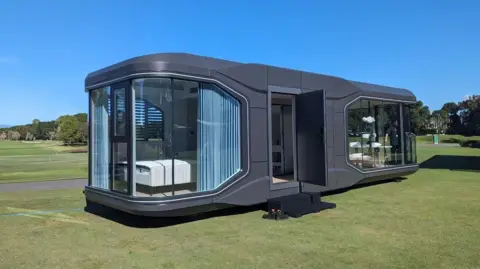
But on Anglesey, designer Craig Ledwards believes he has come up with a caravan alternative akin to a "luxury hotel room".
The idea has received a mixed reaction, with one expert calling the new design too niche, while the National Caravan Council said its success would depend on a variety of factors, such as the availability of spare parts.
 Capsule Holiday Homes/ Alice Gregory
"Caravans haven't changed in 60-odd years," said Ledwards.
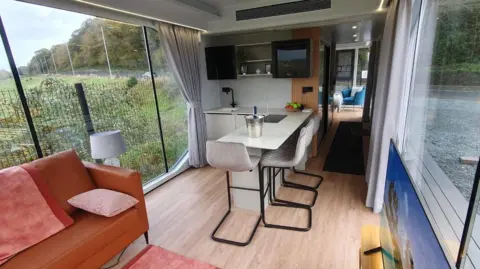
"They're the same style and layout as they've always been, with poor insulation. But this is totally different, it's open-plan living. It feels like you're entering a luxury hotel room.
"My aim is to bring something genuinely new to north Wales - modern, design-led holiday accommodation that is both exciting for guests and commercially practical for local holiday parks."
His shipping-container-style holiday units are being introduced on the island as a potential alternative to traditional static caravans.
The first capsule was delivered in October, and is now being used as a demonstration model.
 Capsule Holiday Homes/Alice Gregory
Built using galvanised steel frames and aluminium external panels by a Chinese firm, the capsules are designed to be fully-insulated and suitable for year-round use.
Ledwards said they were significantly more durable than conventional static caravans.
"A normal caravan, I think they last about 15 years, but these have a lifespan of 50," he added.
Although their appearance is radically different, the units have been designed to match the footprint of a standard static caravan.
This would allow them to replace older models without altering existing service connections, costing around £35,000.
 National Motor Museum/Heritage Images/Getty Images
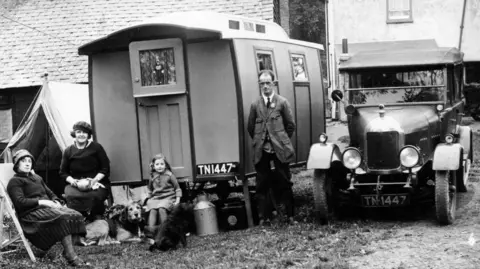
The arrival of such futuristic designs marks a sharp departure from how we have traditionally holidayed.
Horse-drawn caravans were used as mobile homes in the early 19th Century, but leisure caravanning expanded rapidly after World War One.
The first true commercial touring caravan, designed specifically to be towed by a car, was launched by Eccles Motor Transport in 1919.
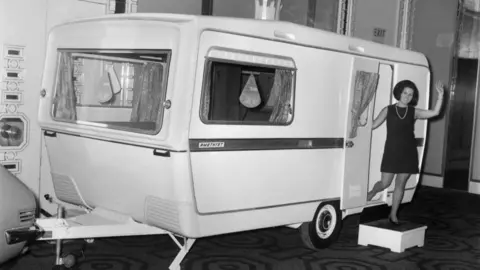
Over time, toilets, showers and kitchens were added.
Yet, the internal layout established by those early models still defines most caravans on Britain's roads and holiday parks today.
Demand grew rapidly in the post-World War Two decades, as the appetite for affordable domestic holidays surged, and dedicated holiday parks spread across coastal and rural Britain.
Their familiar design has helped make caravan holidays a mainstay of British tourism, particularly in Wales.
'A niche thing'
However, not everyone is convinced the new capsule-style units represent the future of caravan holidays.
Industry expert Andrew Jenkinson said that while he "applauds anyone trying to do something different", he did not believe the capsules would gain widespread appeal.
"It's a niche thing," he said.
Jenkinson said he had concerns about their design after seeing similar models at a trade show.
He questioned whether the extensive use of glass would provide enough privacy for holidaymakers, and how well the units would retain heat during the winter months.
Many similar ideas have come and gone over the years, he added, and he does not expect the capsules to appear widely on British holiday parks, with many consumers favouring familiarity.
According to Jenkinson, modern UK-built holiday lodges already offer contemporary design, strong insulation and high-quality finishes without straying too far from established expectations.
 Craig Ledwards
In 2022–23, Wales' holiday park and campsite sector generated an estimated £1.66bn in direct visitor spending, according to data from the UK Caravan and Camping Alliance.
This supported 30,726 full-time equivalent jobs and contributed £945.9m to the Welsh economy once wider economic impacts are included.
It remains one of the fastest-growing areas of the visitor economy.
Industry analysts say rising living costs and a renewed appetite for lower-cost breaks closer to home have helped sustain demand.
The data shows that in 2023, 922 holiday parks and campsites were operating across Wales, providing 69,088 pitches for visitors.
 Daily Mirror/Mirrorpix via Getty Images
Trade association the National Caravan Council said caravan holidays continued to endure because they offered "a convenient home away from home, away from the pressures of everyday life".
A spokesperson was lukewarm over the chances of innovations like Ledwards' catching on, and said this would depend on a number of factors.
"New designs such as ones imported from China may appeal to a niche audience, drawn to contemporary styling and different layouts," they said.
"But widespread appeal will depend on how well they meet the expectations of the UK holiday park market, the access to spare parts, the availability of reliable and timely after-sales service and those who are responsible for licensing their use."
