Chaos, courage and sacrifice in the grip of the Great Gale

 Mike Milner/RNLI
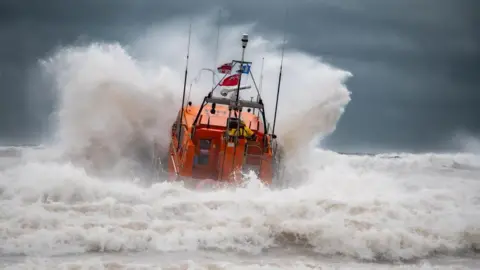
On a cold February day, massive grey waves are thundering across Bridlington Bay and threatening to come over the front.
It is a sight to remind people of the unforgiving power of the North Sea.
Few understand that better than the volunteers of the RNLI, whose modern lifeboat station overlooks the resort's south beach.
It was here, 155 years ago this month, that their predecessors went to the rescue of sailors caught up in one of the worst storms ever seen on the East Yorkshire coast.
Scores of ships were caught up in the Great Gale of 1871 and it is thought as many as 70 people died.
Mike Milner, a volunteer press officer at the RNLI, recalls hearing stories of the disaster from his grandfather, who had been told them by his own dad.
"What we had in Bridlington was a load of boats taking shelter that were en route from Newcastle, travelling down to Paris and London," Mike tells the latest episode of the Hidden East Yorkshire podcast.
"They'd taken shelter in the bay, hoping for some good weather the next day and unfortunately the wind totally turned round.
"So it was a south-easterly wind, about force nine, sleet and snow."
Battered by the storm, the skippers feared sinking at anchor and ran their ships towards the coast, hoping to beach them.
But many crashed against the pier or close to what is now Bridlington Spa and the lifeboat station.
"By night on the 10th, it was total carnage down here," Mike says.
"All the way towards Withernsea, all the way up towards Flamborough, there were just boats in distress all over the place."
Two lifeboats, crewed by brave volunteers, set out to help.
They were the RNLI's Robert Whitworth II and a smaller fishermen's lifeboat, the Harbinger.
"The equipment they would have had there in 1871 doesn't compare with anything like we've got today," Mike explains.
"We've got modern boats with modern equipment and life jackets. Back then, they'd have had virtually nothing.
"And they were just setting off out to sea in rowboats, going out to rescue all these boats in distress."
The Harbinger attempted to go to the aid of a brig called the Delta, which was in trouble near the harbour.
"It got alongside the boat and then an enormous freak wave came and flipped the boat over. Unfortunately, six of the crew were lost in the sea."
 Mike Milner/RNLI
It is thought about 30 boats were sunk on the east coast, with many families from the fishing and lifeboat communities affected.
Over the next few days, many of the bodies washed up on the coast were taken to a pub called The Albion, on Hilderthorpe Road, which still stands today.
"They were laid out there, waiting to be identified by families that were coming from all over the place really, especially up on the Tyne," Mike says.
"This all then amounted to having a mass grave up at the Priory Church."
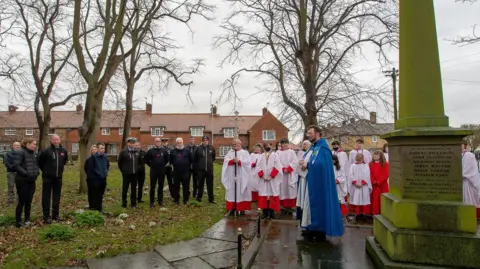
Forty-three people were buried in the grounds of Bridlington Priory after the Great Gale.
A tall stone obelisk stands in silent tribute to the victims.
The disaster did lead to positive change, however. Many of the boats caught up in the gale were full with cargo and the MP Samuel Plimsoll used the episode to press Parliament to bring in a new law to prevent ships being dangerously overladen.
A new load line – known as the Plimsoll Line – was painted on the hulls of ships to indicate the maximum depth a vessel can sit in the water when loaded.
Horrific conditions
Back at Bridlington's lifeboat station, Mike says the job is still fraught with danger.
In October last year, during Storm Amy, the Bridlington lifeboat was launched to go to the rescue of a trawler.
"The noise from the waves and the wind and everything was horrific," says Mike.
"It was just coming dark. And I thought, my word, it's going to be horrific out there tonight.
"And then my mind cast back straight away to 1871, thinking, if this lot are in this boat, what must it have been like that night?
"Till this day we're still sending out the message that we're still saving lives at sea, we're an organisation that's a charity, we rely on the public and any support we can get is more than welcome."
Listen to highlights fromHull and East Yorkshire on BBC Sounds, watch the latest episode of Look Northor tell us about a story you think we should be coveringhere.
Download the BBC News app from the App Storefor iPhone and iPad orGoogle Play for Android devices
