'Extensive damage' at Qatar industrial site as Iran retaliates for gas field attack

 Getty Images
Qatar has reported "extensive damage" at a major energy industry site, the UAE said operations at a gas facility had been halted and Saudi Arabia said it had intercepted drones and ballistic missiles as Iran retaliated for a strike on a key gas field.
Earlier Qatar blamed Israel for the strike on Iran's South Pars gas site - part of the world's largest natural gas field. Israeli media quoted officials as saying Israel had carried out the attack but Its military has not officially confirmed this.
Oil prices leapt to nearly $110 (£83) a barrel after the South Pars strike.
Conflict across the Middle East continues to rage after the US and Israel launched wide-ranging strikes on Iran on 28 February.
Tehran responded by launching attacks on Israel and US-allied states in the Gulf. Israel is also fighting Iran-backed Hezbollah in Lebanon, where more than a million people have been displaced.
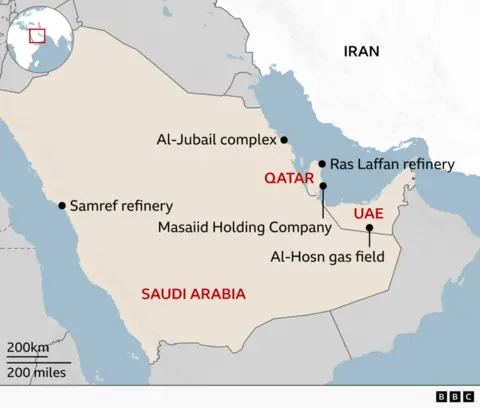
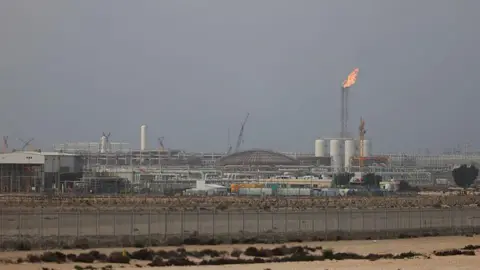
In a statement, QatarEnergy state-owned petroleum company said Iranian missiles struck its Ras Laffan site on Wednesday. Ras Laffan is an industrial area that contains the world's biggest liquefied natural gas (LNG) processing facility.
QatarEnergy said "extensive damage has been caused", but all personnel at the site were accounted for. A fire at the site was later put under control.
The Qatari government described the Iranian attack as "brazen" and a "direct threat to its national security and the stability of the region".
"The Iranian side continues its escalatory policies that are pushing the region toward the abyss and drawing in countries that are not parties to this crisis into the circle of conflict," the ministry said in a statement.
It added that Qatar "reserves its right to respond".
Two Iranian diplomats - a military and a security attaches - and their staff were ordered to leave Qatar within 24 hours.
Meanwhile authorities in Abu Dhabi said they were dealing with two incidents of fallen debris following the interception of missiles.
The missiles had been on course for the Habshan gas facility and the Bab oil field, the emirate's media office said. No injuries were recorded but operations at the gas facilities had been suspended, it said.
Also on Wednesday evening Saudi Arabia's foreign ministry said it was "thwarting an attempt to attack one of the gas facilities in the eastern region". It follows reports that five drones were destroyed as they attempted to approach energy facilities in the region.
Elsewhere near the capital Riyadh, authorities said four residents were injured by falling shrapnel after a ballistic missile was intercepted.
Earlier on Wednesday, Iran had listed sites in Qatar, Saudi Arabia and the United Arab Emirates (UAE) that Tehran could attack in response for the South Pars attack.
The warning was published by Iran's press agency linked to the press agency linked to the country's powerful Islamic Revolutionary Guard Corps (IRGC).
Iranian President Masoud Pezeshkian warned of "consequences beyond control, the scope of which would engulf the entire world" after the attack on South Pars.
Verified images of the strike on South Pars showed smoke rising from at least two impacts.
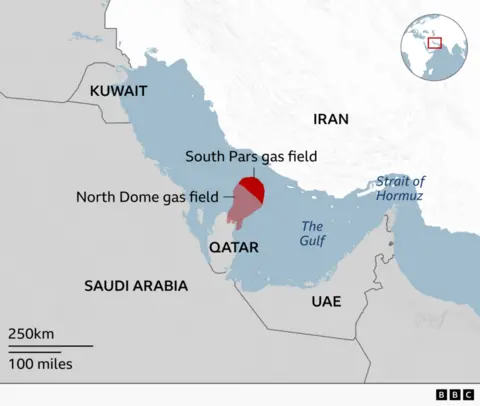
South Pars is part of the world's largest natural gas field and is located offshore between Iran and Qatar. Reports say the gas field accounts for about 70% of Iran's total gas production.
After the attack on South Pars, Qatar's foreign ministry spokesman said "the Israeli targeting of facilities linked to Iran's South Pars field, an extension of Qatar's North Field" was a "dangerous and irresponsible step". The UAE and Oman also condemned the attack.
Later on Wednesday the Wall Street Journal quoted unnamed US officials as saying that President Donald Trump had supported the strike on South Pars as a message to Iran over its restriction of tanker traffic through the Strait of Hormuz, but that he did not want to see further such strikes.
However Trump could be open to more attacks on Iranian energy targets if Iran impeded the vital oil and trade route, the officials told the newspaper